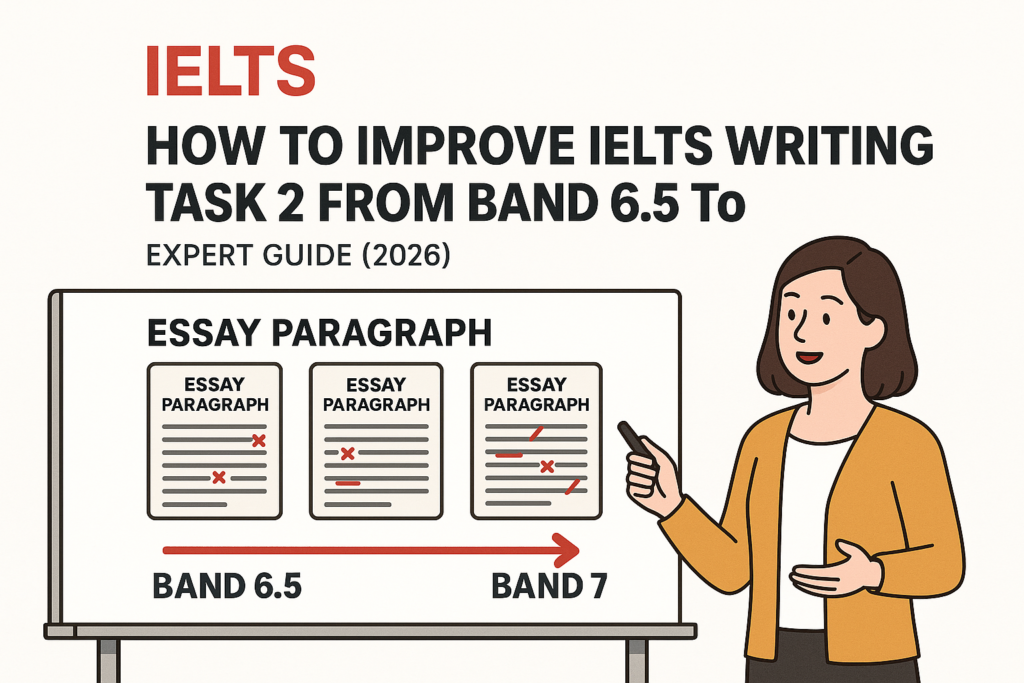
If you want to know how to improve IELTS Writing Task 2 from band 6.5 to 7, you are probably close enough to feel frustrated. Your essays are understandable, your vocabulary is not basic, and you may already write 250 words easily. The problem is usually not effort. It is that a Band 7 essay needs clearer control. Before you keep writing more practice essays without knowing what is holding you back, take the IELTS Express Pre-Test to check your current band range and identify the skill that needs the most attention.
The jump from 6.5 to 7 is often smaller than candidates imagine, but it is also more precise. You do not need a perfect academic essay. You need to answer the question fully, hold a clear position, develop each main idea, connect sentences naturally, and reduce the errors that distract the examiner. This guide gives you a practical repair plan, not a list of vague advice.
Why IELTS Writing Task 2 Gets Stuck At Band 6.5
Band 6.5 usually means the essay is doing several things well, but not consistently enough for Band 7. The examiner can follow your argument, but parts of the response may feel underdeveloped, repetitive, unclear, or grammatically uneven. The essay may have a good introduction and conclusion, but the body paragraphs may not prove the position strongly enough.
Many candidates stuck at 6.5 think they need more advanced vocabulary. Sometimes vocabulary helps, but it is rarely the main issue. Band 7 depends more on control than decoration. A simple, well-developed argument usually beats an essay filled with memorised phrases and complicated sentences that do not quite work.
- Answer all parts of the task directly.
- Make your position clear from the introduction.
- Develop one main idea per body paragraph.
- Use linking language to guide the reader, not to decorate the essay.
- Reduce repeated grammar errors that interrupt meaning.
The Band 6.5 To Band 7 Difference In Task Response
Task Response is often where the half-band disappears. A Band 6.5 essay may answer the general topic, but it may not answer the exact question. For example, if the question asks whether the advantages outweigh the disadvantages, you need to compare weight, not simply list one advantage and one disadvantage.
Before writing, underline the instruction words. Are you being asked to discuss both views, agree or disagree, evaluate advantages and disadvantages, explain causes and solutions, or give your opinion after considering two sides? Each task type needs a slightly different answer. If your essay uses the same structure for every prompt, it may look organised but still miss the task.
To practise this under pressure, access unlimited IELTS mock tests and spend the first three minutes planning the exact answer, not just the topic vocabulary.
Start With A Clear Position
A Band 7 essay does not leave the examiner guessing. Your position should be visible in the introduction and should remain stable through the body paragraphs. This does not mean your answer must be extreme. You can partly agree, but you must explain exactly what you agree with and where your limit is.
Weak position: “This essay will discuss both sides and give my opinion.” Stronger position: “Although online education is convenient, I believe classroom learning remains more effective for younger students because it provides structure and immediate teacher support.” The second version gives a direction for the whole essay.
After writing the introduction, check whether your two body paragraphs actually support that position. If one paragraph goes in a different direction, the essay will feel less controlled. Band 7 writing is not just about having ideas. It is about making those ideas work together.
Build Body Paragraphs Around One Main Idea
Many 6.5 essays lose marks because the body paragraphs contain too many ideas. A paragraph begins with one point, jumps to another point, adds an example, then ends with a general sentence. The reader can understand each sentence, but the paragraph does not build a clear argument.
Use a simple paragraph chain: topic sentence, explanation, example, result or link back to the question. For example, if your point is that public transport reduces congestion, explain how fewer private cars reduce traffic pressure, give a realistic city example, then connect that example to the question about government investment.
The IELTS Writing Task 2 band score strategy guide is useful if you want to see how paragraph control connects with the official scoring areas.
Develop Ideas Instead Of Listing Them
Development is one of the biggest Band 7 signals. Listing three reasons in one paragraph may look productive, but it often produces shallow writing. It is usually better to explain one strong reason properly than to mention three weak reasons briefly.
Imagine the question asks whether governments should fund public transport. A shallow paragraph says public transport is cheap, convenient, and good for the environment. A developed paragraph explains that reliable public transport gives workers a practical alternative to driving, which reduces congestion and makes cities more efficient. That explanation gives the examiner more to reward.
Ask yourself two questions after every main idea: why is this true, and what is the result? If you cannot answer both, the idea is probably underdeveloped. Add explanation before adding new vocabulary.
Use Examples That Prove The Point
Examples do not need statistics or famous studies. They need to be specific enough to support your argument. A useful example can be local, realistic, and simple. For instance, you might mention a city where better train services make commuting easier, or a school where online lessons work well for older students but not for younger children.
A weak example is often too general: “For example, many people use technology.” A stronger example connects to the claim: “For example, university students can replay recorded lectures and review difficult sections before exams, which makes online learning more flexible than a fixed classroom lesson.” This example proves a clear point.
Do not invent dramatic data. IELTS does not require exact numbers unless you genuinely know them. Realistic examples are enough when they are clearly connected to the argument.
Improve Cohesion Without Overusing Linking Words
Band 7 cohesion is smooth, not mechanical. Candidates stuck at 6.5 often use too many obvious connectors: moreover, furthermore, nevertheless, therefore, in addition. These words are useful, but they cannot fix weak logic. The best cohesion comes from clear progression of ideas.
Use reference words and repeated key terms carefully. If your paragraph is about teacher feedback, words such as this support, such guidance, these corrections, and the same feedback can connect sentences naturally. This is more controlled than starting every sentence with a formal linker.
If your writing feels choppy, compare IELTS preparation plans and choose a feedback option that marks paragraph flow, not only grammar mistakes.
Control Grammar For Accuracy And Range
You do not need perfect grammar for Band 7, but you do need mostly accurate sentences with some range. The goal is to use complex sentences when they help the meaning, not to make every sentence long. A mix of simple, compound, and complex sentences is usually safest.
Common errors at 6.5 include article mistakes, subject-verb agreement, unclear pronoun reference, sentence fragments, and overloaded sentences with too many clauses. These errors may not completely block meaning, but repeated mistakes can keep the score below 7.
After writing, check only two or three error types that you commonly make. Trying to check everything in two minutes is unrealistic. If articles and verb forms are your weakness, focus there first. Small repeated errors matter because they affect the examiner’s impression of control.
Upgrade Vocabulary Without Sounding Forced
Band 7 vocabulary is flexible and precise. It is not a collection of rare words. Instead of trying to use phrases such as “a plethora of detrimental ramifications”, choose accurate topic language: affordable housing, public funding, long-term employment, early childhood education, environmental regulation, digital access, and community safety.
Precision is especially important for Task 2 because many topics are broad. If the question is about children and technology, decide whether you mean screen time, online learning, social media, digital games, or access to information. Clear nouns make arguments sharper.
Learn collocations rather than isolated words. For example, make a decision, place pressure on families, reduce inequality, provide access, improve productivity, and protect public health are more useful than single impressive words you cannot use naturally.
A 14-Day Plan To Move From 6.5 To 7
For the first three days, diagnose your essays. Write two Task 2 responses and mark them against the four criteria: Task Response, Coherence and Cohesion, Lexical Resource, and Grammar. Look for repeated weaknesses, not one-off mistakes.
From day four to day ten, focus on one repair skill per day. Practise introductions with clear positions, body paragraphs with one main idea, examples that prove the point, and conclusions that do not add new arguments. Do not write a full essay every day if your paragraphs are still weak. Targeted practice is faster.
From day eleven to day fourteen, write full essays under time conditions and review them the next day. The delay helps you see problems more clearly. Keep a short error list and a short list of strong phrases you can reuse naturally.
Final Checklist Before You Submit Task 2
Before you finish, check the essay in this order. First, does the introduction answer the exact question? Second, does each body paragraph support the position? Third, is each main idea explained, not just stated? Fourth, are examples specific enough? Fifth, have you corrected your most common grammar errors?
This checklist is more useful than trying to rewrite the whole essay in the final minutes. Band 7 comes from controlled decisions across the essay. If you can make the answer clearer, remove one weak idea, and fix repeated errors, you give yourself a much better chance.
The jump from 6.5 to 7 is not about writing like a professor. It is about writing like a candidate who understands the question, controls the argument, and makes the examiner’s job easy. That is a trainable skill.
Ready to find out your IELTS band score?
Take the IELTS Express Pre-Test for just $4.99 and get your personalised band prediction with a 14-day improvement plan.
FAQ: How To Improve IELTS Writing Task 2 From Band 6.5 To 7
Is it hard to improve IELTS Writing Task 2 from 6.5 to 7?
It is achievable, but the improvement needs to be precise. Most candidates need better task response, stronger paragraph development, smoother cohesion, and fewer repeated grammar errors.
How many essays should I write to move from 6.5 to 7?
Quality matters more than quantity. Two or three carefully reviewed essays per week, plus targeted paragraph practice, is usually more useful than writing a new essay every day without feedback.
What is the biggest reason candidates stay at Band 6.5?
The most common reason is limited development. The essay answers the topic, but the main ideas are not explained or supported clearly enough for a stable Band 7.
Do I need advanced vocabulary for Band 7 Task 2?
You need precise and flexible vocabulary, not rare words. Natural topic collocations and clear word choice usually score better than memorised high-level phrases.
Can grammar mistakes still appear in a Band 7 essay?
Yes. Band 7 writing can contain some errors, but they should not be frequent or distracting. Repeated basic errors are more damaging than occasional complex-sentence mistakes.