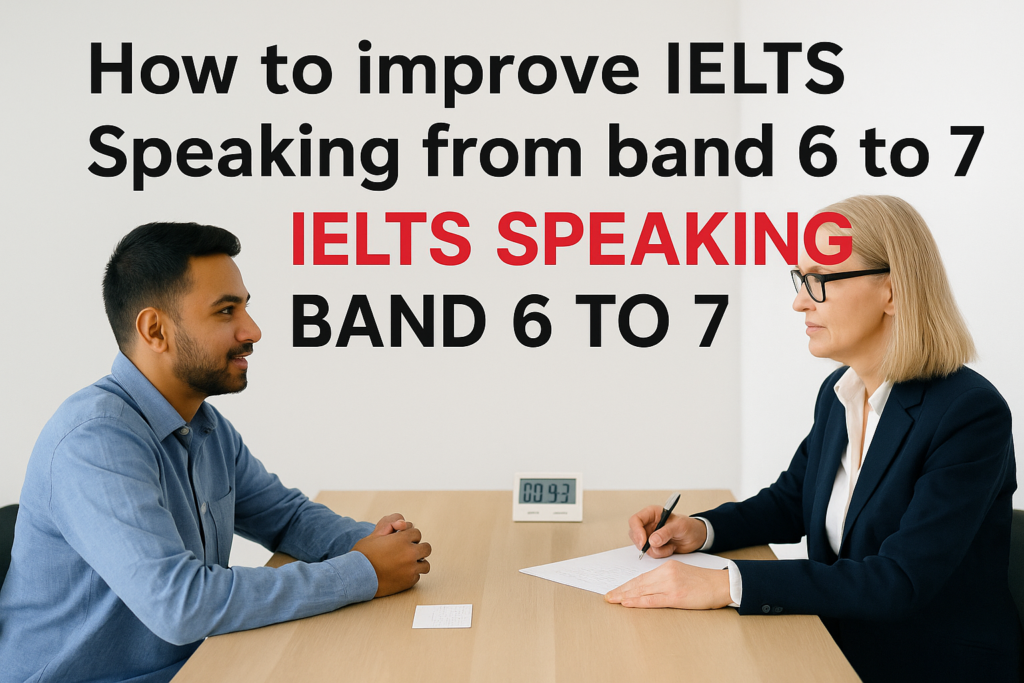
If you want to know how to improve IELTS Speaking from band 6 to 7, the answer is usually not “learn harder words”. Band 6 speakers can often communicate, but their answers may be uneven, underdeveloped, repetitive, or difficult to follow under pressure. Before you keep practising without a clear baseline, take the IELTS Express Pre-Test to get a quick band prediction and a focused 14-day improvement plan.
The move from Band 6 to Band 7 is a control problem. You need to speak at length without losing organisation, use less repetitive vocabulary, reduce grammar errors, and make pronunciation easier to understand. You do not need to sound like a native speaker. You need to sound clear, flexible, and steady across all three parts of the test.
What Changes Between Band 6 And Band 7 In IELTS Speaking?
Band 6 usually means you can speak about familiar topics, but your performance is not fully stable. You may repeat phrases, pause too often, correct yourself frequently, or give answers that are understandable but not well extended. Some grammar and pronunciation problems may also make the examiner work harder to follow you.
Band 7 is different because the speaker shows better control. Answers are longer when needed, ideas connect more smoothly, vocabulary is more precise, and errors do not usually block meaning. The examiner hears someone who can handle personal, descriptive, and abstract questions with confidence.
- Fluency becomes smoother, with fewer long silences.
- Answers are developed with reasons, examples, and comparisons.
- Vocabulary is flexible rather than memorised.
- Grammar includes more accurate complex sentences.
- Pronunciation is clear enough to follow without strain.
How To Improve IELTS Speaking From Band 6 To 7
To improve IELTS Speaking from Band 6 to 7, focus on answer control before advanced language. A Band 7 answer is not a speech full of impressive words. It is a clear response that answers the question, adds useful detail, and keeps moving naturally.
Use a simple structure for most answers: answer directly, explain why, add one example, and finish with a short result or contrast. This works for Part 1 and can be expanded for Part 3. For Part 2, use a cue-card plan with past, detail, feeling, and result, so you do not run out of ideas after thirty seconds.
If you want to test this under real timing, access unlimited IELTS mock tests and check whether your Speaking answers stay organised when you are nervous.
Fix The Main Band 6 Fluency Problem
Many Band 6 candidates think fluency means speaking quickly. That is wrong. Fluency means speaking at a natural pace with enough continuity. You can pause briefly to think, but long gaps, repeated restarts, and constant self-correction will pull the score down.
Record yourself answering ten common questions. Then listen for where the answer breaks. Do you stop because you have no idea, because you are searching for grammar, or because you are trying to use a difficult word? Each problem needs a different fix.
If ideas are the problem, prepare topic banks. If grammar is the problem, practise shorter, cleaner sentences. If vocabulary is the problem, learn flexible phrases you can use in many answers, such as “what I found difficult was”, “the main reason is”, and “compared with before”.
Make Part 1 Answers Sound Natural
Part 1 answers should usually be two or three sentences. One sentence can sound too thin. A long answer can sound prepared. The safest pattern is a direct answer plus one reason or example.
For example, if the question is “Do you like studying English?”, a Band 6 answer may be short: “Yes, I like it because it is useful.” A stronger answer says, “Yes, I do, especially when I can use it in real conversations. I find grammar exercises a bit dry, but speaking practice helps me notice progress quickly.”
The second answer is not complicated. It is better because it has contrast, detail, and a natural speaking rhythm. That is the kind of improvement that moves a candidate towards Band 7.
Use Part 2 To Show Organisation
Part 2 is where Band 6 candidates often lose control. They start strongly, then repeat the same idea or stop too early. The one-minute preparation time matters. Use it to plan a route, not a full script.
For most cue cards, write four quick prompts: background, main detail, example, and feeling. If the topic is a person, describe who they are, how you know them, what they did, and why it matters. If the topic is a place, describe where it is, what it looks like, what you do there, and why you remember it.
Do not memorise full answers. Memorised answers often collapse when the cue card changes slightly. Build a flexible story structure instead. For more section-specific practice, the IELTS Speaking Part 2 tips and strategies guide can help you make cue-card answers more stable.
Handle Part 3 Without Sounding Rehearsed
Part 3 asks broader questions about society, change, advantages, disadvantages, and opinions. Band 6 candidates may give personal answers when the question needs a more general view. Band 7 candidates can discuss the issue more widely and support their opinion.
Use a three-step method: give your view, explain the reason, then add a real-world example or contrast. If the question is “Do people communicate differently now than in the past?”, do not only talk about yourself. Discuss messaging apps, workplace communication, family habits, and how speed has changed expectations.
You can still use simple language. The strength comes from development. A clear, well-supported answer beats a vague answer with advanced vocabulary.
Improve Vocabulary Without Memorising Fancy Words
Vocabulary for Band 7 should be precise and flexible. You need words that fit the topic naturally. Learning rare words from lists can make answers sound unnatural, especially if pronunciation is weak or the word is used in the wrong context.
Build topic groups instead. For work, learn words such as deadline, workload, colleague, shift, training, responsibility, and promotion. For study, learn lecture, assignment, feedback, independent learning, research, and timetable. For technology, learn convenient, distracting, privacy, device, online service, and screen time.
Then practise using those words in complete answers. A word only helps your score if you can use it accurately while speaking. If you want guided support on the best preparation option, compare IELTS preparation plans and choose the one that matches your weakest Speaking criterion.
Reduce Grammar Errors That Hold You At Band 6
Band 7 grammar does not require perfect sentences. It requires a mix of simple and complex structures with good control. If every complex sentence contains mistakes, your grammar score may stay at Band 6 even when your ideas are strong.
Start by fixing high-frequency errors. These often include subject-verb agreement, past tense endings, article use, plural nouns, and sentence fragments. Then add reliable complex patterns such as “although”, “because”, “which means”, “whereas”, and “one reason why”.
Practise one grammar pattern at a time in spoken answers. For example, spend one session using “although” accurately in ten answers. This is more useful than reading a grammar chapter and hoping the forms appear correctly in the test.
Pronunciation: Be Clear, Not Perfect
Pronunciation is often misunderstood. You do not need to remove your accent. You need to make your speech easy to follow. The examiner listens for individual sounds, word stress, sentence stress, intonation, and whether pronunciation problems affect understanding.
Record one answer and mark the words that sound unclear. Then practise those words inside short phrases, not alone. Speaking is connected. A word may sound fine by itself but become unclear when you say it quickly in a sentence.
Also practise stress. Important words should sound stronger. Function words such as “to”, “of”, and “and” are usually weaker. Better stress makes your answers easier to understand and more natural.
A 14-Day Band 6 To Band 7 Speaking Plan
Use days one and two to diagnose your current Speaking score. Record Part 1, Part 2, and Part 3 answers. Listen for pauses, repetition, grammar errors, weak examples, and unclear pronunciation.
Use days three to six for fluency and organisation. Practise short Part 1 answers and one Part 2 cue card each day. Use a timer. Do not stop and restart when you make a mistake. Train yourself to continue.
Use days seven to ten for vocabulary and grammar control. Choose common topics and prepare flexible phrases, then use them in recorded answers. Use days eleven to fourteen for full Speaking practice. Review your recordings and check whether your answers are clearer, longer, and more controlled than on day one.
Final Checklist Before Your Next Speaking Test
Before your next IELTS Speaking test, check whether you can answer familiar questions without memorised scripts. Check whether your Part 2 answer reaches close to two minutes with clear organisation. Check whether your Part 3 answers include reasons, examples, and wider discussion.
The move from Band 6 to Band 7 is realistic, but it needs targeted practice. Do not spend all your time collecting vocabulary. Spend more time recording, reviewing, and fixing the exact problems that appear when you speak under pressure.
Ready to find out your IELTS band score?
Take the IELTS Express Pre-Test for just $4.99 and get your personalised band prediction with a 14-day improvement plan.
FAQ: How To Improve IELTS Speaking From Band 6 To 7
How long does it take to improve IELTS Speaking from Band 6 to 7?
It depends on the reason for your Band 6 score. If the main issue is answer structure or fluency, two to four weeks of focused practice may help. If grammar and pronunciation are major problems, you may need longer.
Do I need advanced vocabulary for Band 7 Speaking?
No. You need flexible, accurate vocabulary that fits the topic. Natural word choice is better than rare words used incorrectly.
Can I memorise answers for IELTS Speaking?
Memorising full answers is risky because the examiner can change the question. Prepare ideas, examples, and useful phrases, but practise adapting them naturally.
What is the biggest difference between Band 6 and Band 7 Speaking?
The biggest difference is control. Band 7 candidates usually develop answers more clearly, speak with fewer breakdowns, and use language more flexibly.
Should I practise Speaking alone or with a teacher?
You can improve fluency by practising alone and recording yourself. A teacher or trained assessor is useful when you need specific feedback on grammar, pronunciation, and band criteria.