How to choose a realistic IELTS practice test online is a serious question if you are using practice results to make study, visa, university, or registration decisions. A weak online test can make you feel safe when your exam skills are still uneven. A useful test should feel close to the real IELTS format, measure each skill separately, and give you feedback that leads to better preparation. Before you trust any score estimate, take the IELTS Express Pre-Test to check your current band range and see which parts of your preparation need attention.
Online IELTS practice can be excellent, but only when the test is designed carefully. The goal is not to find the easiest test or the fastest result. The goal is to find a practice experience that reveals your real level under exam-like pressure. That means timed sections, realistic question types, clear answer review, useful Writing and Speaking guidance, and a sensible path from the score to the next study action.
What Makes An IELTS Practice Test Realistic?
A realistic IELTS practice test should match the shape of the real exam. Listening should use section-style audio, Reading should require sustained attention, Writing should include Task 1 and Task 2 or the correct General Training equivalent, and Speaking should test fluency, vocabulary, grammar, and pronunciation rather than only memorised answers.
The test should also create the right amount of pressure. If there is no timer, no section order, no word-count expectation, and no limit on replays or pauses, the result may show your relaxed study performance rather than your exam performance. Many candidates know the material, but lose marks when time, nerves, and multitasking appear together.
- Choose tests that separate Listening, Reading, Writing, and Speaking scores.
- Check whether timing matches IELTS conditions.
- Look for real IELTS question types, not generic English quizzes.
- Use tests that explain mistakes instead of only showing a number.
- Avoid practice that feels easier than the official exam format.
Check The Test Format Before You Start
The first filter is format. A useful online IELTS practice test should make it clear whether it is Academic or General Training. It should also show the number of questions, timing, tasks, and scoring method. If the test mixes formats casually or never states which IELTS version it supports, treat the result carefully.
Listening and Reading are easier to structure online because answers can be checked automatically. Writing and Speaking are harder. A realistic platform should explain how those productive skills are assessed. If Writing is judged by a vague overall comment, or Speaking is reduced to a grammar quiz, the score prediction may not mean much.
For a broader view of question types and exam structure, read the IELTS test format guide before choosing a practice platform. Knowing the real format helps you spot practice tests that look polished but measure the wrong thing.
Look For Separate Band Feedback
A single overall score can be tempting, but it is not enough. IELTS decisions often depend on section minimums. A candidate aiming for migration, nursing, engineering, or university entry may need at least 7.0 in each skill, not just a strong average. A realistic online practice test should show where the score is coming from.
Separate feedback is especially important when one skill is much weaker than the others. You might have strong Reading and Listening but lose marks in Writing because your essays are underdeveloped. You might speak fluently but give short Part 2 answers. If the platform hides those differences behind one general estimate, it can lead you into the wrong study plan.
Use Timing As A Quality Test
Timing is one of the clearest signs of realism. IELTS is not only a language test. It is also a performance test under strict time limits. Reading requires you to manage passages and questions quickly. Writing requires planning, drafting, and checking. Listening requires you to follow audio without drifting. Speaking requires answers that are natural but not rambling.
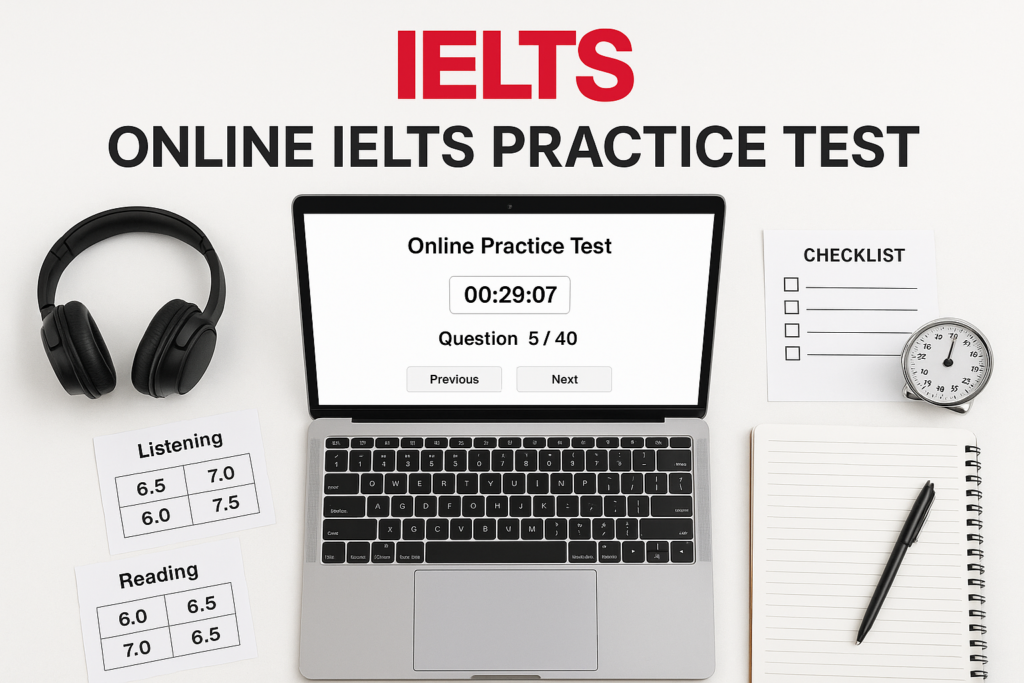
If an online practice test lets you stop whenever you want, replay everything, or take unlimited time without warning you, use it as learning practice, not as a score predictor. For score prediction, choose timed practice. For skill building, untimed practice can still be useful, but it should not be confused with exam readiness.
When you are ready to practise under repeated exam conditions, access unlimited IELTS mock tests so you can compare your performance across several attempts rather than trusting one easy result.
Evaluate The Quality Of The Answers And Explanations
Good practice tests teach you something after the score. In Listening and Reading, the answer review should help you understand why the correct answer works. It should point to keywords, paraphrases, distractors, and question logic. Without that review, you may know that you were wrong but not know how to improve.
For Writing, feedback should comment on task response, coherence, vocabulary, grammar, and common IELTS patterns. For Speaking, useful feedback should mention fluency, answer development, pronunciation clarity, grammar range, and vocabulary control. A test that only says good job or needs improvement is too thin to guide serious preparation.
Be Careful With Instant Band Score Promises
Instant scores can be useful for Listening and Reading because those sections have clear answers. They are less reliable for Writing and Speaking unless the platform has a strong assessment process. An instant Writing band score may be a rough signal, but it should not be treated as final proof of exam readiness.
Look for honest language. A credible test will usually explain that a band prediction is an estimate. It may give a range, show confidence levels, or recommend further review for Writing and Speaking. A weak test often promises certainty too quickly. That certainty feels comforting, but it can be expensive if it delays proper preparation.
Match The Practice Test To Your IELTS Goal
Your goal should shape the test you choose. A student applying to university may need Academic Writing and Academic Reading. A migration candidate may need General Training Writing and Reading. A nurse or engineer may need strict section minimums. Choosing the wrong format can waste time and create false confidence.
Start with your required band score, test version, and deadline. Then choose a practice test that measures the same conditions. If your target is a section minimum, avoid platforms that only report an overall score. If your deadline is close, choose feedback that tells you what to fix first, not a long list of general study tips.
If you need help turning your result into a study plan, see our IELTS preparation plans and choose support that matches your target band, time frame, and weakest skills.
Watch For Red Flags In Online IELTS Tests
Some online tests look professional but are not very useful. Be cautious if the questions feel like general English exercises, the timer is missing, the platform never mentions Academic or General Training, or the score appears without explanation. Also be careful with tests that ask only a few questions and then claim to predict a full IELTS band.
Another red flag is over-simple Writing feedback. IELTS Writing is judged across several criteria. If a platform gives a band score without showing why the answer did or did not meet the task, the result may be too shallow. The same applies to Speaking. Pronunciation, fluency, vocabulary, grammar, and answer development all matter.
How To Use A Practice Test Result Properly
One practice test is a snapshot, not a full diagnosis. Use the result to find patterns. If Reading is consistently low, check whether vocabulary, speed, or question type is the problem. If Writing is unstable, compare task response, paragraphing, examples, and grammar control. If Speaking drops under pressure, practise longer answers and follow-up questions.
Do not repeat the same test many times and treat the improved score as proof of progress. Familiarity can lift your result without improving your underlying skill. Rotate practice materials, review mistakes, and retest under similar conditions after you have worked on the weakness.
For a practical framework on turning scores into action, use the IELTS band score framework alongside your practice results.
A Simple Checklist Before You Trust The Score
Before you rely on an online IELTS practice result, ask five questions. Did the test match your IELTS version? Were the sections timed properly? Were the question types realistic? Did you receive separate skill feedback? Did the result tell you what to fix next? If the answer is no to several of these, use the test for light practice only.
A realistic IELTS practice test online should make you slightly uncomfortable in the right way. It should show gaps you can fix before the real exam. It should not flatter you, rush you, or hide weak skills behind a broad average. Choose practice that gives you evidence, then use that evidence to prepare with more focus.
Ready to find out your IELTS band score?
Take the IELTS Express Pre-Test for just $4.99 and get your personalised band prediction with a 14-day improvement plan.
FAQ: How To Choose A Realistic IELTS Practice Test Online
How realistic can an online IELTS practice test be?
An online IELTS practice test can be realistic when it uses IELTS-style question types, correct timing, separate skill scoring, and useful answer review. It is strongest when Writing and Speaking feedback is handled carefully.
Can an online IELTS practice test predict my band score?
It can give a useful estimate, especially for Listening and Reading. Writing and Speaking predictions should be treated as a guide unless they include detailed feedback against IELTS criteria.
Should I choose Academic or General Training practice?
Choose the same version you will take in the real exam. Academic and General Training differ in Reading and Writing, so using the wrong format can make your practice result misleading.
How many practice tests should I take before IELTS?
Take enough tests to see a pattern, not just one result. Many candidates benefit from one diagnostic test, focused study, and then several timed mock tests before the real exam.
What is the biggest mistake when using online IELTS tests?
The biggest mistake is trusting an easy or untimed test as a real band prediction. Use relaxed practice for learning, but use timed and realistic mock tests for exam-readiness decisions.