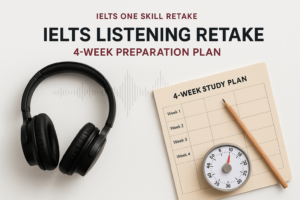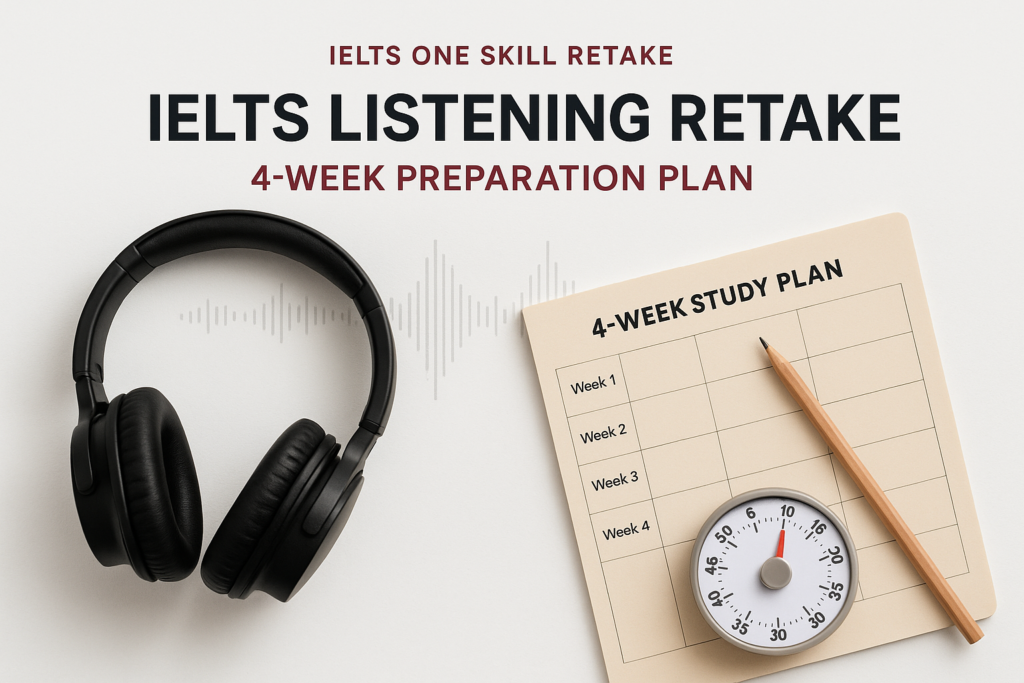
An IELTS One Skill Retake Listening preparation plan should be narrower than a full IELTS study programme. You are not starting again from zero. You already know the test, you have a recent result, and one section needs focused repair. The challenge is to identify exactly where Listening marks disappeared, then practise those weaknesses without wasting the weeks before your retake. If you want a quick benchmark before planning your sessions, the IELTS Express Pre-Test provides a personalised band prediction and a 14-day improvement plan.
This guide sets out a practical four-week structure. It covers diagnosis, question-type drills, full timed tests, review and test-day preparation. Adapt the volume to your available time, but keep the sequence: understand the error, train the underlying skill, test it under pressure, and review the evidence. That cycle is more useful than completing test after test and merely recording the score.
Confirm Your Retake Target Before You Practise
Begin with the score you actually need, not the score that sounds impressive. Check the requirements set by your university, employer, registration body or visa pathway, and confirm whether they accept IELTS One Skill Retake. Requirements can change, so use the official source relevant to your application. Then compare the required Listening band with your most recent result.
Translate the gap into a working target. IELTS Listening has 40 questions, although the raw-score conversion can vary slightly between test versions. Do not build your plan around a single unofficial conversion table. Instead, aim to score consistently above your likely threshold across several realistic practice tests. A buffer matters because unfamiliar accents, one lapse in concentration or a difficult Section 4 can affect a test-day result.
Write down three numbers: your previous Listening band, your required band and your recent timed-practice range. These numbers separate a knowledge problem from a consistency problem. Someone who alternates between 28 and 35 correct needs control and reliability. Someone who stays around 27 needs to strengthen specific listening and answer-processing skills.
Use Your Previous Result As A Diagnostic Clue
Your score report tells you the outcome, but it may not explain the cause. Reconstruct your experience while it is still useful. Which section felt hardest? Did you lose your place after one missed answer? Were spelling, plurals or word limits a problem? Did multiple-choice options become confusing while the recording continued?
Complete one full test under timed conditions and create an error log. For every wrong or uncertain answer, record the question type, the relevant audio phrase, your chosen answer and the reason for the mistake. Use specific labels rather than writing “didn’t hear it”. Helpful labels include:
- Prediction error: you did not anticipate the kind of word or information needed.
- Paraphrase error: you expected the wording in the question and missed a synonym in the recording.
- Distractor error: you selected an early option that the speaker later corrected.
- Navigation error: you lost track of the current question.
- Language error: unfamiliar vocabulary, connected speech or an accent blocked understanding.
- Answer-form error: spelling, grammar, plural form or the word limit made an otherwise correct response wrong.
After the test, count errors by category and section. The pattern determines the next week of work. For a useful model of deliberate review, see this guide to an IELTS practice test with explanations study method. The central idea is simple: the explanation is part of the practice, not something to skim after checking a score.
Week 1: Rebuild Accuracy With Short Listening Drills
During the first week, favour short, controlled exercises over daily full tests. Work for 45 to 75 minutes on five days if your schedule allows. Start each session with one question type or one section. Complete it without pausing, check the answers, then replay the difficult part with a transcript.
Use the transcript in stages. First, listen again without reading and try to locate the answer. Next, read the relevant lines and underline the paraphrase or distractor. Then listen once more while following the text. Finally, close the transcript and replay the segment. You should be able to explain what changed your understanding.
For form and note completion, predict whether each gap needs a name, number, noun, adjective or plural. For maps, establish the starting point and direction before the recording begins. For multiple choice, reduce each option to its key difference instead of trying to reread three long sentences while listening. For matching tasks, scan the option list and notice contrasts such as cost, location, availability or opinion.
Keep the audio natural during the first attempt. Slower playback may help you study connected speech afterwards, but it should not become your normal practice condition. The retake will not slow down when you miss a phrase.
Week 2: Train The Problems That Cost The Most Marks
Review your error totals at the start of Week 2 and choose the top two categories. Spend roughly 70 per cent of your practice time on them, with the remaining time used to maintain other question types. This prevents the common mistake of practising only the sections you already enjoy.
If distractors are the main issue, listen for correction signals: “actually”, “rather than”, “but”, “I used to”, “we originally planned” and similar turns. Do not write the first plausible detail immediately. Hold it briefly, continue listening and confirm whether the speaker keeps or changes it.
If you lose your place, practise recovering within one question. When an answer passes, make a quick guess, move your eyes to the next item and listen for its keywords or predicted answer type. Mentally replaying the missed sentence while the recording continues can turn one lost mark into four.
If Section 4 is weak, practise following lecture structure. Listen for topic shifts, examples, causes, results and summaries. Preview the notes before the recording so you understand the argument’s shape. You do not need to understand every word; you need to recognise when the speaker reaches the information requested.
At the end of the week, complete one full timed Listening test. A larger bank of unlimited IELTS mock tests can help you check whether the targeted work transfers to a complete section rather than only to isolated drills.
Week 3: Build Full-Test Consistency
Week 3 is where practice becomes more test-like. Complete two or three full Listening tests on separate days. Use headphones or the setup appropriate to your booked format, remove interruptions and follow the official timing. Do not pause to check an answer, search vocabulary or restart a section.
Record more than the final raw score. Note your score by section, the number of uncertain answers and any sequence in which concentration dropped. A score of 33 with ten guesses is less secure than a score of 33 with three carefully identified uncertainties. Your aim is repeatable control.
Review every test on the same day if possible. For a wrong answer, identify both the immediate error and the replacement behaviour. “Missed plural” becomes “check noun grammar and listen for final consonants”. “Lost place” becomes “guess once, move immediately and reacquire at the next item”. The replacement action turns analysis into training.
Do not force a full test when tired simply to meet a quota. One attentive test with a careful review can produce more improvement than three rushed papers. On lighter days, use ten-minute drills for numbers, letter spelling, dates, addresses and common answer forms.
Week 4: Rehearse The Retake, Then Reduce The Load
Complete your final serious mock early in the last week, not the night before the retake. Reproduce the likely test conditions and use your recovery routine whenever something goes wrong. The purpose is to rehearse behaviour, not to prove that you deserve a target score.
Compare your last three complete results. Ideally, they should sit at or above your working threshold, with no single error category dominating. If one issue remains, use brief focused drills. Avoid redesigning the entire plan because of one unusually difficult practice paper.
Two days before the test, reduce volume. Review your error log, complete a short familiar exercise and check practical details such as location, identification, arrival time and equipment rules. On the final evening, stop at a sensible hour. Listening performance depends on sustained attention, and another late practice test rarely compensates for poor sleep.
Candidates retaking another section may need a different routine. The recent IELTS One Skill Retake Reading preparation plan shows how the same diagnose-train-test cycle changes when navigation and passage evidence are the main demands.
Use A Weekly Schedule You Can Actually Sustain
A good plan fits around work, study and family responsibilities. If five long sessions are unrealistic, use four focused sessions and protect their quality. A practical week might look like this:
- Monday: one targeted section, transcript analysis and error-log update.
- Tuesday: question-type drills plus spelling and answer-form checks.
- Wednesday: rest or 15 minutes of low-pressure listening with a short spoken summary.
- Thursday: a second targeted section, followed by replay and shadowing of difficult phrases.
- Saturday: one full timed test and complete review.
- Sunday: review the week’s pattern and choose the next priority.
Measure progress across several attempts. Raw scores will move up and down. Look for fewer repeated errors, faster recovery after a missed answer and a tighter score range. Those changes show that your process is improving even before your highest score rises.
Practise The Listening Behaviours That Matter On Test Day
Before each section begins, use the preview time actively. Read the instruction, mark the word limit, predict answer types and underline the differences between options. Keep your eyes one question ahead when possible, but keep your ears with the current speaker. If you read too far, you may stop processing the recording.
Expect answers in order for most Listening tasks, but stay alert when a task format requires matching or option selection. Write or select the answer promptly, then move on. At the end, check spelling, singular and plural forms, and whether the answer fits grammatically. Never add extra words that break the stated limit.
When you miss an answer, use a fixed recovery sequence: guess, release, locate the next question, predict its cue, and listen forward. Do not chase audio that has already gone. This routine deserves deliberate practice because stress makes people revert to habit.
For structured IELTS guidance beyond this retake, Career Wise English offers practical preparation resources for candidates working towards study, professional and migration goals.
Final Listening Retake Checklist
- Confirm that your receiving organisation accepts One Skill Retake.
- Know the exact Listening band you need and build a small practice buffer.
- Classify errors by cause, not only by question number.
- Use transcripts after an honest first attempt.
- Target the two error types costing the most marks.
- Complete several full tests under uninterrupted timing.
- Practise recovering immediately after a missed answer.
- Reduce study volume in the final two days and protect sleep.
A focused retake plan is not about consuming more material. It is about making fewer repeated mistakes. Diagnose carefully, train the weak behaviour, test it under realistic pressure and keep the routines that produce stable results.
Ready to find out your IELTS band score?
Take the IELTS Express Pre-Test for just $4.99 and get your personalised band prediction with a 14-day improvement plan.
FAQ: IELTS One Skill Retake Listening Preparation
How long should I prepare for an IELTS Listening One Skill Retake?
Two to four focused weeks may be enough for a candidate who is close to the required band and has a clear error pattern. A larger score gap or inconsistent practice results may require longer. Base the decision on several timed tests, your deadline and the availability of a suitable retake date.
Should I complete a full Listening test every day?
Usually not. Daily full tests can repeat the same mistakes without correcting them. Combine short targeted drills, transcript analysis and two or three full tests per week during the intensive phase. Every full test should be followed by a review that identifies why marks were lost.
Can I use transcripts while preparing?
Yes, after completing the first attempt without help. Use the transcript to find paraphrases, reductions, distractors and unfamiliar language. Then close it and listen again. Reading the transcript before attempting the task removes the listening challenge you need to train.
What should I do if I miss an answer during the recording?
Make a quick best guess, move to the next question and listen for its cue. Do not mentally replay the missed phrase while new information continues. Practise this recovery sequence until it becomes automatic.
Is IELTS One Skill Retake accepted everywhere?
No. Acceptance depends on the organisation, programme, profession or visa pathway receiving your score. Check the current policy directly with the relevant authority before booking or relying on the result.