The first two sentences of an IELTS General Training complaint letter do more work than most candidates realise. In those few lines the reader should learn who you are writing to, why you are writing and exactly what you are complaining about. Many letters lose this chance with a personal introduction or a vague sentence such as "I have a problem".
This lesson is for General Training candidates who can write a complete letter but whose openings feel slow, emotional or memorised. It has one goal: by the end, you should be able to write a two-sentence opening that states your purpose, identifies the situation precisely and begins answering the first bullet point.
The practice task
Read this original task. We will use it for the whole lesson.
You recently enrolled in an evening cooking course at a community college. The course has not been what was advertised.
Write a letter to the course coordinator. In your letter:
- explain which course you enrolled in and why you chose it
- describe the problems with the course
- say what you would like the college to do
Write at least 150 words. You do NOT need to write any addresses. Begin your letter as follows: Dear ...
Before writing, decide on the relationship. The coordinator is someone you do not know personally, so this is a formal letter. If no name is given, "Dear Sir or Madam" with "Yours faithfully" is the safe choice. If you use a name, such as "Dear Ms Patel", finish with "Yours sincerely".
What a strong opening has to do
The official IELTS band descriptors for Writing Task 1 describe a General Training letter at Band 7 as one that "presents a clear purpose" with a tone that "is consistent and appropriate to the task". At Band 4, "the purpose of the letter is not clearly explained and may be confused". Your opening is the first place an examiner looks for that purpose. A good complaint opening therefore does three jobs:
- States the purpose at once. "I am writing to complain about..." tells the reader the type of letter in the first few words.
- Identifies the situation precisely. Name the course, booking, product or service, with one or two details (place, date, reference) so the reader knows exactly what you mean.
- Starts the first bullet point. Here the first bullet asks which course you enrolled in and why. A strong opening can answer both parts in two sentences.
A weak opening
Dear Sir/Madam,
My name is Mei Lin and I am 34 years old. I am writing this letter to you because I have a big problem and I am very angry about it. I hope you can help me.
This opening is grammatically correct, but it wastes about 40 words:
- Irrelevant personal details. The coordinator does not need your age. Nothing in the task asks for it.
- No real purpose. "A big problem" could be about anything. After three sentences the reader still does not know it is a complaint about a course.
- Inconsistent tone. "I am very angry" is emotional for a formal letter. Firm and polite is more persuasive.
- No task content. None of the three bullet points has started yet, so the body of the letter must do all the work.
An improved opening
Dear Sir or Madam,
I am writing to complain about the Tuesday evening Everyday Cooking course at your Parramatta campus, which I enrolled in on 3 February. I chose this course because your brochure promised hands-on practice in a fully equipped kitchen, but so far it has not matched that description.
Why this works:
- Purpose in five words. "I am writing to complain" leaves no doubt about the type of letter.
- Precise identification. Course name, day, campus and enrolment date mean the coordinator could find your booking.
- First bullet covered. Sentence one says which course; sentence two says why you chose it (the brochure's promise).
- A bridge to the body. "It has not matched that description" introduces the problems without listing them, so paragraph two has a clear job.
- Consistent tone. The writer is clearly unhappy, but the language stays calm and formal.
The complete model letter
Here is the full letter built from the improved opening. It is about 175 words, comfortably above the minimum.
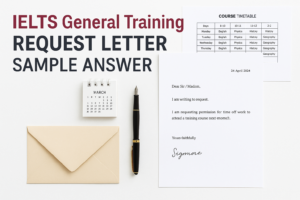
Dear Sir or Madam,
I am writing to complain about the Tuesday evening Everyday Cooking course at your Parramatta campus, which I enrolled in on 3 February. I chose this course because your brochure promised hands-on practice in a fully equipped kitchen, but so far it has not matched that description.
Firstly, the kitchen has only four working stoves for eighteen students, so most of us spend each lesson watching rather than cooking. Secondly, two of the first five classes were cancelled with less than an hour's notice, and no replacement sessions have been offered. As I travel forty minutes each way after work, these cancellations have cost me a considerable amount of time.
I would therefore like the college to arrange two replacement classes before the course ends and to limit each group to the number of stoves available. If this is not possible, I would appreciate a partial refund of the course fee.
I look forward to your reply by the end of this month.
Yours faithfully,
Mei Lin Tan
Paragraph-by-paragraph notes
Opening paragraph. Purpose: say what the letter is and what it is about. Bullet coverage: completes bullet one (which course and why). Tone: formal and controlled; "has not matched that description" is firm without exaggeration.
Second paragraph. Purpose: give the evidence. Bullet coverage: bullet two, with two specific problems (equipment and cancellations) and one consequence (lost time). Tone: factual; numbers such as "four working stoves for eighteen students" persuade better than adjectives like "terrible".
Third paragraph. Purpose: ask for action. Bullet coverage: bullet three, with a main request and a fallback option, so the reader knows what would solve the problem. Tone: polite modal language ("I would like", "I would appreciate") keeps the request reasonable.
Closing line and sign-off. Purpose: set a clear next step. "By the end of this month" gives a reasonable time frame. "Yours faithfully" matches "Dear Sir or Madam".
Opening patterns you can adapt
Do not memorise one opening for every letter. Instead, learn the pattern and fill it with details from the task:
- Formal (unknown reader): Dear Sir or Madam, I am writing to complain about [specific item or service] that I [bought, booked, enrolled in] on [date] at [place].
- Formal (named reader): Dear Mr Nguyen, I am writing regarding [specific situation], which I reported to your office on [date].
- Semi-formal (someone you know): Dear Ms Roberts, I hope you are well. I am writing about [specific issue] that has affected [who or what] over the past [time].
For more on choosing the register, compare our formal letter sample and semi-formal letter sample. If you would like another complete complaint letter with a different problem, see our complaint letter sample answer.
Try it yourself
Here is a new task. Write only the salutation and the first two sentences (about 35 to 50 words). Then compare your answer with the model.
You live in an apartment building. For the past three weeks, renovation work in the apartment above yours has started very early in the morning.
Write a letter to the building manager. In your letter:
- explain where you live in the building
- describe the problem and how it is affecting you
- suggest what the building manager could do
Show a model opening
Dear Sir or Madam,
I am writing to complain about the renovation noise coming from Unit 14, which is directly above my apartment, Unit 9, on the third floor. For the past three weeks, the work has started before 6.30 am, and I would like your help in resolving the matter.
Check your version: Does the first sentence state the purpose? Can the manager identify both apartments? Have you started the first bullet (where you live)? Is the tone firm but polite? If a name had been given, "Dear Mr Collins" with "Yours sincerely" would also be correct.
Opening checklist
- The salutation matches the relationship, and the sign-off matches the salutation.
- The first sentence states the purpose ("I am writing to complain about...").
- The reader can identify the exact course, booking, product or service.
- The opening begins answering the first bullet point.
- There is no personal introduction (name, age, nationality) unless the task asks for one.
- The tone is firm and polite, with no emotional words such as "very angry".
- The opening could only belong to this task, not to any letter.
- It is about two sentences long, leaving the details for the body paragraphs.
Find more writing lessons on the Career Wise English home page.
Official references
- IELTS Writing test preparation resources (IELTS.org): the four assessment criteria (Task Achievement, Coherence and Cohesion, Lexical Resource, Grammatical Range and Accuracy), and the General Training Task 1 letter, which may be personal, semi-formal or formal. It advises writing at least 150 words and spending no more than about 20 minutes on Task 1.
- IELTS Writing band descriptors (PDF, linked from the page above): source of the Band 7 and Band 4 General Training wording quoted in this lesson.
Sources checked 9 November 2026. IELTS may update these documents, so check IELTS.org for the current versions. This lesson is preparation advice from Career Wise English; it is not an official IELTS marking or score.