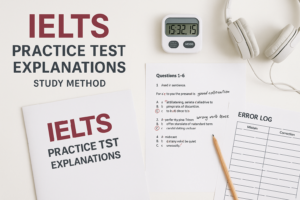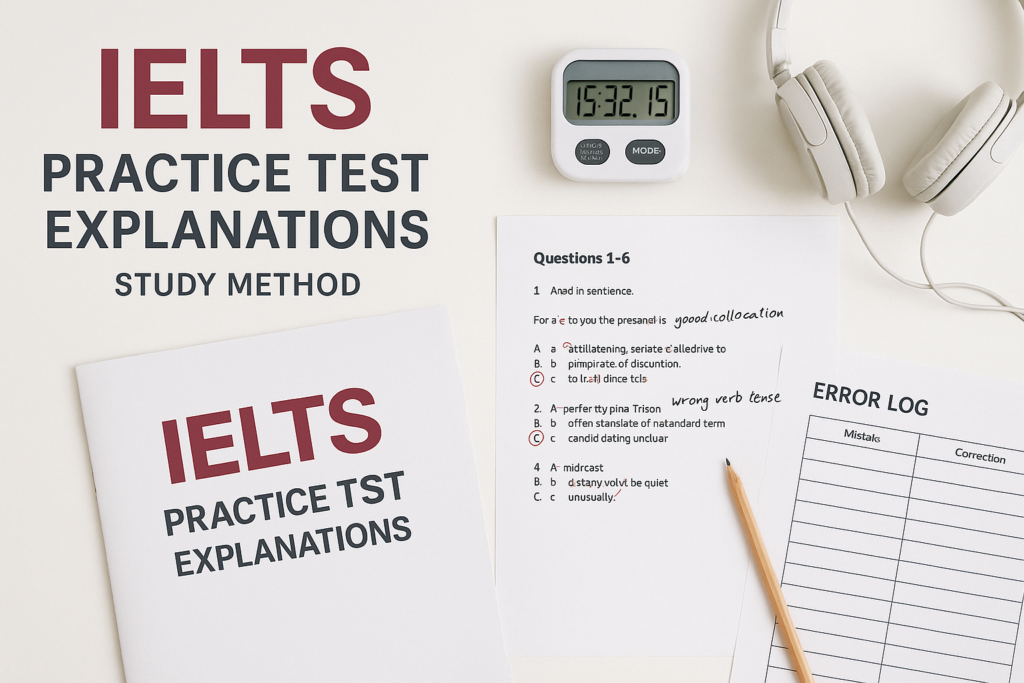
An IELTS practice test with explanations is most useful after you have finished answering the questions. The score tells you what happened; the explanations help you understand why it happened and what to change before the next attempt. Used properly, one carefully reviewed test can teach you more than several tests completed in a rush. If you want an initial benchmark before building your study routine, the IELTS Express Pre-Test provides a band prediction and a personalised 14-day improvement plan.
The key is to treat each explanation as evidence, not as something to read once and forget. You need to compare the correct reasoning with your own reasoning, identify the exact point where they separated, and practise that decision again. This guide gives you a repeatable method for doing that across Listening, Reading, Writing and Speaking.
Why Answer Explanations Matter More Than The Score
A raw practice score is a snapshot. It can show that Reading accuracy dropped in Passage 3 or that you missed several Listening questions, but it cannot tell you whether the cause was vocabulary, timing, misunderstood instructions or a weak decision. An explanation adds the missing layer. It shows the evidence for the answer and, in a good resource, why the distractors are wrong.
This distinction matters because two candidates can choose the same incorrect answer for different reasons. One may not recognise a paraphrase. Another may find the correct sentence but overlook a limiting word such as “only” or “mainly”. Giving both candidates another full test is inefficient. Their next practice activity should address the specific process that failed.
That is the central study principle: do not merely correct an answer; correct the method that produced it. The broader IELTS practice test guide can help you choose realistic materials and conditions, while the review system below shows what to do once the timer stops.
Step 1: Complete The Test Under Honest Conditions
Explanations are valuable only when the original attempt gives you trustworthy information. Complete the section under conditions that match your current goal. If you are measuring test readiness, use the official time limit, avoid dictionaries and do not pause the audio. If you are learning a new question type, an untimed attempt may be appropriate, but label it clearly as training rather than a score prediction.
Record more than correct and incorrect answers. Mark any answer you guessed, any question that took too long, and any item you changed at the end. A correct guess should not be treated as secure knowledge. An incorrect answer reached through sound reasoning may reveal a smaller problem, such as a spelling mistake or an overlooked plural ending.
- Use one uninterrupted sitting when you want a realistic baseline.
- Keep the answer sheet clean so that later notes do not blur what you originally thought.
- Mark uncertainty with a simple symbol beside the question number.
- Record timing at useful checkpoints, such as the end of each Reading passage.
- Note interruptions or technical issues that may have affected the result.
For computer-delivered preparation, practise the format as well as the content. The recent IELTS computer-based practice test preparation guide explains how to rehearse navigation, screen reading and typing without confusing interface familiarity with language ability.
Step 2: Review Before Looking At The Explanation
After scoring the test, resist the urge to open every explanation immediately. Return first to each wrong or uncertain question and try to locate the evidence yourself. In Reading, underline the sentence or paragraph that should control the answer. In Listening, replay the relevant part only if your practice format allows review, and write down what you thought you heard. This short second attempt exposes whether the problem disappears when time pressure is removed.
Use three review questions: What did I choose? Why did I choose it? What evidence would have made another answer stronger? Write a brief response before reading the official reasoning. Even a note such as “matched the same word but ignored the contrast” is useful because it captures your actual decision.
Now read the explanation and compare it with your note. Do not copy the explanation word for word. Translate it into a rule you could use in a new question. For example, “Option B is wrong” is not a reusable lesson. “Check whether the option describes the cause or merely a result” is.
Once you have established this review habit, use the unlimited IELTS mock tests to repeat the cycle under realistic timing. The value comes from alternating simulation with analysis, not from collecting a long list of completed tests.
Step 3: Classify The Real Cause Of Each Error
An error log becomes useful when its categories lead to different actions. Avoid vague labels such as “careless” or “bad English”. They describe frustration, not a fix. Choose the narrowest cause that explains the mistake.
- Instruction error: you exceeded a word limit, used the wrong number of words or answered the wrong task.
- Evidence error: you selected an answer without locating enough support in the passage or recording.
- Paraphrase gap: you did not connect the wording in the question with equivalent wording in the source.
- Distractor error: you noticed familiar vocabulary but missed a correction, contrast or changed detail.
- Language gap: grammar or vocabulary prevented accurate understanding or expression.
- Timing error: you knew the method but spent too long earlier and rushed later questions.
- Transfer error: spelling, singular and plural forms, numbering or answer entry cost the mark.
Some questions will have two causes. Record a primary cause and, if necessary, a secondary one. Suppose you miss a Reading answer because you spend four minutes searching the wrong paragraph. The primary issue may be poor passage mapping, while timing is the consequence. Fixing the search process is more useful than simply telling yourself to work faster.
After one test, count the categories. The largest cluster should shape your next week of study. Five paraphrase errors suggest targeted paraphrase work. One isolated spelling mistake needs a quick correction routine, not an entire week of spelling exercises.
Step 4: Turn Each Explanation Into A Practice Rule
Every important explanation should produce a short action statement. Begin it with a verb so that it tells you what to do: check, compare, locate, predict, verify or move on. Keep the rule narrow enough to remember under pressure.
- Check all words that limit quantity or frequency before choosing TRUE.
- Compare the speaker’s final decision with the option, not the first suggestion.
- Verify that a Reading heading matches the whole paragraph, not one example.
- Predict the grammatical form needed before a Listening gap.
- Move on after 90 seconds if the evidence remains unclear, then return later.
Next, attach a small drill to the rule. If you missed contrast markers in Listening, review five short extracts containing “but”, “however” or “actually”. If you chose Reading headings from repeated keywords, summarise five paragraphs in seven words each before viewing the headings. A drill should recreate the decision, not simply repeat the original question.
This is also where you decide whether the explanation is genuinely helpful. A useful explanation cites evidence and distinguishes the right answer from plausible wrong choices. A weak explanation merely states the correct letter. When the reasoning is unclear, consult a teacher or a reliable IELTS source rather than inventing a rule from an ambiguous item.
How To Apply The Method To Listening And Reading
For Listening, review the transcript alongside the audio. Identify the exact words that carried the answer and the words that created the distractor. Then listen again without reading. Your goal is to hear the relationship in real time, not to memorise the sentence. Pay particular attention to corrections, changed plans, negative forms, dates, numbers and singular or plural endings.
For Reading, locate the evidence and mark the paraphrase connection between question and passage. If the task is TRUE, FALSE or NOT GIVEN, state which test applies: agreement, contradiction or insufficient information. If it is matching headings, summarise the paragraph’s main purpose before reconsidering the options. If it is gap completion, check meaning, grammar and the stated word limit.
Redo the missed questions after two or three days without looking at your notes. A correct answer from memory proves little, so explain the evidence aloud or in one sentence. If you cannot justify the answer, the method is not yet secure. Create a parallel example or complete another short drill before moving to a full section.
How To Apply Explanations To Writing And Speaking
Writing and Speaking explanations usually appear as model answers, examiner comments, band descriptors or teacher feedback rather than a single correct response. Use them comparatively. Do not copy impressive phrases into a notebook without understanding their function. Ask what the stronger response does that yours does not.
For Writing, compare task coverage, paragraph purpose, idea development, cohesion, vocabulary control and grammatical accuracy. Choose one or two changes for the next response. If a model essay develops each main idea with explanation and a specific example, practise expanding one body paragraph rather than rewriting the entire model.
For Speaking, examine how an answer stays relevant, extends naturally and remains easy to follow. Record your response, listen back, and compare it with the criteria. An explanation that says an answer lacks development should become a concrete rule such as “add one reason or example after the direct answer”. Re-record the same prompt once, then apply the rule to a different prompt.
Avoid turning model answers into scripts. Memorised language can sound unnatural and may not fit the precise question. Borrow structures and decision patterns: answer directly, explain, illustrate and stop when the point is complete. Your own language, used accurately and flexibly, is more valuable than a polished paragraph you cannot adapt.
A Seven-Day Study Schedule Using One Explained Test
You do not need a new full test every day. One explained test can support a complete week of focused preparation when review and transfer are built into the schedule.
- Day 1: complete the test or target section under defined conditions, then score it.
- Day 2: review wrong and uncertain answers before reading explanations; create the error log.
- Day 3: study the two largest error categories and complete short, untimed drills.
- Day 4: redo missed questions and explain the evidence or scoring principle.
- Day 5: complete a new timed section focused on the same skills.
- Day 6: compare the new errors with the original log and update your practice rules.
- Day 7: rest, or complete a light review of vocabulary, rules and successful corrections.
At the end of the week, look for movement in the process as well as the score. Did you find evidence faster? Did fewer distractors work? Did you finish with time to check instructions? Those changes often appear before a large band-score improvement, and they show that the study method is becoming reliable.
Common Mistakes When Using Explained Practice Tests
The most common mistake is reading the explanation and feeling that it is obvious. Recognition is not the same as retrieval. Close the page and explain the reason in your own words. Then apply it to another item. If you cannot do both, you have not yet learned the lesson.
- Checking answers too early: this removes the chance to inspect your original reasoning.
- Recording only wrong answers: uncertain correct answers may reveal the next weakness.
- Using “careless” as a category: replace it with the precise missed check or decision.
- Doing another full test immediately: targeted drills should come before another measurement.
- Copying model language: study why it works and practise adapting the structure.
- Ignoring repeated errors: a recurring category deserves more attention than an isolated difficult question.
- Trusting poor explanations: use materials that show evidence and address plausible distractors.
Another mistake is changing too many habits at once. If your review identifies seven problems, choose the two that cost the most marks or affect the most tasks. A short priority list is easier to use under test pressure. Once those behaviours improve, return to the log and choose the next pair.
How To Know When You Are Ready For Another Full Test
Take another full test when you have completed the review cycle, practised the new rules and can explain the original errors without relying on the answer key. This may take several days. The goal is not to protect yourself from a disappointing score; it is to give the next test a fair chance to measure a changed process.
Before starting, write down two or three behaviours you will apply. Examples include checking limiting words, moving on at a fixed time, or verifying plurals during transfer. After the test, assess those behaviours separately from the score. If accuracy improves but timing collapses, the method needs adjustment rather than abandonment.
Use a rolling comparison of three tests instead of reacting dramatically to one result. Topic familiarity, fatigue and test difficulty can create normal variation. A consistent improvement in error categories, completion and section scores is stronger evidence than one unusually high mark. For further guidance on making review actionable, read the recent article on using feedback from an IELTS practice test.
Your Practical Review Checklist
- Complete the test under conditions that match the purpose of the session.
- Mark guesses, slow questions and changed answers before checking the key.
- Attempt each error again before opening the explanation.
- Locate the evidence or scoring principle behind the correct response.
- Classify the primary cause using a specific category.
- Convert the explanation into a short action rule.
- Complete a small drill that rehearses the corrected decision.
- Redo the item after two or three days and justify the answer.
- Apply the rule in a new timed section before taking another full test.
An explained practice test should leave you with fewer mysteries and a clearer next step. Keep the cycle simple: attempt, inspect, explain, classify, drill and retest. For practical preparation resources and support across all four IELTS skills, visit Career Wise English.
Ready to find out your IELTS band score?
Take the IELTS Express Pre-Test for just $4.99 and get your personalised band prediction with a 14-day improvement plan.
FAQ: Studying With IELTS Answer Explanations
Should I read explanations for answers I got right?
Yes, especially when you guessed, changed the answer or could not clearly justify it. You do not need to study every easy item in equal depth, but checking uncertain correct answers prevents luck from being mistaken for a reliable method.
How long should I spend reviewing one IELTS practice test?
Review may take as long as the test itself, and sometimes longer. A full test can be divided across several sessions. Prioritise wrong and uncertain answers, then spend extra time on repeated error categories rather than forcing the review into one exhausted sitting.
Are answer explanations enough to improve Writing and Speaking?
They help, but Writing and Speaking benefit from feedback linked to the public band descriptors and your own performance. Model answers show possibilities; they do not diagnose every weakness in your response. Use them to identify one or two transferable changes, then practise those changes in new tasks.
How many explained practice tests should I complete each week?
For many candidates, one full test plus targeted sections is enough. The right number depends on your deadline and available review time. It is better to analyse one test carefully and apply its lessons than to complete three tests without changing your method.
What should I put in an IELTS error log?
Record the question number, your answer, the correct answer, the evidence, the primary error cause, the practice rule and the follow-up drill. Keep entries brief enough to review. The log should guide decisions, not become a second study project.