The IELTS computer Writing test interface is deliberately simple, but it can still feel unfamiliar when a timer is running and you are deciding what to write. The screen gives you the question, a typing area, a word count and basic navigation. It does not plan your answer, correct your grammar or warn you that an idea is off topic. If you want a quick benchmark before you begin practising on screen, the IELTS Express Pre-Test can estimate your current band range and provide a personalised 14-day improvement plan.
This guide explains what you are likely to see, how to move between tasks, which editing habits are useful and what to practise before test day. The exact appearance may vary slightly by test centre or software update, so follow the instructions displayed at your venue. The core skill does not change: you need to control your time and produce a clear response while using a basic text editor.
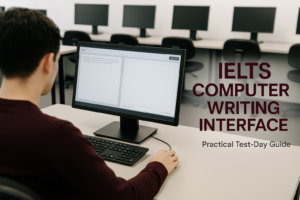
What The IELTS Computer Writing Screen Shows
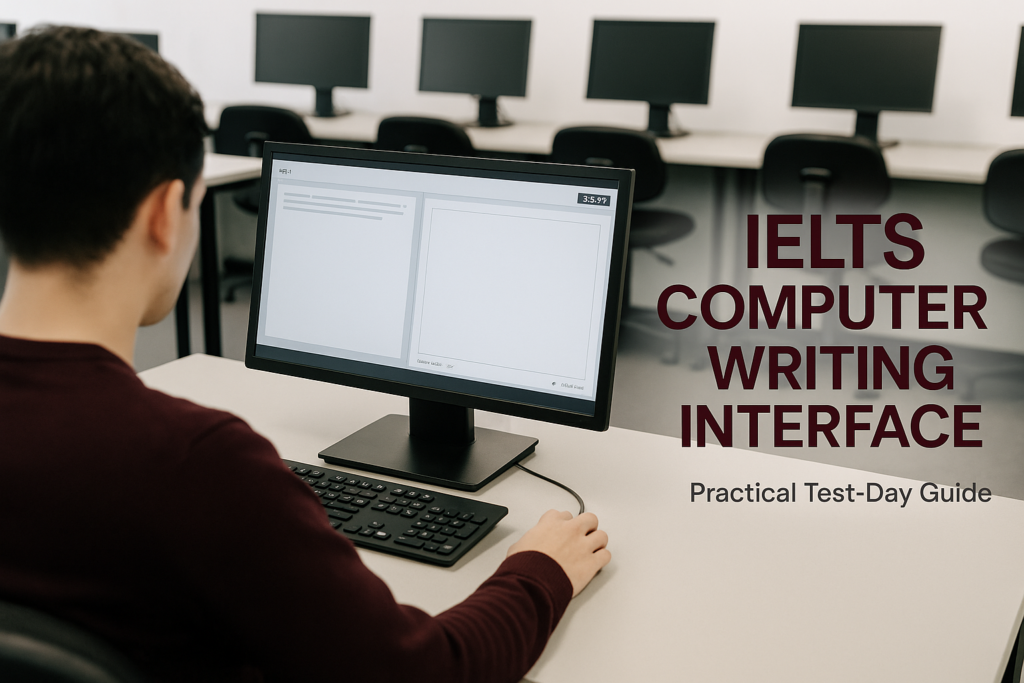
The Writing test normally places the task instructions and source material on one side of the screen and the answer box on the other. In Task 1, the left panel may show an Academic graph, chart, map or process, or a General Training letter prompt. In Task 2, it shows the essay question. The answer area is where you type your response.
A clock remains visible so that you can track the 60-minute Writing period. You can move between Task 1 and Task 2, and the interface keeps each response in its correct task. A word counter displays the number of words entered in the active answer box. Scroll bars may appear when the prompt or your response is longer than the visible panel.
Expect a functional exam screen, not a familiar word-processing program. There are no elaborate page-layout controls. The visual simplicity is helpful once you have practised with it, because the important information stays in view. For broader preparation across all sections, Career Wise English provides practical IELTS resources and test support.
How To Read The Prompt Without Missing Details
Before typing, read every instruction and identify the exact task. In Academic Task 1, inspect the title, units, dates, labels and legend. In General Training Task 1, identify the recipient, purpose and three bullet points. In Task 2, separate the topic from the question instructions. A prompt may ask for an opinion, a discussion of both views, causes and solutions, or two direct answers.
You can select text in the question area and use any highlighting or note function that the live interface provides, but do not depend on a feature you have never tested. A reliable alternative is to pause and form a short mental checklist. For Task 2, ask: What is the topic boundary? How many instructions are present? Must I state a position?
Do not begin writing merely because the keyboard is ready. Two or three minutes of analysis can prevent a well-written but incomplete response. If the prompt contains several bullet points, treat each one as required. The interface will not tell you that you have ignored one.
Switching Between Task 1 And Task 2
You are generally free to choose the order in which you complete the two Writing tasks. Navigation controls allow you to open Task 1 or Task 2, and your saved text remains in the relevant answer area. Before switching, glance at the task label so that you do not type an essay paragraph in the Task 1 box.
IELTS recommends about 20 minutes for Task 1 and 40 minutes for Task 2 because Task 2 contributes more to the Writing score. Many candidates complete Task 1 first, then move to Task 2. Others prefer to tackle the higher-value essay while their concentration is strongest. Either approach can work if you rehearse it and protect enough time for both responses.
Use a full simulation to test your preferred order. The unlimited IELTS mock tests are useful when you are ready to practise decisions, typing and checking under a realistic time limit. A method that feels comfortable in an untimed exercise may break down after forty minutes of sustained concentration.
Typing, Selecting And Editing Your Answer
The interface supports ordinary text entry and basic editing. You can place the cursor, select words, delete text and move material using standard functions available on the test computer. Keyboard shortcuts may help, but the safest strategy is to master a small set of actions rather than experimenting during the exam.
When revising, make targeted changes. Replacing one inaccurate word is low risk. Moving a large paragraph late in the test can create repeated or missing text if you rush. After any substantial edit, read the sentence before and after the change to confirm that grammar and logic still connect.
Paragraphs should be visibly separated. Press Enter to start a new paragraph, and keep the structure easy to scan. You do not need indentation, special fonts, coloured text or headings in a standard IELTS response. Examiners assess the quality of the writing, not decorative formatting.
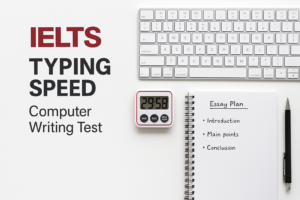
Spelling remains your responsibility. The test editor should not be treated as a spelling or grammar checker. Watch for errors caused by fast typing, such as omitted letters, doubled words and accidental capitalisation. The recent guide to typing speed for the IELTS computer Writing test explains why controlled accuracy matters more than chasing an extreme words-per-minute result.
Using The Word Count Correctly
The on-screen word count is convenient because you do not need to count manually. Task 1 requires at least 150 words, while Task 2 requires at least 250 words. Writing below the minimum can damage your result, but reaching the number does not prove that the response is complete or well developed.
A practical target might be around 170 to 200 words for Task 1 and 270 to 310 words for Task 2. These are working ranges, not official maximums. They leave enough room to develop the answer while keeping the review manageable. Your ideal length depends on how accurately and coherently you can write within 60 minutes.
Check the counter at sensible milestones rather than after every sentence. For example, look after finishing your first body paragraph and again before the final review. Constantly watching the number interrupts your reasoning and can encourage padding. If an essay is short, add explanation where an idea is underdeveloped; do not repeat the introduction in different words.
Managing The 60-Minute Timer
The timer is a guide, not a signal to panic. Decide on checkpoints before the test. One workable schedule is three minutes to analyse Task 1, fourteen minutes to write it and three minutes to check it. For Task 2, use five minutes to plan, thirty minutes to write and five minutes to review.
If you start with Task 2, set an equally firm stopping point. A polished essay cannot compensate fully for an unfinished Task 1 response. When your planned time expires, complete the current sentence, add a concise conclusion if needed and move on. Returning later is safer than allowing one task to consume the entire test.
The computer does not remove the need for a plan. Before Task 2, type or mentally organise a compact outline: position, two main ideas and one explanation or example for each. Avoid leaving planning notes in the final answer. If you type notes in the response box, delete them and confirm that no fragments remain.
A Practice Routine For The Interface
Begin with short technical drills. Spend ten minutes typing from a prompt, creating paragraphs, selecting a phrase and correcting errors. Then practise analysing questions on screen without writing full answers. The aim is to make navigation and editing automatic so that most of your attention stays on language and ideas.
Next, complete individual tasks under time limits. Review both the final response and your process. Did you lose time scrolling repeatedly? Did you check the word count too often? Did a large late edit create errors? Record one interface habit and one writing skill to improve in the next session.
Finally, complete full 60-minute Writing simulations. Use a desktop or laptop with a physical keyboard and a screen layout that requires you to read and type side by side. A tablet or phone does not reproduce the same experience. The computer-based IELTS practice guide can help you organise a broader preparation routine around realistic digital practice.
Do not memorise whole essays during this process. Practise transferable actions: identifying instructions, planning paragraphs, typing accurately, checking references and correcting repeated errors. Familiarity should make you calmer, not make your answer sound pre-written.
Common Interface Mistakes To Avoid
- Writing in the wrong task box: check the active task label whenever you switch screens.
- Trusting the word counter alone: minimum length does not guarantee complete task coverage.
- Making risky late edits: reread around moved or deleted text to catch broken sentences.
- Ignoring scrollable content: inspect all labels, bullet points and question instructions.
- Overusing formatting: clear paragraphs are enough; decorative presentation earns no extra marks.
- Waiting for automatic correction: reserve time to check spelling, grammar and punctuation yourself.
Another mistake is practising only with a favourite keyboard or writing app. Your test-centre keyboard may feel different, and the editor will be more basic than your usual software. You do not need to train on poor equipment, but occasional practice on an unfamiliar keyboard helps you remain adaptable.
Test-Day Checklist
- Read the full prompt, including every bullet point, label and instruction.
- Confirm whether you are working in Task 1 or Task 2.
- Plan the response before writing full sentences.
- Use clear paragraph breaks and straightforward formatting.
- Monitor the clock at planned checkpoints.
- Check that Task 1 has at least 150 words and Task 2 at least 250.
- Review task coverage before making minor vocabulary changes.
- Leave no planning notes or sentence fragments in the answer box.
The interface is not the real challenge once its basic actions are familiar. Your score still depends on task achievement or response, coherence and cohesion, lexical resource, and grammatical range and accuracy. Practise the screen until it becomes unremarkable, then direct your effort towards producing a relevant, developed and accurate answer.
Ready to find out your IELTS band score?
Take the IELTS Express Pre-Test for just $4.99 and get your personalised band prediction with a 14-day improvement plan.
FAQ: IELTS Computer Writing Test Interface
Does the IELTS computer Writing test have spellcheck?
You should not rely on automatic spelling or grammar correction. Build time into your plan to check common typing errors, word endings, articles, punctuation and sentence boundaries yourself.
Can I move between Writing Task 1 and Task 2?
Yes, the computer-delivered test normally lets you navigate between the two tasks during the 60-minute Writing period. Your text remains with its task, but always confirm the active task before typing.
Is there an automatic word count?
Yes, the interface displays a word count for your response. Use it to confirm that Task 1 reaches at least 150 words and Task 2 reaches at least 250 words, while remembering that relevance and development matter more than length alone.
Can I use copy and paste in the IELTS Writing test?
Basic selection and editing functions may be available within the test interface. Practise simple keyboard editing beforehand and follow the instructions at your test centre. Avoid moving large sections late in the test unless you have time to check the result carefully.
Should I complete Task 2 first on computer?
That is a personal strategy rather than a requirement. Task 2 carries more weight, so some candidates prefer to begin there. Others gain confidence by completing Task 1 first. Practise both approaches, choose one and set strict time limits so that neither task is left unfinished.