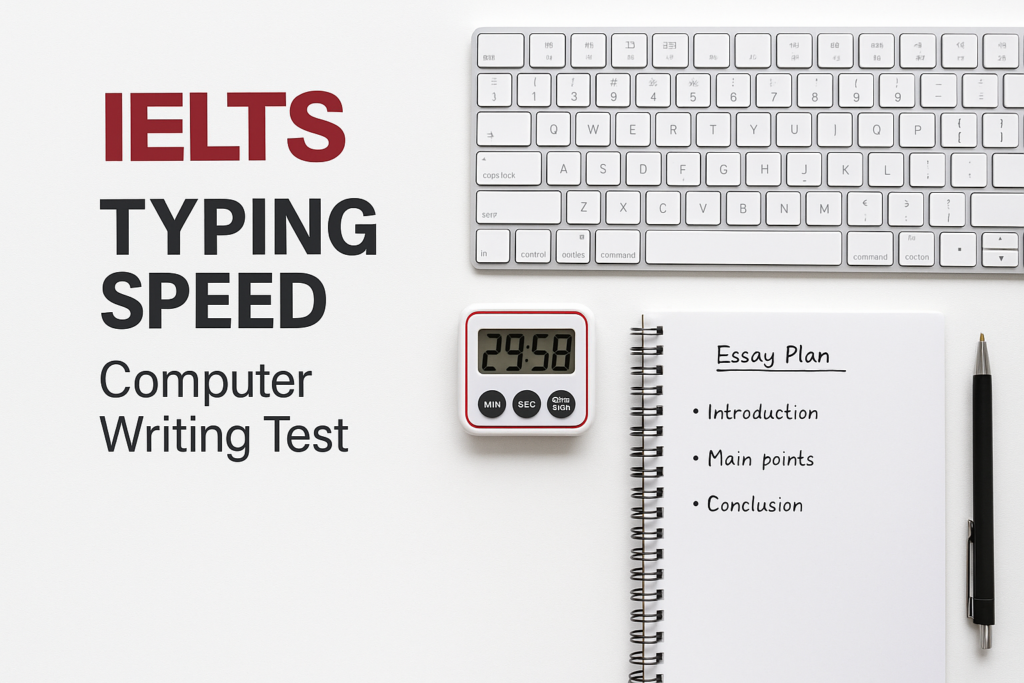
If you are worried about your typing speed for IELTS computer based Writing test day, the reassuring news is that you do not need to type like a professional. You need enough speed to plan, write, review and correct your response within the time limit. For most candidates, accuracy and control matter more than chasing an impressive words-per-minute score. If you want a quick picture of your current readiness before changing your study routine, the IELTS Express Pre-Test provides a personalised band prediction and a focused improvement plan.
This guide explains a realistic typing target, how to test yourself, what to practise and how to avoid the habits that waste time in the computer-delivered test. The goal is not simply to move your fingers faster. It is to produce a clear Task 1 response and a developed Task 2 essay while leaving a few minutes to check both.
What Typing Speed Do You Need For IELTS Writing?
A practical target is about 25 to 35 accurate words per minute when copying straightforward English. That range is usually sufficient because IELTS Writing is not continuous transcription. You will pause to understand the question, choose ideas, organise paragraphs and edit sentences. A candidate who types 30 accurate words per minute and thinks clearly can finish comfortably. A candidate who types 55 words per minute but makes frequent errors may spend too much time correcting.
Do not treat 25 words per minute as an official IELTS requirement. IELTS does not award marks for typing speed, and there is no separate keyboard score. Your writing is assessed through the usual criteria, including Task Achievement or Task Response, Coherence and Cohesion, Lexical Resource, and Grammatical Range and Accuracy. Speed only matters because it affects how well you use the available time.
A better question is: can you complete a properly planned Task 1 response and Task 2 essay, then review them, within 60 minutes? If the answer is yes, your typing is probably fast enough. If not, measure whether the real problem is keyboard speed, slow planning, limited vocabulary, repeated rewriting or uncertainty about essay structure.
Why Raw Words Per Minute Can Be Misleading
Most online typing tests ask you to copy text that is already written. IELTS asks you to create an answer. Your “production speed” will therefore be lower than your copying speed. You need to interpret a chart or letter prompt, develop an argument, select examples and monitor grammar while typing. Those thinking pauses are normal.
Accuracy also changes the value of a speed result. Typing 40 words per minute with 88% accuracy creates a trail of missing letters, wrong word endings and punctuation errors. Typing 30 words per minute with 97% accuracy may produce a cleaner draft and a calmer final review. Measure both numbers, but prioritise accuracy once you reach a functional pace.
The keyboard and screen layout can influence performance too. Practising only on a phone or tablet does not prepare your hands for a desktop keyboard. The recent guide to the IELTS computer based practice test explains how to make your preparation feel closer to the real test interface and conditions.
How To Measure Your Current IELTS Typing Readiness
Begin with a simple five-minute copying test on a physical keyboard. Use a normal English article, not a list of random words. Record your gross speed and accuracy. Repeat the test on three different days and use the average, because one unusually strong or weak attempt is not reliable.
Next, run an IELTS-specific production test. Give yourself 40 minutes for a genuine Task 2 question. Spend five minutes planning, type the essay, and stop when the timer ends. Record the word count, the time you finished the first draft and the number of obvious typing errors you found during review. This tells you far more than a one-minute typing game.
- Green zone: you complete at least 250 words with a clear structure and have three to five minutes to check.
- Amber zone: you reach the word count but finish with little or no review time.
- Red zone: you regularly leave the conclusion unfinished, miss a paragraph or type substantially fewer than 250 words.
Repeat the same process for Task 1 using a 20-minute timer. Do not judge success by word count alone. A 190-word Task 1 response that selects key features is usually more useful than a rushed 260-word response full of minor details.
A Two-Week Accuracy-First Typing Plan
During days one to three, spend 15 minutes a day copying well-written English. Keep your eyes on the screen and use comfortable finger positions. Slow down whenever accuracy drops below roughly 95%. The purpose is to build reliable movement, not to win a speed test.
On days four to seven, add short IELTS sentences. Practise punctuation, capital letters, percentages, dates and common academic words. For Academic Task 1, type sentences that compare figures and describe change. For General Training Task 1, practise greetings, polite requests and sign-offs. For Task 2, type topic sentences and example sentences rather than entire memorised essays.
During week two, move to timed sections. Write one introduction in five minutes, one body paragraph in ten minutes and one conclusion in four minutes. Then complete two full Writing tests on separate days. You can access unlimited IELTS mock tests to practise the complete workflow and see whether your typing remains controlled when the clock is running.
Keep a tiny error log. Note recurring mistakes such as omitted articles, “form” instead of “from”, missed plural endings or accidental double spaces. Review that list before the next session. A personal error log is more valuable than repeating generic drills that do not target your actual weaknesses.
Keyboard Skills That Save Time On Test Day
Learn to use Backspace, Delete, Shift and the arrow keys without looking down for long. You should also be comfortable selecting a short phrase and replacing it. However, avoid depending on elaborate shortcuts or editing features that may not behave exactly as they do in your usual software.
Use the mouse only when it is genuinely quicker. Constantly moving a hand between keyboard and mouse breaks rhythm. For small corrections, arrow keys and Backspace are often faster. For moving a whole idea, it may be safer to rewrite one sentence than to cut and paste large blocks under pressure.
Practise spelling while you type. Do not assume that a test interface will rescue every error in the way a personal word processor might. Also become comfortable with punctuation keys, especially commas, apostrophes, colons and quotation marks. These small movements should not interrupt your thinking.
Finally, practise on a standard desktop or laptop keyboard in an upright position. A familiar home keyboard may feel different from test-centre equipment, but varied practice helps you adapt. The latest overview of IELTS computer test changes in Australia is useful if you also want current context about the move toward computer delivery.
How To Divide The 60 Minutes
A sensible starting point is 20 minutes for Task 1 and 40 minutes for Task 2, because Task 2 contributes more to the Writing score. Within Task 1, allow about three minutes to analyse and plan, fourteen minutes to write and three minutes to check. Within Task 2, allow five minutes to plan, about thirty minutes to write and five minutes to review.
These are working targets, not rigid laws. If your Task 2 planning is strong but your typing is slightly slow, you may use four minutes to plan and thirty-two to type. Do not remove the review completely. A short final check can catch missing words, incorrect endings and sentences damaged during editing.
Set paragraph checkpoints during practice. For Task 2, you might aim to finish the introduction by minute seven, body paragraph one by minute eighteen, body paragraph two by minute twenty-nine and the conclusion by minute thirty-five. Checkpoints reveal early when you are falling behind. They also stop you spending fifteen minutes polishing an introduction that carries only a small portion of the response.
Common Typing Habits That Lower Writing Quality
The first bad habit is editing every sentence immediately. Some correction is sensible, but repeatedly rewriting the opening paragraph destroys momentum. If the meaning is clear, continue to the next idea and return during the review. The second habit is typing before you have a paragraph plan. Fast typing cannot repair weak organisation.
Another problem is watching the keyboard more than the screen. You may not notice duplicated words, missing spaces or a cursor in the wrong position. Practise glancing down only when necessary. Candidates also waste time trying to use complicated vocabulary, deleting it and searching for a replacement. Choose precise words you can spell and use naturally.
Do not inflate the answer simply because typing feels easier than handwriting. More words do not automatically mean a higher band. Extra sentences can introduce repetition, irrelevant detail and grammar errors. Aim for enough development: commonly around 170 to 200 words for Task 1 and 270 to 320 for Task 2, depending on your style.
What To Do If You Type Slowly
If your copying speed is below about 20 words per minute, focused keyboard practice is worthwhile. Start with short daily sessions rather than one exhausting weekly session. Concentrate on the keys and letter combinations you hesitate over. Build accuracy first, then increase pace in small steps.
At the same time, simplify the writing process. Use a four-paragraph Task 2 structure, prepare clear planning questions and learn flexible language for comparison, cause, effect and examples. This is not about memorising an essay. It reduces the mental load of deciding how every paragraph should work.
If you are consistently unable to finish after two weeks of realistic practice, compare computer and paper delivery carefully where both are relevant to your circumstances. Consider handwriting legibility, editing comfort and test availability as well as typing speed. Preparation advice from Career Wise English can help you focus on the format and study habits that support your actual score goal.
A Test-Day Typing Checklist
Before the test begins, adjust your chair and keyboard position if permitted, then type a few characters when the interface allows. During Writing, read the full instruction before touching the keyboard. Make a brief plan, type in clear paragraphs and watch the on-screen word count without chasing an unnecessarily high total.
- Answer every part of the question.
- Use paragraphs with one clear purpose each.
- Keep an eye on time at planned checkpoints.
- Correct obvious errors without repeatedly rewriting.
- Reserve at least three minutes for a final check.
- Review endings, articles, punctuation and accidental omissions.
Your target is a complete, organised and accurate response. Once your keyboard skills stop interfering with that target, additional raw speed brings diminishing returns.
Ready to find out your IELTS band score?
Take the IELTS Express Pre-Test for just $4.99 and get your personalised band prediction with a 14-day improvement plan.
FAQ: Typing Speed For IELTS Computer Writing
Is 20 words per minute enough for IELTS Writing?
It may be enough if your planning is efficient and your typing is accurate, but it leaves less room for hesitation and review. Aim to move toward at least 25 accurate words per minute, then test yourself with full IELTS tasks rather than relying only on a copying score.
Does IELTS check typing speed?
No. There is no separate typing-speed mark. Typing affects your performance indirectly because you must complete both tasks in 60 minutes, but examiners assess the quality of the written response using the standard Writing criteria.
Can I use keyboard shortcuts in computer-delivered IELTS?
You should be comfortable with basic editing actions, but do not build your whole strategy around advanced shortcuts. Practise simple navigation, deletion and replacement, and follow the functions available in the official test interface.
How many words should I type in IELTS Writing?
You must write at least 150 words for Task 1 and at least 250 words for Task 2. There is no benefit in producing a very long answer if it becomes repetitive or inaccurate. Prioritise complete development and leave time to check.
Should I practise typing or IELTS essays first?
Do both, but match the practice to your weakness. If you cannot type accurately at a functional pace, use short daily keyboard drills. Once you are near 25 to 35 words per minute, spend more time on timed IELTS planning, paragraph development and review.