IELTS General Training Writing Task 1 formal letter sample practice is useful because formal letters are easy to recognise, but not always easy to control. You may need to complain, request information, apply for something, apologise to an organisation, or explain a problem to a manager. Before you practise another letter, take the IELTS Express Pre-Test to check your current Writing band range and see whether tone, task response, grammar, or timing is holding your score back.
A formal letter in IELTS General Training is not about sounding old-fashioned. It is about being clear, polite, specific, and organised. The examiner wants to see that you understand the situation, answer every bullet point, use a suitable opening and closing, and keep the tone consistent from start to finish. This guide gives you a complete sample, then breaks down the structure so you can copy the method without memorising the whole answer.
What A Formal Letter Is Testing
IELTS General Training Writing Task 1 tests whether you can write for a real-life purpose. In a formal letter, the reader is usually someone you do not know personally, such as a company manager, landlord, council officer, admissions team, hotel manager, or customer service department. Your language should therefore be respectful and direct.
The task normally gives you a situation and three bullet points. You must cover all three. If you write a beautiful letter but ignore one bullet point, your task achievement score can drop. A strong formal letter answers the purpose quickly, develops each point, and avoids casual phrases such as just letting you know, cheers, or thanks heaps.
- Identify the reader before you write.
- Use a formal greeting and closing.
- Answer all three bullet points clearly.
- Keep the tone polite, even in a complaint.
- Check that your request or action point is easy to find.
The Sample Formal Letter Task
Here is a typical IELTS General Training formal letter task. You recently stayed at a hotel for a work conference. When you returned home, you realised that you had left an important document folder in your room. Write a letter to the hotel manager. In your letter, explain when you stayed at the hotel, describe the folder and why it is important, and ask the manager to help return it to you.
This task is formal because you are writing to a hotel manager you do not know. The purpose is also practical. You need to give enough detail for the manager to find the folder and return it. The letter should be polite because you are asking for help, not blaming the hotel.
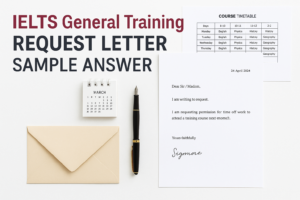
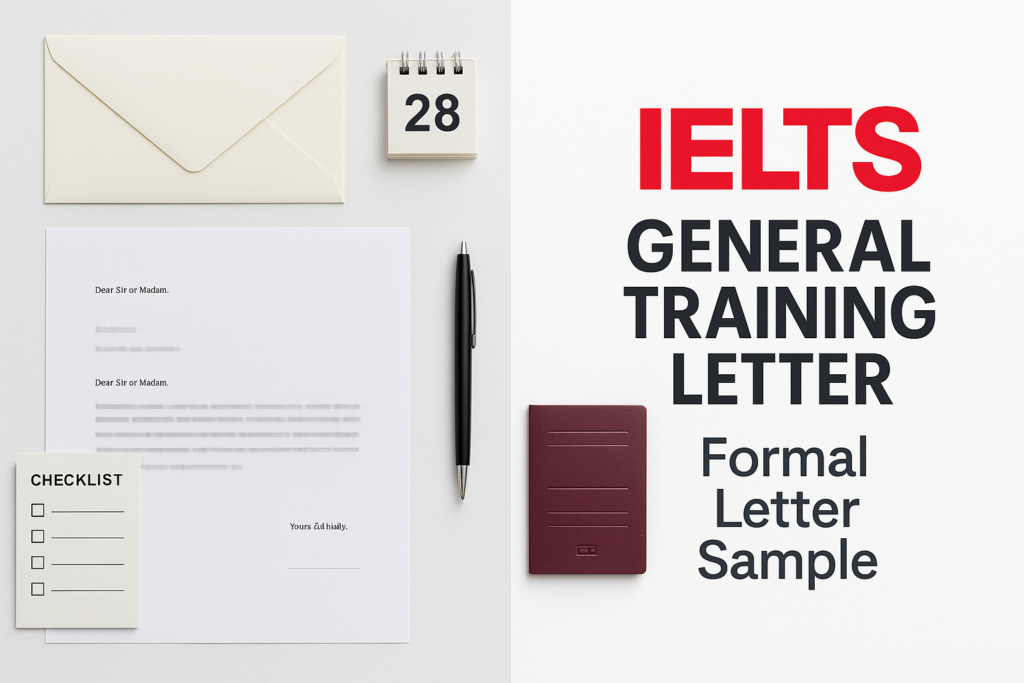
IELTS General Training Writing Task 1 Formal Letter Sample
Dear Sir or Madam,
I am writing to ask for your assistance with an important folder that I believe I left in my room during my recent stay at your hotel.
I stayed at the Riverside Business Hotel from 14 to 16 May while attending a work conference in the city. My booking was under the name Daniel Carter, and I was allocated room 418. I checked out on the morning of 16 May at approximately 8.30 am.
The missing item is a dark blue document folder with a zip around the edge. It contains several signed work contracts, a printed conference schedule, and some handwritten meeting notes. These documents are important because I need to submit them to my employer by the end of this week.
Could you please ask your housekeeping team to check the room, the reception desk, and the lost property area? If the folder is found, I would be grateful if you could contact me by email or arrange for it to be posted to my home address. I am happy to pay any postage costs.
Thank you for your help. I look forward to hearing from you soon.
Yours faithfully,
Daniel Carter
Why This Sample Works
This sample works because it does not waste time. The first sentence explains the purpose immediately. The next paragraph gives the stay dates, hotel name, booking name, room number, and checkout time. Those details help the reader act. The third paragraph describes the folder and explains why it matters. The final body paragraph makes a clear request.
The tone is formal but natural. It uses I am writing to ask for your assistance, I believe I left, I would be grateful, and I am happy to pay. These phrases are polite without sounding too dramatic. For more timed practice across all modules, access unlimited IELTS mock tests and check whether your letters stay clear under pressure.
The Safest Formal Letter Structure
A safe formal letter structure has four main parts. Start with Dear Sir or Madam if you do not know the person’s name. Then write a short opening paragraph that explains why you are writing. After that, use two or three body paragraphs to cover the bullet points. Finish with a polite closing sentence and Yours faithfully.
If the task gives three bullet points, you can often make each bullet point one paragraph. That keeps the letter easy to control. You do not need a long introduction. In fact, a long introduction can waste time and delay the real purpose. IELTS rewards clarity more than decoration.
Opening Lines For Formal Letters
The opening line should match the purpose. For a request, write I am writing to ask for your assistance with. For a complaint, write I am writing to complain about. For an application, write I am writing to apply for. For information, write I am writing to enquire about. These phrases are simple, accurate, and appropriate for formal letters.
Avoid openings that sound too casual, such as I wanted to tell you about or I hope everything is great. You can be polite without becoming chatty. The examiner should know the purpose of the letter by the end of the first paragraph.
How To Keep The Tone Formal
Formal tone comes from controlled word choice, not complicated vocabulary. Use could you please instead of can you. Use I would be grateful instead of please do this quickly. Use contact me instead of get back to me. Use arrange instead of sort out. These small choices make the letter sound more professional.
Do not become rude in a complaint letter. You can say I was disappointed with the service because the room was not cleaned for two days. You do not need to say the service was terrible and completely unacceptable unless the situation truly requires strong language. A calm complaint often sounds more mature and more persuasive.
If you need help choosing support for Writing weaknesses, see our IELTS preparation plans and choose the level of feedback that matches your target band and deadline.
Useful Formal Letter Phrases
Useful request phrases include I would be grateful if you could, Could you please let me know, I would appreciate your assistance with, and Please contact me if you require any further information. These phrases help you make requests politely.
Useful explanation phrases include The reason for this is, This is important because, I was informed that, and I would like to clarify. Useful closing phrases include Thank you for your time, Thank you for your assistance, I look forward to your response, and I look forward to hearing from you soon.
Common Mistakes In Formal Letters
The first common mistake is using the wrong closing. If you start with Dear Sir or Madam, use Yours faithfully. If you start with Dear Mr Smith or Dear Ms Brown, use Yours sincerely. Do not use Best wishes or Cheers in a formal IELTS letter.
The second mistake is missing a bullet point. Many candidates write a strong first half and then rush the final request. Before you finish, compare your answer with the three bullet points and tick each one mentally. For broader writing guidance, read the IELTS Writing Task 1 tips and strategies guide before your next practice letter.
Band 7 Checklist Before You Submit
Before submitting a formal letter, check five things. Is the purpose clear in the first paragraph? Have you answered all three bullet points? Is the tone formal from beginning to end? Are the details specific enough for the reader to act? Is the final request clear?
Then check grammar. Look at articles, prepositions, verb tense, and sentence length. Formal writing does not mean every sentence must be long. Short, controlled sentences often work better than ambitious sentences that contain several grammar errors.
Practice Method For Formal Letters
Choose one formal task and spend two minutes identifying the reader, the purpose, and the three bullet points. Then write one sentence for each bullet point before you begin the full letter. This quick plan stops you from drifting into irrelevant information.
After writing, underline the formal phrases. If the letter has too many casual expressions, replace them. If every sentence sounds memorised, make the details more specific. The best IELTS formal letters sound natural, respectful, and purposeful.
Final Advice For Formal Letter Samples
Do not memorise this IELTS General Training Writing Task 1 formal letter sample word for word. Memorised letters can become risky because the real task will be different. Instead, copy the structure: purpose, details, importance, request, and polite closing.
With practice, formal letters become one of the most manageable IELTS Writing tasks. Keep the reader in mind, answer every bullet point, use polite language, and make your requested action clear.
Ready to find out your IELTS band score?
Take the IELTS Express Pre-Test for just $4.99 and get your personalised band prediction with a 14-day improvement plan.
FAQ: IELTS General Training Writing Task 1 Formal Letter Sample
How do I start a formal IELTS letter?
Start with Dear Sir or Madam if you do not know the person’s name. Then write a clear opening sentence such as I am writing to ask for your assistance with or I am writing to complain about.
What closing should I use for a formal letter?
Use Yours faithfully when you start with Dear Sir or Madam. Use Yours sincerely when you know the person’s name and write Dear Mr, Dear Ms, or Dear Dr.
How many paragraphs should a formal Task 1 letter have?
Most formal IELTS letters work well with four or five short paragraphs: opening purpose, bullet point details, further explanation, request or action, and closing.
Can I use contractions in a formal IELTS letter?
It is safer to avoid contractions in formal letters. Write I am instead of I’m, I would instead of I’d, and cannot instead of can’t.
What is the biggest formal letter mistake?
The biggest mistake is ignoring one of the bullet points. Tone and grammar matter, but the letter must first complete the task fully and clearly.