IELTS Writing Task 2 agree or disagree essay structure matters because this question type looks simple, but it punishes unclear thinking very quickly. The examiner is not just checking whether you have an opinion. They are checking whether your position is clear from the introduction, developed through both body paragraphs, and still consistent in the conclusion. Before you build another essay plan, take the IELTS Express Pre-Test to check your current Writing band range and see whether structure, ideas, grammar, or timing is holding your score back.
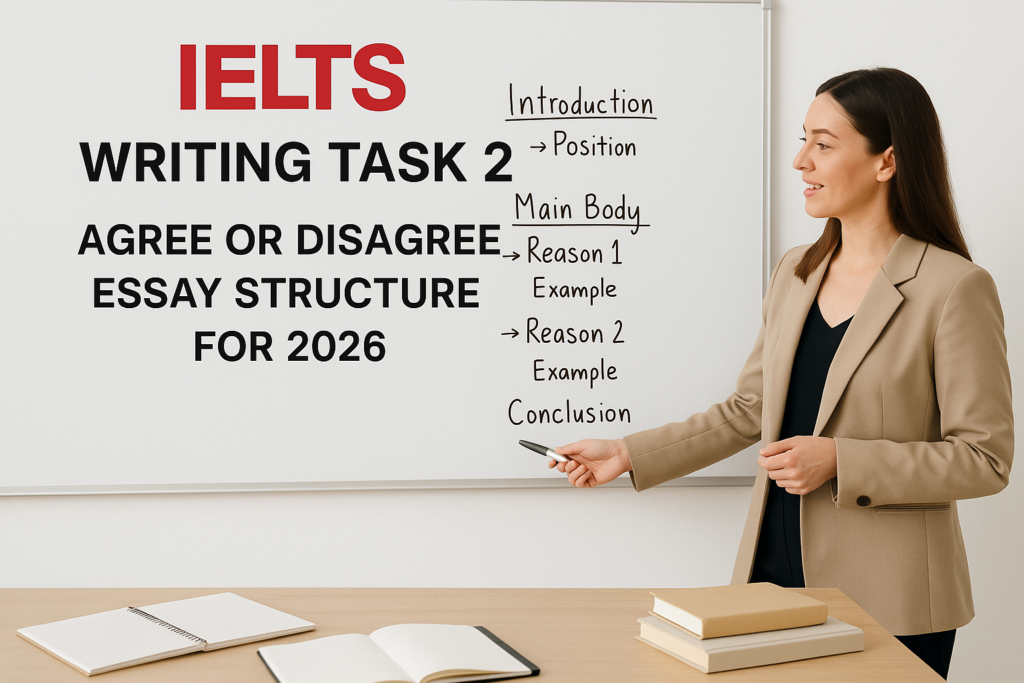
An agree or disagree essay usually asks whether you agree or disagree with a statement. Your job is to take a clear position and support it with relevant reasons and examples. The safest structure is not complicated. It is a clean four-paragraph essay: introduction, first body paragraph, second body paragraph, and conclusion. The difficulty is keeping every paragraph connected to the same position.
What An Agree Or Disagree Essay Is Testing
This question type tests your ability to respond directly to an opinion. The prompt gives a statement such as: Some people believe that children should start learning a foreign language at primary school. To what extent do you agree or disagree? You need to decide how far you support the statement and then explain that view logically.
The key phrase is to what extent. You do not always need to be 100 percent for or against the statement, but your answer must not feel undecided. A fully agree essay is usually easier to control. A partly agree essay can work well, but only if you explain the balance clearly. A weak essay often says both sides have advantages and disadvantages without telling the examiner what the writer actually thinks.
- Choose a clear position before writing the introduction.
- Make the thesis sentence direct and easy to find.
- Use each body paragraph to prove one main reason.
- Keep examples relevant to the statement, not just the general topic.
- Finish with the same position you introduced.
The Safest Four-Paragraph Structure
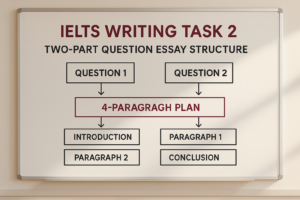
The most reliable structure for IELTS Writing Task 2 is four paragraphs. Paragraph one introduces the topic and states your position. Paragraph two gives your first main reason. Paragraph three gives your second main reason or a controlled qualification. Paragraph four summarises the position without adding a new argument.
This structure works because it gives the essay enough development without becoming hard to manage in 40 minutes. You do not need three body paragraphs unless you can write quickly and accurately. Many candidates lose marks because they start too many ideas and then cannot develop them properly. Two strong body paragraphs are usually better than three thin ones.
For wider timed practice, use the IELTS Writing Task 2 practice test after studying this structure so you can apply the same planning method to different topics.
How To Write The Introduction
The introduction should do two jobs. First, paraphrase the topic simply. Second, state your opinion clearly. Do not spend five minutes searching for rare synonyms. Accuracy is more important than decoration. If the statement is about whether governments should fund public transport, your introduction should keep that meaning intact.
A safe introduction might look like this: Many people argue that governments should invest more money in public transport than in new roads. I strongly agree with this view because better public transport can reduce traffic congestion and make cities more affordable for residents. This introduction is clear because the position and the two reasons are visible immediately.
Thesis Statements That Do Not Drift
Your thesis statement controls the essay. If your thesis says you strongly agree, the body paragraphs should sound like agreement. If your thesis says you partly agree, the body paragraphs must explain the part you support and the part you question. The reader should never need to guess your view halfway through the essay.
A strong thesis is specific enough to guide the body. Instead of writing I agree with this statement, write I agree because early language learning improves pronunciation and gives children more time to build confidence. That sentence gives you two ready-made body paragraphs. It also stops you from wandering into unrelated points.
Body Paragraph One: Your Strongest Reason
The first body paragraph should contain your strongest reason. Start with a topic sentence that directly supports your position. Then explain the reason in two or three sentences. Add a realistic example if it helps. End the paragraph by connecting the point back to the question.
For example, if you agree that children should learn foreign languages early, your first reason might be pronunciation. Young learners often copy sounds more naturally than adults, so early lessons can help them develop clearer speech patterns. A brief example about primary school students learning basic pronunciation through songs and games is enough. The example should support the point, not take over the paragraph.
Body Paragraph Two: Your Second Reason Or Qualification
The second body paragraph should either give another reason for your position or explain a limited qualification. If you fully agree, use this paragraph for a second benefit. If you partly agree, this is where you can acknowledge a concern while still keeping your main view clear.
For a partly agree essay, you might write that early language learning is useful, but only if schools protect time for literacy and numeracy. This is not the same as sitting on the fence. You are still giving a view: early language learning has value, but it must be introduced carefully. The paragraph should explain that balance in a controlled way.
If you want repeated practice under realistic pressure, access unlimited IELTS mock tests and compare whether your position stays consistent across several Task 2 attempts.
Fully Agree Versus Partly Agree Structure
A fully agree structure is the simplest option. The introduction says you agree. Body paragraph one gives reason one. Body paragraph two gives reason two. The conclusion repeats the agreement. This structure is direct and usually easy to finish within the time limit.
A partly agree structure needs more care. The introduction should say exactly what you agree with and what you do not fully accept. Body paragraph one can explain the side you support. Body paragraph two can explain the limitation. The conclusion then restates the balanced position. The danger is becoming vague, so use partly agree only when you can express the balance clearly.
Useful Language For Agree Or Disagree Essays
You can use direct opinion language without sounding informal. Useful phrases include I strongly agree that, I largely agree with this view, I agree to a certain extent, this view is reasonable because, and this argument is convincing when. These phrases help the examiner find your position quickly.
For development, use because, this means that, as a result, for example, in practical terms, and this is important because. These linking phrases are not fancy, but they create logic. IELTS Writing rewards clear development more than memorised connectors. Do not force phrases such as henceforth or aforementioned if they do not sound natural.
Common Structure Mistakes
The first common mistake is writing a discussion essay instead of an agree or disagree essay. If the question asks whether you agree, do not spend the whole essay presenting both sides equally. You may mention the other side briefly, but your position must lead the response.
The second mistake is changing your opinion. A candidate may strongly agree in the introduction, then write one paragraph for and one paragraph against, then conclude that both sides are equal. That pattern damages task response because the answer feels unresolved. For more practical essay habits, read the IELTS Writing Task 2 tips and strategies guide before your next timed essay.
A Band 7 Style Mini Model
Question: Some people believe that students should be required to study financial skills at school. To what extent do you agree or disagree?
Introduction: Many people argue that schools should teach students how to manage money. I strongly agree with this view because financial education can help young people avoid debt and make better decisions when they start working.
Body paragraph plan: Paragraph two explains why students need practical money skills before adulthood. Paragraph three explains how school lessons can reduce common mistakes with credit cards, loans, and budgeting. The conclusion repeats that financial education should be required because it prepares students for real adult responsibilities.
This model works because the position is simple and every paragraph has a job. It does not try to discuss every possible advantage and disadvantage. It answers the question that was asked.
Planning The Essay In Five Minutes
Use the first five minutes to make three decisions. What is your exact position? What are your two main reasons? What example or explanation will support each reason? If you cannot answer those questions before writing, the essay will probably become harder halfway through.
A quick plan can be very short. Write agree, reason one, reason two, and conclusion. Under each reason, add one example or result. This small plan protects your essay from repetition. It also helps you avoid writing a long introduction because you already know where the essay is going.
Checking Your Structure Before Submission
In the final two minutes, check the structure before checking small vocabulary. Ask whether the introduction has a clear position. Ask whether each body paragraph begins with a reason. Ask whether the conclusion matches the introduction. These checks catch the mistakes that hurt task response most.
Then check grammar, articles, verb forms, and sentence length. You do not need perfect English for a strong score, but errors should not block meaning. If your ideas are clear but your sentences are too long, split them. Controlled sentences are usually stronger than ambitious sentences that collapse under pressure.
Final Checklist For Agree Or Disagree Essays
Before you practise again, use this checklist. Have you answered agree or disagree directly? Have you used four clear paragraphs? Does each body paragraph support your position? Have you avoided turning the essay into a general discussion? Have you repeated your view in the conclusion without adding a new argument?
The best IELTS Writing Task 2 agree or disagree essay structure is simple, but it is not lazy. It gives your opinion a clear path from the first paragraph to the last. Choose your position, build two strong reasons, explain them carefully, and make the examiner’s job easy.
Ready to find out your IELTS band score?
Take the IELTS Express Pre-Test for just $4.99 and get your personalised band prediction with a 14-day improvement plan.
FAQ: IELTS Writing Task 2 Agree Or Disagree Essay Structure
How many paragraphs should an agree or disagree essay have?
Four paragraphs is usually the safest structure: introduction, two body paragraphs, and conclusion. This gives you enough development without making the essay hard to finish in 40 minutes.
Can I partly agree in IELTS Writing Task 2?
Yes, but your position must be clear. Explain exactly what you agree with and what limitation you see. Do not simply say both sides are important without giving a direct answer.
Should I discuss both sides in an agree or disagree essay?
You can mention the other side briefly if it helps your argument, but the essay should focus on your opinion. If both sides receive equal treatment, it may become a discussion essay instead.
Where should I put my opinion?
Put your opinion in the introduction and repeat it in the conclusion. Your body paragraphs should also make the same position clear through their topic sentences and explanations.
What is the biggest structure mistake?
The biggest mistake is changing position during the essay. Choose your view before writing and make sure every paragraph supports that same answer.