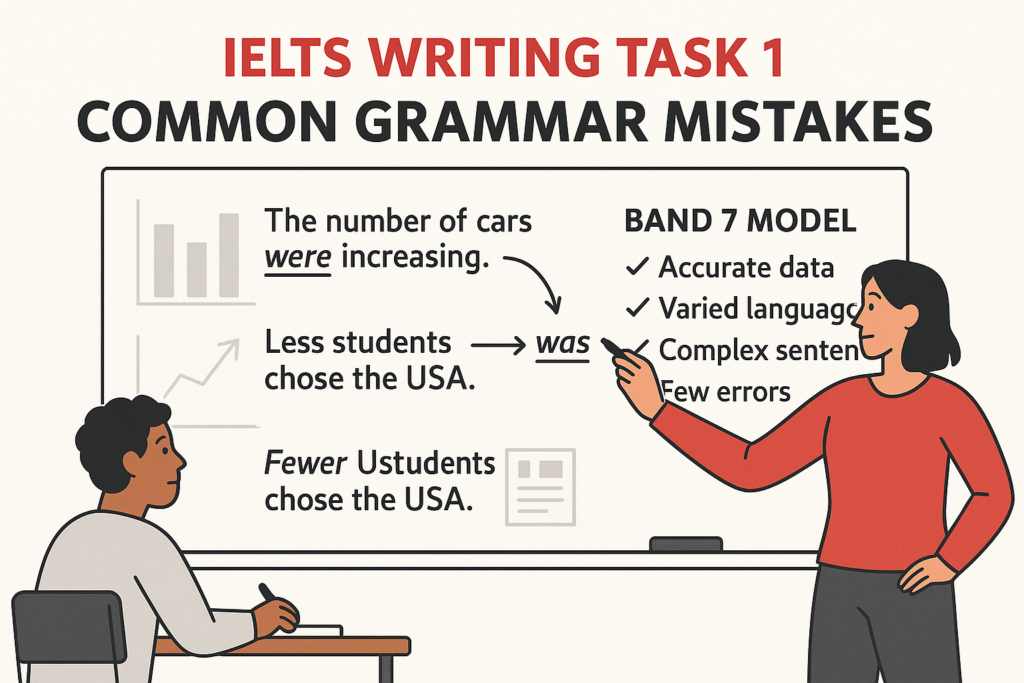
IELTS Writing Task 1 Common Grammar Mistakes band 7 model is for Academic IELTS candidates who can understand a chart, table, map, or process, but lose marks because the grammar in the report is not controlled enough. In Task 1, grammar is not decoration. It is how you show comparisons, trends, quantities, time periods, and relationships between data. Before you write another answer, take the IELTS Express Pre-Test to check your current Writing band range and see whether grammar, overview quality, vocabulary, or timing is holding you back.
This guide gives you a Band 7 style model, then breaks down the grammar mistakes that commonly keep candidates at Band 6. The aim is not to write complicated sentences. The aim is to write accurate sentences that describe the data clearly, compare figures correctly, and avoid repeated errors under exam pressure.
What Band 7 Grammar Means In Task 1
Band 7 grammar in IELTS Writing Task 1 means you can use a variety of sentence forms with good control. You do not need every sentence to be long. You do need most sentences to be accurate, natural, and appropriate for a data report. The examiner should be able to follow your comparisons without stopping to decode the grammar.
A Band 6 answer may have some good language, but errors are more frequent. Articles may be missing, plural nouns may be wrong, verbs may not agree with subjects, and comparison structures may be awkward. Those errors do not always hide the meaning, but they reduce the impression of control.
- Use past tense when the data period is finished.
- Use present tense for charts with no past time period.
- Match singular and plural nouns carefully.
- Use comparison grammar accurately.
- Keep complex sentences clear rather than overloaded.
The Band 7 Model Task
Imagine a line graph compares the percentage of students using three IELTS preparation methods in Australia from 2015 to 2025. Online mock tests rose from 18% to 58%. Classroom lessons fell from 52% to 33%. Printed study books declined from 44% to 27%.
This task is useful because it needs tense control, comparison grammar, trend language, and accurate use of percentages. It also shows why grammar mistakes can damage Task Achievement. If a candidate writes that online mock tests were increased by students, the meaning becomes clumsy. If they write books was decline, the error is obvious and repeated.
Band 7 Model Answer
The line graph compares the proportion of students in Australia who used three IELTS preparation methods between 2015 and 2025.
Overall, online mock tests became much more popular and finished as the most common preparation method. By contrast, both classroom lessons and printed study books declined steadily over the period.
In 2015, classroom lessons were the leading method, used by 52% of students, while printed study books were also common, at 44%. However, both figures fell during the next ten years. Classroom lessons dropped to 33% by 2025, and printed books decreased even further to 27%.
The only category that rose significantly was online mock testing. It began at just 18% in 2015, but increased steadily to 58% in 2025, overtaking the other two methods. As a result, online mock tests became 25 percentage points higher than classroom lessons at the end of the period.
Why This Model Reaches Band 7
This model reaches Band 7 because the grammar is varied but controlled. It uses a relative clause in the introduction, a contrast sentence in the overview, passive reduction in used by 52% of students, and comparison language in the final sentence. None of the grammar is showy. It is there to make the data easier to read.
The model also avoids a common problem: using too many structures in one sentence. The final paragraph has two clean sentences before the final comparison. That is often stronger than one long sentence with several trends, dates, figures, and linking phrases squeezed together.
For timed practice with similar charts, access unlimited IELTS mock tests and check whether your Task 1 grammar stays accurate after the first five minutes.
Mistake 1: Wrong Verb Tense
Many Task 1 answers lose control because the tense changes for no reason. If the graph covers 2015 to 2025 and both years are in the past or presented as a completed period, past tense is usually safest: classroom lessons fell, online tests increased, printed books declined.
If the chart gives current general information with no past dates, present tense may be appropriate: the chart shows, the table compares, the diagram illustrates. For process diagrams, use present simple for a natural process, such as water is heated and steam is produced. For a historical map, use past tense because the place changed over time.
Avoid mixing tense inside the same description unless the data clearly requires it. Do not write online tests increased from 2015 to 2025 and are becoming the most popular method. The second verb adds a present idea that is not shown by the chart.
Mistake 2: Singular And Plural Errors
Plural errors are especially common with IELTS Task 1 because candidates write quickly around numbers. Write 52% of students were using classroom lessons, not 52% of student was using classroom lesson. Percentages usually refer to plural groups when the noun is plural.
Be careful with words such as figure, percentage, proportion, number, and amount. The figure was high is singular. The figures were high is plural. The percentage of students was 52% can be correct because percentage is the grammatical subject. Students were 52% is usually unnatural.
For more Task 1 practice across chart types, use the IELTS Writing Task 1 practice test and underline every subject and verb after you finish.
Mistake 3: Articles With Countable Nouns
Articles are small, but repeated article mistakes can make a report sound less accurate. Write the line graph compares, not line graph compares. Write a sharp increase when you mention one increase for the first time, and the increase when you refer to it again.
Some nouns in Task 1 are countable: a figure, a category, a method, a percentage, a period, a trend. Other nouns are usually uncountable in this context: information, data, spending, consumption, production. Do not write an information or many datas. Write information, data, or pieces of information if you need a countable form.
Mistake 4: Incorrect Comparison Grammar
Task 1 is full of comparison, so comparison grammar must be accurate. Write higher than, lower than, more common than, twice as high as, and the highest figure. Do not write more higher than or most highest. Those double comparison forms are easy to notice.
Use whereas and while to compare two clauses. For example: online tests rose sharply, whereas classroom lessons declined. Use compared with before a noun phrase: online tests reached 58%, compared with 33% for classroom lessons. If you want help choosing a preparation plan that targets these weak points, see our IELTS preparation plans.
Mistake 5: Overloaded Complex Sentences
Many candidates think Band 7 requires very long sentences. It does not. A sentence can be complex because it contains a useful clause, not because it is hard to read. If a sentence includes four categories, three dates, two comparisons, and a trend phrase, the risk of error rises quickly.
A safer method is to combine one main comparison with one supporting detail. For example: Online mock tests, which were the least popular option in 2015, became the leading method by 2025. This sentence is complex, but it is still manageable. The grammar supports the data instead of fighting it.
Mistake 6: Unnatural Passive Forms
Passive grammar is useful in Task 1, but only when it sounds natural. Write classroom lessons were used by 52% of students. Do not write the percentage was used classroom lessons. For processes, passive forms are often useful: the plastic is collected, sorted, cleaned, and melted.
For charts, active verbs are often simpler. Online tests increased from 18% to 58% is cleaner than online tests were increased from 18% to 58%. In most chart descriptions, figures rise and fall; they are not increased by someone unless the chart clearly shows an action by a person or organisation.
A Grammar Checking Routine For Task 1
In the final two minutes, do not reread the whole report vaguely. Check for specific error types. First, check tense. Then check singular and plural agreement. Then check articles before countable nouns. Finally, check comparison phrases such as higher than, the most popular, and compared with.
This routine is simple, but it works because it targets the errors that appear most often in Task 1. If you usually run out of time, practise with shorter reports first. A clean 180-word report is usually stronger than a messy 260-word report.
Final Checklist Before You Submit
Before you submit a Task 1 report, ask five grammar questions. Did I use the correct tense for the time period? Do my subjects and verbs agree? Did I use articles before countable singular nouns? Are my comparison phrases correct? Are my complex sentences still easy to follow?
An IELTS Writing Task 1 Common Grammar Mistakes band 7 model is useful when you copy the control, not just the vocabulary. Write accurate sentences, compare data cleanly, and use complex grammar only when it helps the reader understand the chart.
Ready to find out your IELTS band score?
Take the IELTS Express Pre-Test for just $4.99 and get your personalised band prediction with a 14-day improvement plan.
FAQ: IELTS Writing Task 1 Common Grammar Mistakes Band 7 Model
What grammar mistakes are most common in IELTS Writing Task 1?
The most common mistakes are wrong tense, subject-verb agreement errors, singular and plural errors, missing articles, inaccurate comparison forms, and overloaded complex sentences.
Do I need complex grammar for Band 7 in Task 1?
Yes, but complex grammar should be controlled. A few accurate complex sentences are better than many long sentences with repeated mistakes.
Should Task 1 be written in past tense?
Use past tense when the chart describes a completed past period. Use present tense when the chart presents current or general information with no completed time period.
How can I reduce grammar errors in Task 1?
Use a short checking routine: tense first, then subject-verb agreement, articles, plurals, and comparison phrases. Practise checking the same error types after every timed report.
Can grammar mistakes lower Task Achievement?
Yes. Grammar mistakes can affect Task Achievement if they change the meaning of the data, such as confusing percentages with numbers or writing the wrong comparison.