If you are looking for an IELTS Writing Task 1 Data Selection sample answer, you probably already know the basic report structure. The harder skill is deciding which numbers deserve space in the answer and which numbers should be left out. Before you keep writing full reports without feedback, take the IELTS Express Pre-Test to check your current band range and see whether Task 1 selection is one of the reasons your Writing score is stuck.
Data selection matters because IELTS Writing Task 1 is not a copying task. The examiner wants to see that you can identify the main features, group related information, and support your overview with accurate details. A report that includes every figure often feels busy, mechanical, and unclear. A stronger report chooses the best evidence and uses it to explain the pattern.
What Data Selection Means In IELTS Writing Task 1
Data selection means choosing the figures, categories, stages, places, or changes that best support the main features of the visual. In a line graph, this may mean selecting starting points, ending points, peaks, lows, and the sharpest changes. In a bar chart, it may mean choosing the highest and lowest categories, plus one or two clear contrasts. In a table, it may mean grouping similar figures instead of describing every cell.
The goal is not to hide information. The goal is to report the visual efficiently. IELTS gives you about 20 minutes for Task 1, so you need a controlled answer. If you spend too much time listing minor figures, you may miss the overview, weaken the body paragraphs, and run out of time for Task 2.
- Choose data that supports the main trend or comparison.
- Use enough figures to prove your points.
- Leave out small details that do not change the message.
- Group related numbers in the same sentence.
- Keep the overview broad and save precise data for the body.
IELTS Writing Task 1 Data Selection Sample Answer
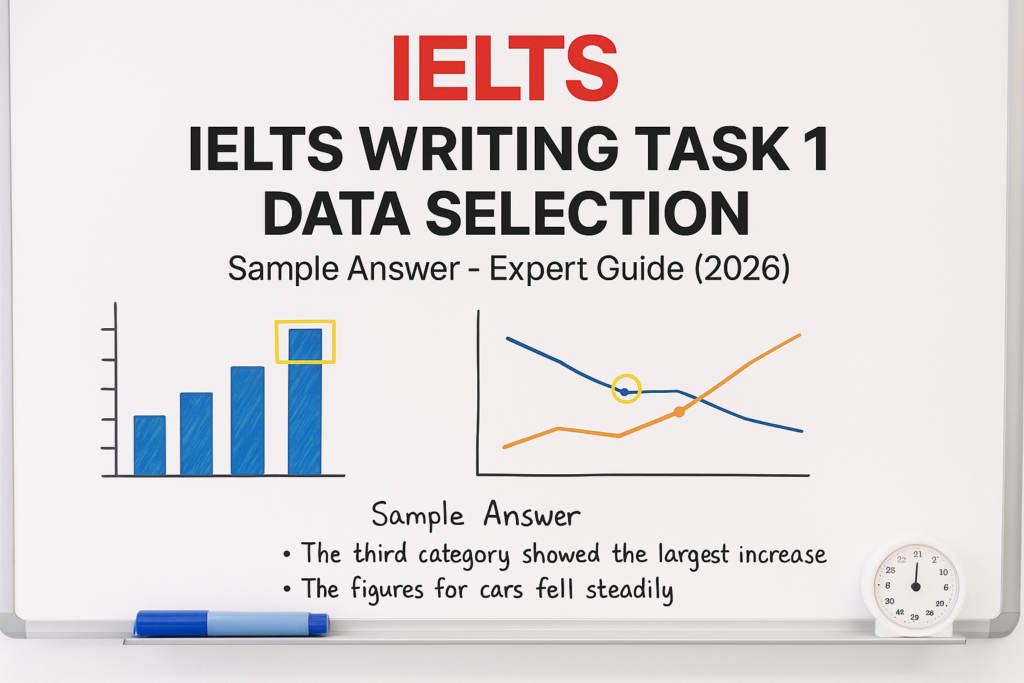
Imagine a line graph showing the percentage of people using three transport methods to travel to work in one city from 2000 to 2020. Car use fell from 62% to 48%. Public transport rose from 22% to 36%. Cycling increased from 4% to 12%, while walking stayed almost unchanged at around 10%.
A strong sample answer might include this overview:
Overall, car travel remained the most common way to commute, although its share declined steadily over the period. By contrast, public transport and cycling became more popular, while walking changed very little.
The body paragraphs would not need every intermediate figure. One body paragraph could compare car use with public transport, using the start and end figures. Another could mention the smaller rise in cycling and the stable pattern for walking. That is enough data to support the main features without turning the report into a number dump.
Why This Sample Uses Selected Figures
The sample focuses on figures that explain change. The start and end points for car use show the decline clearly. The start and end points for public transport show the opposite trend. Cycling matters because it more than tripled, even though it stayed lower than the other methods. Walking matters because it was stable.
Notice what is not included. If the graph also showed figures for 2005, 2010, and 2015, the report might not need all of them. Intermediate numbers are useful only when they show a peak, a sudden change, a reversal, or an important comparison. If they simply repeat the same pattern, they can usually be summarised.
To practise this under realistic timing, access unlimited IELTS mock tests and force yourself to choose the evidence before writing the first body paragraph.
A Band 5 Data Dump Versus A Band 7 Style Answer
A Band 5 style answer might say: “Car was 62% in 2000, 59% in 2005, 55% in 2010, 51% in 2015 and 48% in 2020. Public transport was 22% in 2000, 25% in 2005, 29% in 2010, 33% in 2015 and 36% in 2020.” This is understandable, but it reads like copied data. The examiner has to work out the meaning.
A stronger version would say: “Car use declined steadily from 62% to 48%, but it remained the leading commuting method throughout the period. Public transport showed the opposite pattern, rising from just over one fifth of commuters to more than one third by 2020.” This version selects fewer figures but explains more.
The second answer is not longer or more complicated. It is simply better organised. It tells the reader what happened and uses numbers as evidence, not as the whole answer.
How To Choose The Right Data Quickly
Before writing, spend one or two minutes scanning the visual. Ask four questions. What is the biggest trend? What is the biggest contrast? What is highest or lowest? What changed the most or least? These questions help you choose data with purpose.
Do not begin by circling every number. That creates panic and leads to over-reporting. Start with the story of the visual, then choose the figures that prove it. In many Task 1 reports, six to ten well-chosen figures are enough.
If the visual is crowded, group categories. For example, if three age groups increased and two declined, you can write about the increasing groups together and then contrast them with the declining groups. Grouping is one of the clearest signs that you understand the data.
Data Selection For Line Graphs
For line graphs, useful data usually includes the beginning, the end, and any major peak, low point, or turning point. If the line rises steadily, you may only need the start and end figures. If it rises, falls, and rises again, you need the turning points as well.
Compare lines where possible. A line graph with three categories is rarely about three separate stories. It is usually about how those categories changed in relation to each other. Mention which line was highest, which grew fastest, and whether any lines crossed.
The IELTS Writing Task 1 sample answers guide is useful for seeing how model reports select data from different visual types instead of treating every chart the same way.
Data Selection For Bar Charts And Tables
For bar charts, focus on the tallest and shortest bars, the widest gaps, and any groups that can be compared naturally. If there are many categories, do not describe them one by one in the same order as the chart. That often sounds repetitive.
For tables, selection is even more important. Tables can contain a lot of figures, and weak answers often become lists. Look across rows and columns for patterns. Choose the largest values, smallest values, and any surprising difference. If several figures are similar, say they were similar rather than reporting each one separately.
For mixed charts, connect the visuals. If a bar chart and line graph appear together, the task is usually testing whether you can compare them. Choose data that helps explain the relationship between the two visuals.
Common Data Selection Mistakes
The first mistake is trying to include everything. This usually creates a report with too many numbers and not enough meaning. The examiner already has the chart. Your job is to summarise and compare, not to reproduce the whole visual in sentence form.
The second mistake is choosing random numbers. Some candidates include a figure because it is easy to see, not because it supports the main point. Every number should have a job. It should prove a trend, contrast, high point, low point, or major change.
The third mistake is ignoring units. A figure is not useful if the unit is unclear. Percentages, millions, dollars, tonnes, kilometres, and numbers of people must be reported accurately. If you are unsure, check the axis and title before writing.
If your reports often feel messy, compare IELTS preparation plans and choose support that gives feedback on selection, paragraphing, and overview quality.
Useful Language For Selected Data
Good data selection needs good linking language. Use phrases such as by contrast, whereas, respectively, compared with, followed by, the highest figure, the lowest proportion, a slight increase, a sharp decline, remained stable, and accounted for. These phrases help you connect figures rather than list them separately.
For example, instead of writing two short sentences, you can write: “Car use fell from 62% to 48%, whereas public transport rose from 22% to 36%.” This sentence selects four figures and creates a clear comparison. It is compact, accurate, and easy to follow.
Be careful with dramatic language. Do not say a figure “rocketed” unless the increase is genuinely sharp. Simple words such as rose, increased, fell, declined, and remained stable are usually safer.
A Simple Practice Method
Choose one Task 1 visual and give yourself two minutes to select the data. Write down only the overview points and six key figures. Then write the report using only those notes. This trains you to make decisions before you start writing.
After writing, check whether each number supports a clear point. If a number does not add meaning, remove it. If a paragraph makes a claim without evidence, add one figure. This review step is where selection improves.
Repeat the same exercise with line graphs, bar charts, tables, maps, and processes. Maps and processes may not use numerical data, but they still require selection. You choose the biggest physical changes or the main stages rather than describing every small label.
Final Checklist Before You Finish Task 1
Before you submit your answer, check three things. First, does the overview summarise the main features without too many numbers? Second, do the body paragraphs include enough figures to support the overview? Third, have you left out minor details that would distract from the main message?
A good Task 1 answer feels selective. It gives the reader a clear map of the visual and enough evidence to trust the description. It does not panic. It does not list every number. It chooses the right data and explains why those figures matter.
If you can build that habit, Task 1 becomes much more manageable. You will write faster, organise better, and show the examiner that you understand the visual rather than simply copying it.
Ready to find out your IELTS band score?
Take the IELTS Express Pre-Test for just $4.99 and get your personalised band prediction with a 14-day improvement plan.
FAQ: IELTS Writing Task 1 Data Selection Sample Answer
How many figures should I include in IELTS Writing Task 1?
There is no fixed number, but many reports work well with about six to ten carefully selected figures. The figures should support the overview and body paragraph comparisons.
Should I describe every number in the chart?
No. Describing every number often creates a data dump. Choose the figures that show the main trends, contrasts, highest points, lowest points, and major changes.
Can I put numbers in the overview?
You can, but use numbers sparingly in the overview. Most precise data belongs in the body paragraphs, while the overview should focus on the broad pattern.
What if the Task 1 visual has too much information?
Group similar categories and focus on the strongest patterns. You are not expected to report every detail in 20 minutes.
How can I practise data selection quickly?
Before writing a full report, spend two minutes choosing the overview points and six key pieces of evidence. Then write using only those selected notes.