If you are looking for an IELTS Writing Task 1 Map sample answer, the main skill is not describing every tree, road, or building. The real skill is noticing the biggest physical changes and reporting them in a clear order. Before you spend another week guessing your Writing level, take the IELTS Express Pre-Test to get a quick band prediction and a practical 14-day improvement plan.
Map tasks can feel less predictable than line graphs or tables because there are no numbers to copy. That does not make them harder. It means you need a different method. A strong map answer explains what changed, what stayed the same, and how the location was reorganised. The examiner wants a clear report, not a long tour of the picture.
What An IELTS Task 1 Map Answer Must Do
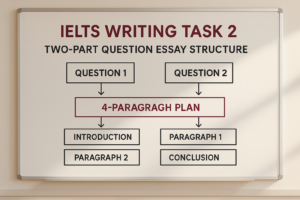
An IELTS Task 1 map answer must summarise visual information. For maps, this usually means describing development, redevelopment, removal, expansion, relocation, or new facilities. Your answer should have an introduction, an overview, and two body paragraphs.
The overview is especially important. It should tell the reader the main story of the maps before you give details. For example, a village may become more residential, a park may become more commercial, or a campus may add new facilities while keeping its main roads unchanged.
- Write at least 150 words.
- Paraphrase the task in the introduction.
- Give a clear overview of the main changes.
- Group details by area, time, or type of change.
- Use accurate location language.
- Avoid opinions, reasons, and speculation.
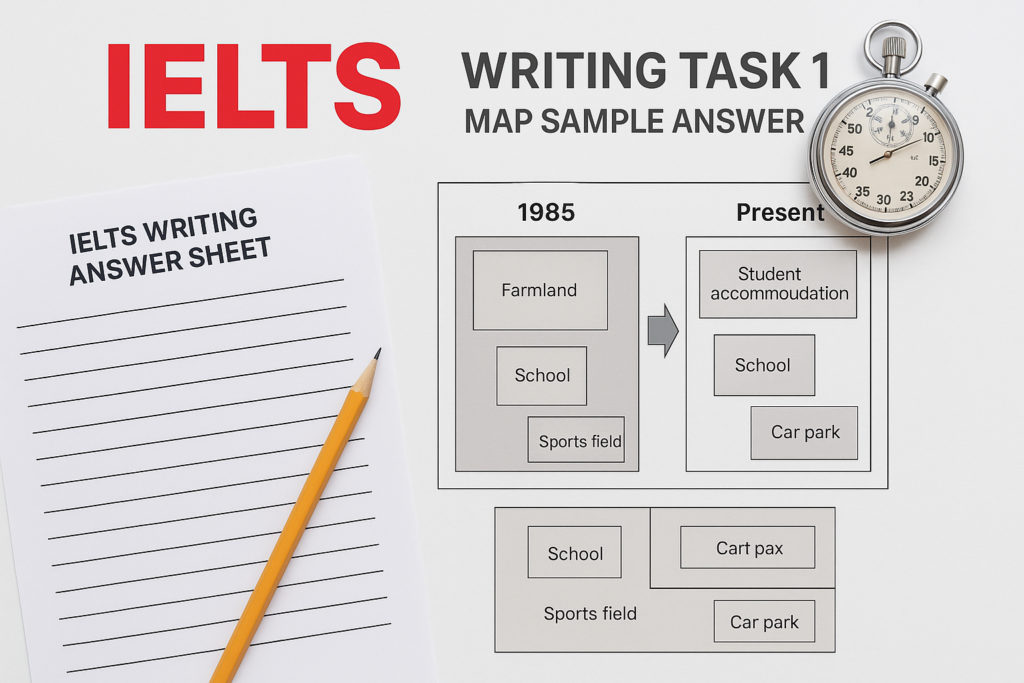
Sample Map Task
Imagine this task: The maps show the layout of a small university campus in 2010 and its planned layout for 2026. In 2010, the campus had a library in the north-west, a car park in the north-east, a main teaching block in the centre, a sports field in the south-west, and student accommodation in the south-east. A path crossed the campus from west to east.
In the planned 2026 layout, the library remains in the north-west but is extended. The car park is replaced by a new science building. The central teaching block is enlarged. The sports field is moved further south, and its old site becomes a student centre. More student accommodation is added in the south-east. The east-west path remains, but a new north-south path is added.
This task gives enough information for a full answer without forcing you to mention every tiny feature. The strongest response will focus on campus development, new academic facilities, expanded student services, and changes to movement around the site.
IELTS Writing Task 1 Map Sample Answer
The maps compare the layout of a small university campus in 2010 with its planned design for 2026.
Overall, the campus is expected to become more developed, with larger academic buildings and extra student facilities. The main east-west path will remain in place, but the site will be reorganised through new buildings, expanded accommodation, and an additional north-south route.
In the northern part of the campus, the library in the north-west will be retained and extended. By contrast, the car park in the north-east will be removed and replaced by a new science building. The central teaching block will also be enlarged, making the middle of the campus more focused on academic use than before.
In the southern half, the sports field will be moved further south, and its former location in the south-west will be used for a new student centre. Student accommodation in the south-east will be expanded, giving the campus more residential space. The original west-to-east path will still cross the site, while a new north-south path will connect the library area with the southern facilities.
Why This Sample Answer Works
The sample answer works because it gives the reader the main changes before the details. The overview does not simply say that the campus changed. It explains how it changed: more development, larger academic buildings, extra student facilities, and improved access.
The body paragraphs are grouped by location. The first body paragraph covers the north and centre. The second covers the south and the paths. This is much easier to follow than jumping randomly from the library to the sports field, then back to the car park.
If you want to compare this structure with other Task 1 response types, the IELTS Writing Task 1 sample answers page is a useful next step.
How To Write The Overview For A Map
A map overview should report the biggest physical changes. Do not list every detail. Ask yourself what a reader would notice first if they looked at both maps for ten seconds. That is usually the overview.
For a development map, look for new buildings, removed features, expanded areas, changes in transport routes, and changes in land use. For a before-and-after town map, the overview may say that the area became more commercial, more residential, or more accessible.
A weak overview says, “Overall, there were many changes.” That is too general. A stronger overview says, “Overall, the area changed from a mainly open site into a more developed campus with additional academic and residential facilities.” That sentence gives a clear direction.
How To Organise Map Details
Organisation matters because maps can easily become messy in writing. You need a simple route through the information. The best method depends on the map, but three options work well: organise by location, organise by type of change, or organise from past to future.
Location is often the safest choice. You can describe the north first, then the centre, then the south. For town maps, you might describe the west side first and the east side second. This helps the reader picture the changes without needing to keep checking the original map.
If you want timed practice with map tasks and other Writing sections, access unlimited IELTS mock tests and review whether your body paragraphs are grouped clearly under exam pressure.
Useful Vocabulary For IELTS Map Descriptions
Good map vocabulary is practical. You need words for location, movement, replacement, and development. Do not force rare words into the answer. Clear phrases such as “to the north of”, “was replaced by”, “was extended”, and “remained unchanged” are usually more useful.
- Location: in the north-west, to the south of, next to, opposite, along the main road.
- Change: was replaced by, was converted into, was demolished, was extended, was relocated.
- Development: a new building was constructed, facilities were added, the site was redeveloped.
- No change: remained in the same place, was retained, was left unchanged.
- Movement: a new path was added, the road was widened, access was improved.
Be careful with tense. If the maps show past and present, use past tense and present tense. If they show now and a future plan, use present tense and future forms such as “will be built” or “is expected to be added”.
Common Mistakes In IELTS Writing Task 1 Map Answers
The first mistake is writing too much detail. A map may contain many features, but you do not need to mention every small item. Select the changes that support your overview and group them logically.
The second mistake is using weak location language. If the reader cannot tell where something is, the answer becomes unclear. Practise phrases such as “in the centre of the site”, “on the eastern side”, and “between the library and the accommodation block”.
The third mistake is explaining reasons. Do not write that a car park was removed because students needed more science facilities. The map does not show the reason. Task 1 asks you to describe the information, not invent background details.
If you keep losing marks through structure or detail selection, compare IELTS preparation plans and choose support that includes feedback on your actual Writing Task 1 reports.
A Simple Planning Method For Map Tasks
Spend two or three minutes planning before you write. First, identify the time relationship: past and present, present and future, or two future designs. Second, circle the biggest changes. Third, decide how to group the body paragraphs.
Your plan can be short. For the sample task above, the plan might be: overview: campus more developed, academic and student facilities expanded, paths improved. Body 1: north and centre. Body 2: south and access. That is enough to guide the answer.
Planning is not wasted time. It prevents a common Band 6 problem: an answer that describes the map in the order your eyes happened to notice the features. A planned answer reads like a report.
Band 7 Habits For Map Sample Answers
A Band 7-style map answer is clear, selective, and well controlled. It does not need advanced language in every sentence. It needs a strong overview, accurate location language, and enough detail to support the main changes.
Use passive forms accurately because maps often focus on changes made to places. For example, “the car park will be replaced by a science building” is more natural than “people will replace the car park”. Use active language only when it fits the task.
Also vary your sentence openings. If every sentence starts with “There was” or “There will be”, the answer sounds repetitive. Mix location phrases, passive verbs, and comparison language so the report flows naturally.
Final Checklist Before You Write Your Own Map Answer
Before writing, decide the main story of the maps. Then choose a structure that helps the reader follow that story. During writing, keep checking that each detail supports the overview. If a feature is minor and does not affect the main picture, it may not deserve a sentence.
After writing, check three things: overview, organisation, and location language. If those are strong, your map answer is already in better shape than many rushed Task 1 responses. Maps reward calm selection. You are not drawing the map again in words; you are reporting the most important changes clearly.
Ready to find out your IELTS band score?
Take the IELTS Express Pre-Test for just $4.99 and get your personalised band prediction with a 14-day improvement plan.
FAQ: IELTS Writing Task 1 Map Sample Answer
How many paragraphs should an IELTS map answer have?
Most strong map answers have four paragraphs: an introduction, an overview, and two body paragraphs. This structure keeps the report clear and easy to follow.
Do I need numbers in an IELTS Writing Task 1 map answer?
Usually no. Map tasks often have no figures. Your score comes from selecting and describing the main physical changes accurately.
What tense should I use for IELTS map descriptions?
Use the tense that matches the maps. For past and present maps, use past and present forms. For planned future changes, use future forms such as “will be built”.
Can I give reasons for changes in a map task?
No. Do not invent reasons unless the task gives them. Describe what changed, where it changed, and how the layout is different.
What is the easiest way to improve map answers?
Improve the overview first. A clear overview that reports the main physical changes can lift the whole answer because it shows strong task control.