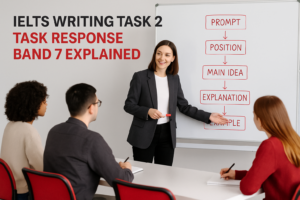
IELTS Writing Task 2 Task Response Band 7 explained in plain English comes down to three things: answer every part of the question, maintain a clear position, and develop your main ideas with relevant support. You do not need a revolutionary argument or specialist knowledge. You need an essay that responds directly to the task and gives the examiner enough explanation to follow your reasoning. If you are unsure where your writing currently sits, the IELTS Express Pre-Test can provide a band prediction and a focused 14-day improvement plan.
Task Response is one of four equally weighted Writing Task 2 criteria. A polished vocabulary range cannot compensate for an essay that answers only half the prompt. The good news is that this criterion is highly trainable: most lost marks come from identifiable planning and development problems, not a lack of clever ideas.
What Band 7 Task Response Actually Requires
At Band 7, an essay addresses all parts of the task, presents a clear position throughout, and supports its main ideas. There may still be some over-generalisation, or a supporting point may lack precision. That is an important distinction. Band 7 does not mean flawless; it means the response is complete, relevant and sufficiently developed.
Think of the examiner asking three questions. First, did the writer do everything the prompt requested? Second, can I identify the writer’s answer from the introduction through to the conclusion? Third, are the body-paragraph claims explained rather than merely listed? A reliable essay makes all three answers yes.
Task Response is different from Coherence and Cohesion. Paragraphing and linking language affect coherence. Task Response concerns what your essay says and how fully it answers the task. A neatly organised paragraph can still be underdeveloped if it gives a claim and an example but never explains why that example proves the claim.
Start By Identifying Every Part Of The Prompt
Before choosing ideas, separate the topic from the instructions. Consider this prompt: “Some people believe governments should make public transport free to reduce traffic congestion. To what extent do you agree or disagree?” The topic is free public transport and congestion. The instruction asks for the extent of your agreement. A response that only discusses the advantages and disadvantages of free transport has changed the task.
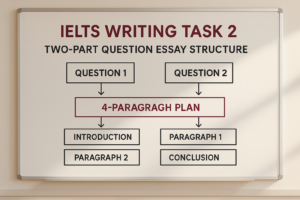
Double questions require even more care. If the task asks why a trend is occurring and whether it is positive or negative, both questions need a direct answer. You may give one body paragraph to each question, or use another balanced structure, but neither part can be treated as a brief afterthought. This guide to IELTS Writing Task 2 two-part question essay structure shows how to divide the response without losing a consistent overall position.
Underline command words such as discuss both views, give your own opinion, causes, solutions, and advantages outweigh disadvantages. Then rewrite the instruction as a short checklist. For example: “View A, View B, my opinion.” This takes seconds and prevents a costly omission.
State A Clear Position And Keep It Consistent
Your position is your direct answer to the question. It should be clear in the introduction and remain stable throughout the essay. For an agree-or-disagree task, “I largely agree because…” is more useful than “This is a controversial issue with arguments on both sides.” The first sentence commits to an answer; the second only announces the topic.
A nuanced position is acceptable. You can partly agree, argue that benefits outweigh drawbacks, or support a policy under particular conditions. However, nuance must not become indecision. If your introduction says that free public transport would substantially reduce congestion, your conclusion should not claim that it would have almost no effect.
Body paragraphs must also match the position. A common Band 6 pattern is an introduction that clearly agrees followed by one paragraph supporting agreement and another giving an equally strong opposing case with no explanation of how the two fit together. The reader is left to calculate the writer’s real view. At Band 7, concession is controlled: “Although cost is a genuine concern, the long-term reduction in road maintenance and pollution can justify targeted subsidies.”
Develop One Main Idea Instead Of Listing Several
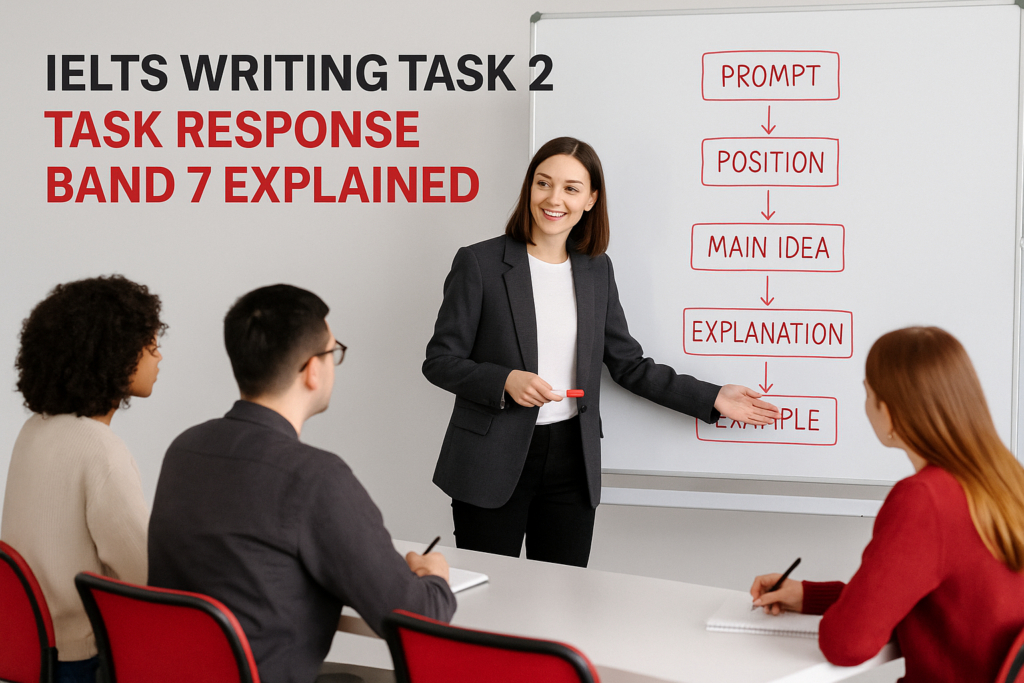
Development means taking a relevant claim far enough. A practical paragraph sequence is:
- Main idea: make one claim that answers the question.
- Explanation: show how or why the claim is true.
- Consequence: connect it to the issue in the prompt.
- Example: give a specific, plausible illustration.
- Link: make the relationship to your position explicit where needed.
Suppose the claim is that free public transport may reduce congestion. A thin paragraph says it is cheaper, so more people will use it, and gives a city as an example. A developed paragraph explains that removing fares lowers the daily cost of switching from a private car, especially for regular commuters; if services are frequent and reliable, enough commuters may change modes to reduce peak-hour vehicle numbers. A realistic city programme can then illustrate the mechanism. The explanation, not the city name, earns the development.
Do not squeeze three unrelated reasons into one paragraph. Each reason then receives one sentence, producing breadth without depth. Two well-developed body ideas are usually safer than four ideas mentioned quickly. To test development, ask “why?”, “how?”, and “so what?” after each main claim.
Timed practice helps you see whether this development survives exam pressure. A bank of unlimited IELTS mock tests lets you practise planning, writing and checking complete responses instead of polishing isolated paragraphs indefinitely.
Use Relevant Support Without Inventing Research
IELTS does not expect citations, statistics or expert quotations. Your support can come from a plausible example, a short comparison, a cause-and-effect chain, or a clearly described consequence. You are assessed on language and argument development, not factual scholarship.
Avoid suspiciously precise claims such as “free buses reduce traffic by 37.4 per cent” unless the prompt provides that figure. A safer example is conditional and concrete: “For instance, a commuter who currently drives because two daily fares cost more than parking may switch to a frequent free service.” This example demonstrates behaviour without pretending to report a study.
Relevance matters as much as detail. If the question concerns government action, a long discussion of individual motivation may drift away from the task unless you connect it back to policy. After drafting each paragraph, compare its topic sentence with the exact wording of the prompt. If the relationship takes several sentences to explain, the idea may be too distant.
Recognise The Difference Between Band 6 And Band 7
The move from Band 6 to Band 7 is often a move from “mostly answered” to “fully and clearly answered”. A Band 6 response may address the main question but neglect one instruction, state a position that becomes unclear, or present relevant ideas with uneven support. A Band 7 response is more complete and controlled, even if one example is slightly general.
Compare these mini-responses to the claim that employers should allow remote work:
Underdeveloped: “Remote work is beneficial because employees are happier. For example, many people like working at home. Therefore, companies should allow it.”
Better developed: “Allowing remote work can improve retention because employees gain control over commuting time and family responsibilities. A parent who can work from home two days a week may be less likely to leave an otherwise suitable job solely because of travel or childcare pressure. Employers can therefore retain experienced staff while still requiring office attendance for collaborative tasks.”
The second version does not use more advanced knowledge. It explains the causal link, gives a specific example and returns to the policy question. That is the kind of depth associated with a stronger Task Response.
Match Your Structure To The Question Type
There is no single four-paragraph template that fits every task. Structure should make every required answer easy to find. For a discussion essay, one body paragraph can explain each view, while your opinion appears clearly in the introduction, throughout the evaluation and in the conclusion. For an advantages-outweigh-disadvantages task, paragraphs should not merely list both sides; they must show which side is stronger and why.
For problem-solution questions, distinguish causes or problems from actions that could realistically address them. A vague recommendation to “raise awareness” is rarely enough unless you explain who would do it, what would change, and why that action targets the stated cause. The recent guide to IELTS Writing Task 2 problem-solution essay structure gives a practical model for keeping diagnosis and remedy connected.
Spend three to five minutes planning. Write the position in one sentence, assign one central idea to each body paragraph, and note a mechanism or example under each. Planning is not lost writing time. It protects you from discovering halfway through that both paragraphs make the same point or that one part of the task has disappeared.
A Band 7 Planning Method You Can Repeat
Use this five-step routine during practice until it feels automatic:
- Box the instruction words. Identify every required judgement, view, cause, solution or comparison.
- Write your answer in one sentence. This becomes the core of your introduction and conclusion.
- Select two main ideas. Choose ideas you can explain, not ideas that merely sound sophisticated.
- Add a because chain. For each idea, note why it happens, what follows, and how that answers the task.
- Check coverage. Match each part of the prompt to a planned paragraph or sentence.
For example, if asked whether governments should restrict private cars in city centres, your plan might state: “I largely agree, provided restrictions are introduced alongside reliable public transport.” Body one can explain reduced congestion and safer streets. Body two can explain why transport alternatives are necessary for workers and people with limited mobility. Both paragraphs support the same qualified position.
During review, label every body sentence as claim, explanation, example or link. If a paragraph contains three claims but no explanation, rewrite it. If an example occupies half the paragraph but the lesson is unclear, shorten it and explain its significance.
Common Task Response Mistakes To Remove
- Answering the general topic: discussing education broadly when the prompt asks whether university should be free.
- Ignoring a second question: giving five paragraphs on causes and one sentence on whether the trend is positive.
- Hiding the opinion: waiting until the conclusion to reveal your answer.
- Changing position: using memorised sentences that contradict the introduction.
- Listing ideas: adding “another reason” repeatedly without developing any reason.
- Using an example as the argument: naming a country or company without explaining the mechanism.
- Writing an unrealistic solution: proposing a total ban without considering implementation or the cause identified.
- Overgeneralising: claiming that all people, every government or no employer behaves in one way.
One useful editing habit is to circle absolute words such as all, always, never and completely. Replace them when the evidence in your paragraph cannot support such a broad claim. Qualified language often makes the position more accurate, not weaker.
How To Check Task Response In The Final Minutes
Reserve two or three minutes for a criterion-based check. Do not spend the entire time hunting for rare vocabulary. Read the prompt again and point to where each part is answered. Underline your position in the introduction and conclusion. Then scan each body paragraph for a main claim and at least one sentence explaining it.
Ask these questions:
- Have I answered the precise question rather than the broad subject?
- Is every instruction covered with adequate space?
- Can a reader state my position in one sentence?
- Does each body paragraph support that position?
- Have I explained how each example proves the main idea?
- Are any claims too broad for the support I provide?
If one answer is no, make the smallest useful repair. Add a direct position clause, explain a causal link, or remove an irrelevant sentence. Rewriting an entire paragraph in the last minute creates more risk than clarifying the missing connection.
For broader preparation resources and practical guidance across all four skills, visit Career Wise English. The central Task Response lesson is straightforward: give the examiner a complete answer, make your position unmistakable, and develop a small number of relevant ideas properly.
Ready to find out your IELTS band score?
Take the IELTS Express Pre-Test for just $4.99 and get your personalised band prediction with a 14-day improvement plan.
FAQ: IELTS Writing Task 2 Task Response Band 7
Can I get Band 7 if one idea is slightly underdeveloped?
Yes. Band 7 does not require every supporting detail to be perfect. A response may contain some generalisation or a point that could be more precise. However, the essay should still address all parts of the task, maintain a clear position and support its main ideas overall.
How many ideas do I need for Band 7 Task Response?
There is no fixed number. Two central body ideas are often enough when each is clearly explained and supported. Adding more ideas can lower the quality if they become a list of undeveloped claims. Choose ideas you can take through a complete cause, consequence or example chain.
Do examples need to be true or include statistics?
Examples should be plausible and relevant, but they do not need citations or precise statistics. IELTS is not testing your research knowledge. A realistic hypothetical example can support an argument effectively when you explain exactly how it demonstrates the point.
Should my opinion appear in every paragraph?
Your position should be clear throughout, but you do not need to repeat “I believe” in every paragraph. Topic sentences, evaluation and explanation should consistently support or qualify the position stated in your introduction. Restate the answer naturally in the conclusion.
Can a memorised template reduce my Task Response score?
It can if the template makes you answer a different question, adds irrelevant material or hides your position behind generic statements. A flexible structure is useful, but every sentence should serve the specific prompt. Adapt paragraph purposes and wording to the actual instructions.