
IELTS Writing Task 2 coherence and cohesion Band 7 is about making your argument easy to follow, not filling every sentence with linking words. Readers should understand what each paragraph contributes, how its sentences connect and why the next point belongs there. This guide shows how to build that control through planning, paragraph development and focused revision.
If you already have enough ideas but your essays feel like separate statements, start with the relationships between those ideas. A short, well-developed argument is usually easier to organise than a long list of claims. You can explore wider preparation options at Career Wise English, then use the exercises below to work specifically on essay flow.
1. Understand what coherence and cohesion assess
Coherence concerns the organisation of meaning: can a reader follow the argument from the introduction to the conclusion? Cohesion concerns the language that connects that meaning, including pronouns, repeated key terms, substitution and connectors. They work together, but they are not interchangeable. Adding “therefore” cannot repair a conclusion that does not follow from the previous sentence.
In the official Band 7 description, the emphasis is on a clear route through the response, flexible connections and effective paragraphs, despite occasional imperfections. Consult the official IELTS Writing band descriptors for the assessment wording. The practical advice and examples below are teaching exercises, not examiner-awarded sample scores or guarantees of a particular result.
Keep this criterion separate from whether you have answered the question. A beautifully connected essay can still overlook part of the task. Our guide to Task Response at Band 7 explains that companion skill. Check your answer to the question first; then check how you lead the reader through it.
2. Plan an argument rather than a collection of topics
Consider this practice question: “Some people think cities should spend more on public transport than on new roads. To what extent do you agree?” Before writing, decide your position and give each body paragraph a distinct purpose. For example, one paragraph could explain how reliable services reduce dependence on cars; another could acknowledge necessary road maintenance while explaining why expansion should not be the priority.
Now compare a weaker plan: paragraph one discusses buses, traffic, pollution and ticket prices; paragraph two discusses trains, jobs, cycling and roads. Both contain relevant vocabulary, but neither has a clear job. The problem begins before any linking word is chosen. Reorganise ideas around a claim and the reasons supporting it, rather than around every association you have with transport.
A useful planning drill is to write one sentence for each paragraph before drafting. Read only those sentences in order. They should form a compact argument with a recognisable direction. If the second sentence simply repeats the first, choose a different contribution. If it introduces an unrelated topic, explain its relevance or remove it. This small check can save much more editing later.
3. Develop one central idea in each body paragraph
A paragraph needs more than a topic sentence followed by an example. Explain the mechanism connecting your claim to the question. If you argue that reliable buses can reduce car use, show why reliability matters: commuters need confidence that they will arrive on time. Then illustrate the situation and explain what the illustration demonstrates.
Here is an original practice paragraph:
More reliable public transport can make commuting without a car a realistic choice. Workers who cannot predict when a bus will arrive may drive even when a route serves their neighbourhood. A frequent service with dependable arrival information reduces that uncertainty. For example, a commuter travelling to an early shift could choose the bus if a missed service would not mean a long delay. Investment should therefore improve reliability as well as extend the network.
Notice the movement: claim, explanation, practical illustration and implication. Each sentence adds something. The last sentence returns to the spending decision instead of starting a new discussion about tourism or fuel taxes. This is a useful development pattern, not a compulsory formula. Some arguments need a comparison, qualification or second explanation instead of an example.
Use a deletion test when revising. Ask what would disappear if you removed a sentence. If the answer is “nothing, because the previous sentence says the same thing,” combine or cut it. If removing it makes the next sentence confusing, you have found an important connection that should remain clear.
4. Choose linking language for meaning, not decoration
Before inserting a connector, name the relationship you intend. Are you adding a supporting point, contrasting two situations, explaining a cause or showing a consequence? “However” signals contrast; it does not mean “here is my next sentence.” “For example” promises an illustration, not another general claim. A correct connector makes an existing relationship visible.
Compare these sentences: “Buses are cheaper than cars. However, many students use buses.” The second statement does not clearly oppose the first. A more logical version is: “Buses are often cheaper than driving, so they can be attractive to students with limited budgets.” Alternatively, create a real contrast: “Buses may be cheaper than driving, but unreliable services can discourage commuters.”
Connections do not always need a separate linking phrase. “Reliable services” can become “this reliability” in the following sentence. A clearly established group can become “these commuters.” Repeating an important term is also reasonable when a synonym would change the meaning. Do not replace “public transport” with an inaccurate expression merely to avoid repetition.
Check references carefully. In “The council increased fares after operators reported losses, and this angered residents,” does “this” mean the fare increase or the report? “The fare increase angered residents” is clearer. Variety is useful only when the reader can still identify the people, objects and decisions being discussed.
5. Repair a disconnected paragraph step by step
Start with this deliberately weak example:
Firstly, public transport is important. Moreover, cars cause traffic. However, buses need money. For example, the government should invest. In addition, people go to work.
The issue is not a shortage of connectors. The sentences do not explain a single argument, and the supposed example is only a recommendation. First choose the claim: better bus services can reduce commuting by car. Next identify the missing explanation: frequent departures make buses a usable alternative. Finally, add a specific situation that illustrates that explanation.
A revised version could read:
Improving bus frequency can reduce the need to commute by car. When services run only once an hour, workers may have little practical choice but to drive. More frequent departures give them an alternative that fits different shift times. A hospital employee finishing late, for instance, could travel home without waiting an hour for the next service. Funding should therefore address gaps in the timetable, not simply purchase additional vehicles.
This revision is stronger because its reasoning is more complete, not because it sounds more elaborate. Try the same exercise with an old essay: remove the connectors temporarily and read the underlying claims. If the argument falls apart, repair the sequence and explanation first. Add back only the language that helps communicate the intended relationship.
6. Practise and check your essay under time pressure
Use separate practice sessions for planning, paragraph writing and complete essays. In a planning session, outline several questions without writing introductions. In a paragraph session, develop one reason fully and check every reference. In a timed essay, apply those skills together. This makes it easier to identify whether the difficulty is choosing ideas, explaining them or managing time.
Choose a question from the IELTS Writing Task 2 practice test resources and write a brief paragraph plan before starting. Afterwards, label each sentence by its function: claim, explanation, illustration, qualification or conclusion. Several consecutive claims with no explanation are a useful warning sign. A sentence that cannot be labelled may not belong in that paragraph.
For broader practice, explore IELTS mock test options and compare the available course packages. Check what each option includes before choosing. Repeated practice is most useful when you review the organisation of each response rather than simply complete another test.
During your final check, read the introduction and conclusion together to confirm that your position stays consistent. Then read the opening sentence of each body paragraph. Finally, inspect pronouns and connectors in any section that feels awkward. Prioritise changes that clarify meaning; replacing a familiar connector with a more formal one rarely fixes a structural problem.
Frequently asked questions
How many linking words do I need for Band 7?
There is no useful target number to build an essay around. Choose connectors when they express a necessary relationship, and use reference, consistent terminology and sentence order as well. A paragraph with a connector at the start of every sentence can still be difficult to follow if the reasoning is incomplete.
Do I need exactly four paragraphs?
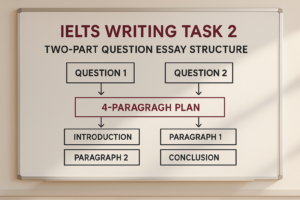
Four paragraphs can be a practical structure for many responses, but the paragraph count is not a substitute for organisation. Choose a structure that answers the particular question and gives each body paragraph a clear central purpose. Avoid splitting one explanation into several tiny paragraphs or packing unrelated arguments into one long block.
Can I repeat words without losing cohesion?
Yes. Repeating a key term can keep your meaning precise, especially when the topic has no natural equivalent. Vary wording where it remains accurate, and use clear references when appropriate. Forced synonyms can create confusion, while an unexplained pronoun can make the reader work harder than a repeated noun would.
Will better coherence guarantee an overall Writing Band 7?
No. Organisation is only one part of writing performance. You also need to address the task, select suitable vocabulary and control grammar. Use this guide to diagnose flow and paragraph development, then review the other assessment areas separately. A teacher can help identify weaknesses that are hard to notice in your own writing.