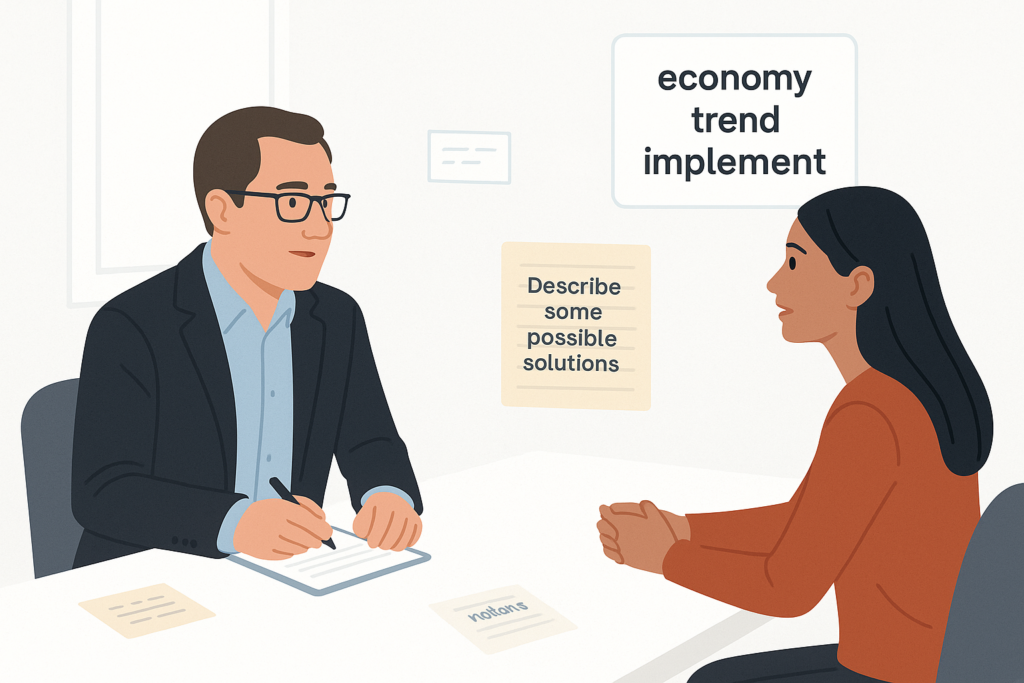
If you are searching for an IELTS Speaking Part 3 vocabulary list, you probably already know the real problem is not only vocabulary. It is how to discuss bigger ideas without sounding blank, repetitive, or strangely memorised. Part 3 often moves into topics like education, technology, work, culture, and social change. The questions feel less personal than Part 1, so many candidates suddenly lose range even when their basic English is fine. Before you keep guessing where your speaking score is slipping, take the IELTS Express Pre-Test to get a quick band prediction and see how your discussion answers hold up.
What an IELTS Speaking Part 3 vocabulary list should actually do
A useful vocabulary list should help you explain ideas more clearly. It should not push you into using words that feel unnatural in your mouth. In Part 3, examiners are listening for flexible, precise language that supports your ideas. They are not waiting for rare academic words or a perfect speech.
That matters because many candidates study vocabulary in the wrong way. They memorise long synonym lists, but when the examiner asks a real question, they cannot use those words naturally in a full answer. A better IELTS Speaking Part 3 vocabulary list gives you practical words, common collocations, and simple ways to extend your point without panic.
If you want a broader picture of how this section fits into the full interview, the IELTS Speaking Test complete guide is a useful companion.
Why Part 3 vocabulary feels harder than Part 1 vocabulary
Part 1 usually asks about familiar daily topics, so everyday language is often enough. Part 3 is different. The examiner may ask why society is changing, whether technology is improving communication, or how education should adapt in the future. Those questions require language for comparison, cause and effect, opinion, and possibility.
This is why candidates often feel that their mind goes empty. The real issue is usually not a lack of English. It is a lack of ready-made language patterns for abstract discussion. Once you build those patterns, Part 3 becomes much more manageable. You stop trying to invent everything from zero.
Core opinion and discussion vocabulary you will use often
The first group of words in an IELTS Speaking Part 3 vocabulary list should help you give a clear opinion and then develop it. These are not advanced for the sake of sounding advanced. They are useful because they appear in many topics.
- I tend to think: a softer way to give an opinion
- in many cases: useful when you want to avoid over-generalising
- to some extent: helpful for balanced answers
- from my point of view: natural personal framing
- a key factor is: good for explanation
- this often leads to: useful for cause and effect
- the main reason is that: simple but strong support language
- on the other hand: helpful for contrast
- that said: a natural way to qualify a statement
- in the long term: useful for future effects or social change
For example, if the examiner asks whether young people rely too much on social media, you could say, “I think in many cases they do, mainly because these platforms shape how they communicate and spend their free time. That said, the effect depends on how they use them.” The vocabulary is not fancy, but it makes the answer sound organised.
Vocabulary for comparing past and present
Many Part 3 questions ask you to compare different time periods. You may need to talk about how education, work, transport, parenting, or communication has changed. Without the right language, those answers become repetitive very quickly.
Useful comparison language includes:
- compared with the past
- these days
- in earlier generations
- far more common
- less dependent on
- more aware of
- the shift towards
- has become increasingly common
- used to be seen as
- is now treated as
Suppose the examiner asks whether people spend their leisure time differently now from the past. A clear answer could be, “Yes, definitely. Compared with the past, people are far more dependent on digital entertainment, and the shift towards screen-based leisure has become increasingly common.” That sounds more developed than repeating “now” and “before” several times.
If you want to practise discussion answers around real timing and pressure, access unlimited IELTS mock tests and record several Part 3 questions in one sitting.
Vocabulary for cause, effect, and explanation
Part 3 questions often become stronger when you explain why something happens. That means cause-and-effect language is one of the most valuable parts of any IELTS Speaking Part 3 vocabulary list. When candidates cannot explain reasons clearly, their answers stay short and thin.
Useful cause-and-effect language includes:
- this is mainly because
- one reason for this is
- this can result in
- this tends to create
- as a result
- this can have a positive effect on
- this can put pressure on
- it often encourages people to
- one consequence is that
- this may reduce the chance of
Imagine the examiner asks why some people prefer online learning. You could answer, “One reason for this is flexibility, because online study often allows people to learn at their own pace. As a result, it can be easier for workers or parents to continue their education.” That answer is still simple, but the language gives it shape.
Topic vocabulary for common Part 3 themes
You do not need a separate dictionary for every possible topic, but it helps to prepare useful words for the themes that appear most often. The goal is not to memorise huge lists. It is to know enough language to explain ideas accurately.
Education
- practical skills
- critical thinking
- academic pressure
- learning environment
- access to information
Example: “Schools should focus not only on academic pressure but also on practical skills and critical thinking.”
Technology
- digital tools
- screen time
- online platforms
- data privacy
- face-to-face interaction
Example: “Digital tools are useful, but too much screen time can reduce face-to-face interaction.”
Work and career
- job stability
- career progression
- flexible working arrangements
- work-life balance
- financial pressure
Example: “Many people change jobs because they want faster career progression or better work-life balance.”
Society and behaviour
- social expectations
- public awareness
- community support
- consumer habits
- long-term impact
Example: “Public awareness has improved, but consumer habits do not always change as quickly.”
How to use this vocabulary without sounding memorised
This is where many candidates go wrong. They learn good words, then try to force all of them into one answer. That usually sounds unnatural. A better method is to choose one clear opinion phrase, one reason phrase, and one support phrase. That is often enough for a strong response.
For example, if the examiner asks whether cities are better places for young people than small towns, you might say, “From my point of view, cities are often more attractive for young people because they usually offer more education and career options. On the other hand, smaller towns may provide a calmer lifestyle and stronger community support.” That answer sounds balanced because the vocabulary is working with the idea, not competing with it.
Natural delivery also depends on collocations, which are common word pairings. For instance, it is more natural to say academic pressure than study pressure, or career progression than career improvement. Learning these pairings is often more useful than collecting random synonyms.
Common vocabulary mistakes in Part 3
The first mistake is using words that are too formal for natural speech. Some candidates try to sound academic because Part 3 feels serious. The result is language that seems borrowed rather than owned. In the speaking test, natural control usually sounds stronger than forced sophistication.
The second mistake is repeating one flexible word too often, such as important, beneficial, or convenient. These words are not wrong, but if they appear in every answer, your range sounds limited. Replace them when possible with more precise options such as effective, practical, time-saving, or financially useful.
The third mistake is memorising full answers from a vocabulary list. That can make your delivery stiff, especially when the real question changes slightly. If you want a stronger understanding of how discussion responses are scored, the IELTS Speaking Part 3 band score guide helps explain what examiners are really hearing.
A simple study routine for building your Part 3 vocabulary
You do not need to study hundreds of words each week. A small, repeatable routine works better. Choose one topic area, such as education or technology, and learn five to eight useful expressions. Then answer three or four spoken questions using those expressions naturally.
A practical routine could look like this:
- Day 1: choose one Part 3 topic and collect eight useful words or phrases
- Day 2: write one short answer using those phrases
- Day 3: answer three spoken questions aloud without reading
- Day 4: listen back and replace repetitive or awkward wording
- Day 5: keep the structure but switch to a new topic
This routine works because it links vocabulary to speaking behaviour. You are not only reading the words. You are training yourself to reach for them under pressure. If you want more structured support while you build that habit, see our IELTS preparation plans and choose the level of guidance that fits your timeline.
Ready to find out your IELTS band score?
Take the IELTS Express Pre-Test for just $4.99 and get your personalised band prediction with a 14-day improvement plan.
Frequently Asked Questions
How much vocabulary do I need for IELTS Speaking Part 3?
You do not need a huge vocabulary list. You need enough useful language to give opinions, explain reasons, compare ideas, and discuss common topics such as education, technology, work, and society.
Should I memorise an IELTS Speaking Part 3 vocabulary list?
No, not word for word. It is much better to learn practical phrases and then use them in your own spoken answers. That helps you sound flexible rather than rehearsed.
Is advanced vocabulary necessary for a high Part 3 score?
Not always. Precise and natural vocabulary is usually more valuable than difficult words used awkwardly. Examiners reward control, clarity, and relevance.
What topics appear most often in Part 3?
Common themes include education, technology, work, transport, public behaviour, family life, culture, and social change. Preparing vocabulary for these themes gives you a strong base.
What is the fastest way to improve with an IELTS Speaking Part 3 vocabulary list?
The fastest progress usually comes from speaking aloud. Learn a small group of expressions, use them in real answers, record yourself, and notice where your language becomes repetitive or vague.
Your next step with Part 3 vocabulary
An IELTS Speaking Part 3 vocabulary list is only useful if it helps you think more clearly while you are speaking. Build a small bank of opinion phrases, comparison language, cause-and-effect expressions, and topic words you can actually use. Then practise turning them into short, natural answers. That is what makes your speaking sound stronger on test day.
If you keep the vocabulary practical and train with real spoken questions, Part 3 starts to feel less unpredictable. And that usually leads to better fluency, better development, and a more stable speaking score overall.