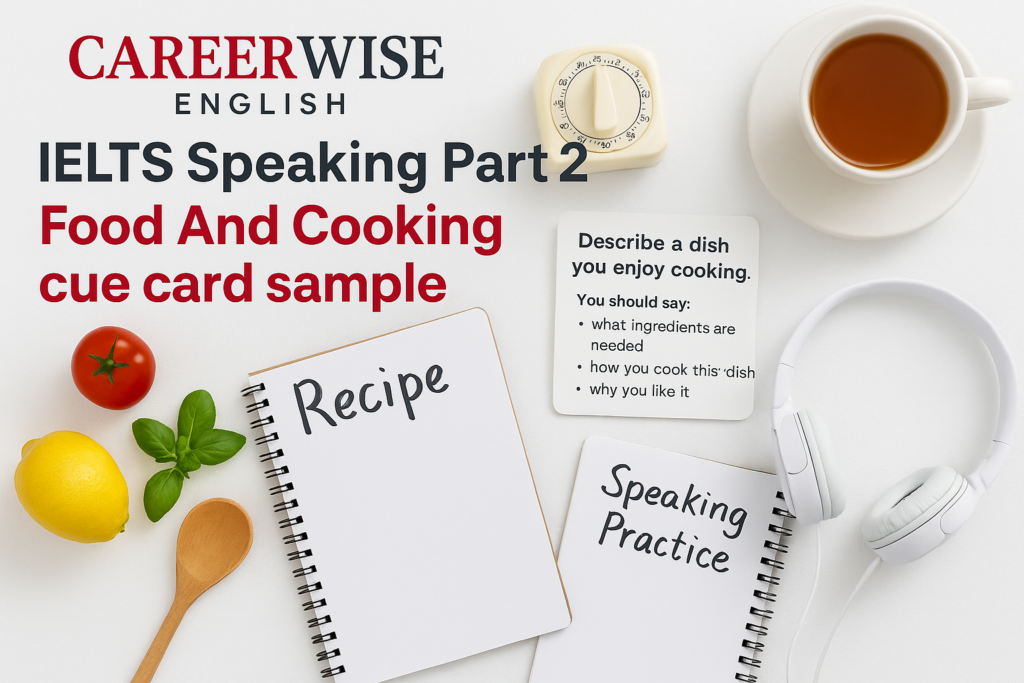
If you are searching for an IELTS Speaking Part 2 Food And Cooking cue card sample, you probably want more than a short script to memorise. You want to know how to speak about food naturally, how much detail to include, and how to keep your answer organised for the full two minutes. This topic looks easy at first, but many candidates become repetitive because they talk only about taste, say everything was “delicious”, and then run out of ideas. Before you guess whether your speaking is already strong enough, take the IELTS Express Pre-Test to get a quick band prediction and see where your long-turn answers start to weaken.
What this cue card is really testing
A food and cooking topic is not testing whether you are a chef. It is testing whether you can tell a clear story, add relevant detail, and speak with enough range to sound comfortable. In IELTS Speaking Part 2, the examiner wants to hear fluency, organisation, vocabulary, grammar control, and pronunciation working together.
That means a strong answer does not need a dramatic story. It needs a clear focus. You might describe a meal you cooked for your family, a dish you learned from a friend, or a food experience that changed how you think about cooking. The topic works well when you choose one specific event and build around it.
How to choose the best angle for a food and cooking cue card
The biggest mistake with this cue card is choosing an answer that is too broad. If you say, “I like cooking pasta” and then try to speak about pasta in general, the answer can become thin very quickly. A better approach is to pick one meal, one moment, or one learning experience.
For example, you could talk about:
- a dish you learned from your mother or grandmother
- a meal you cooked for a birthday or celebration
- the first time you followed an online recipe successfully
- a traditional food from your home country that takes time to prepare
- a simple dish you make often because it is cheap, healthy, or comforting
Specific choices help because they give you natural detail. You can mention where you were, why the meal mattered, what ingredients you used, and how people reacted. If you want a broader overview of how the long turn fits into the full speaking interview, the IELTS Speaking Test complete guide is a useful companion.
A band-friendly answer structure you can actually use
The safest structure for this topic is simple. You do not need a fancy performance. You need a shape that helps you keep talking without sounding lost.
- Set the scene: say what the food was and when you cooked or ate it
- Explain the process: describe how it was prepared or learned
- Add sensory detail: mention smell, taste, texture, or appearance
- Show meaning: explain why the experience stayed with you
That structure works because it gives you movement. You are not only listing ingredients. You are telling the listener what happened, what it felt like, and why it mattered. In other words, the answer sounds like a real memory instead of a classroom exercise.
IELTS Speaking Part 2 Food And Cooking cue card sample answer
Here is a natural sample answer you can study for structure rather than memorise word for word.
Sample answer: I would like to talk about a meal I learned to cook with my older sister a few years ago, and it was a homemade chicken curry. I chose this example because before that day I was not very confident in the kitchen. I could prepare simple food like eggs or noodles, but I had never cooked a full meal for other people.
It happened on a Sunday afternoon when my parents were visiting relatives, so my sister suggested that we cook dinner for everyone before they came home. At first I thought it would be stressful because curry has quite a few steps. We had to cut onions, garlic, ginger, tomatoes, and chicken, and then prepare the spices carefully so the flavour would be balanced.
What I remember most clearly is the smell in the kitchen once the onions and spices started cooking together. It felt warm, rich, and slightly spicy, and it honestly made the whole house feel more welcoming. My sister showed me that cooking was not only about following a recipe exactly. It was also about timing, patience, and tasting the food as you go.
The final dish was not perfect, but it turned out much better than I expected. The curry was thick, full of flavour, and especially good with rice and a little yoghurt on the side. When my parents came home, they were genuinely surprised that we had made dinner ourselves, and that reaction made me feel proud.
Since then, that meal has stayed in my mind because it changed my attitude towards cooking. Before that, I saw it as a boring chore. After that day, I started seeing it as a useful life skill and even a relaxing activity. I still make that curry from time to time, especially when I want something comforting that reminds me of home.
Why this answer works: it stays focused on one experience, includes clear sensory detail, and ends with a personal reflection. It does not try to sound overly clever. It just sounds organised and real.
Why this sample answer scores better than a generic one
Many weak answers on this topic sound like this: “I like pizza because it is tasty and popular. I often eat it with my friends. It is easy to buy and everyone enjoys it.” Nothing there is wrong, but it is too general. The listener does not get a strong picture, and the answer can become repetitive after only a few sentences.
A stronger IELTS Speaking Part 2 Food And Cooking cue card sample gives the examiner something concrete to follow. In the example above, there is a setting, a small challenge, sensory detail, and an ending reflection. Those features make the answer easier to extend naturally. If you want to test whether your long turns stay this organised across multiple topics, access unlimited IELTS mock tests and record several cue cards in one sitting.
Useful vocabulary for food and cooking topics
You do not need rare culinary vocabulary to do well. In fact, simple but precise language is usually more useful than trying to sound like a restaurant critic. The goal is to help the examiner picture the food and understand your experience clearly.
Helpful vocabulary includes:
- texture: creamy, crunchy, soft, tender, crispy
- flavour: rich, mild, spicy, savoury, sweet
- process: chop, stir, boil, fry, bake, season, marinate
- reaction: comforting, satisfying, memorable, surprising
- context: family gathering, celebration, traditional dish, homemade meal
Try to combine these words with natural collocations. For example, you can say a dish had a rich flavour, the meat became tender, or the kitchen smelled amazing once the spices were frying. Those combinations sound more natural than forcing difficult words that you do not fully control.
Common mistakes candidates make with this cue card
The first mistake is describing only the ingredients. Ingredients matter, but they are not enough to carry a full answer. If you keep listing what was in the dish, the response becomes static.
The second mistake is staying too general. Candidates often say the food was delicious, healthy, or popular without explaining why it mattered to them personally. IELTS Speaking rewards development, not just labels.
The third mistake is choosing a story they cannot actually describe. Some candidates pick a complicated dish from a restaurant they visited once, then realise they do not know how it was made. It is usually safer to choose an experience you genuinely remember.
The fourth mistake is memorising a perfect sample answer. That feels safe in practice, but it often sounds stiff in the test. A better method is to borrow the structure and keep the details flexible.
How to extend your answer if you start running out of ideas
If you feel your answer is ending too early, do not panic and start repeating yourself. Add one of these support layers instead:
- describe who taught you the recipe or where you found it
- mention one problem you faced while cooking and how you solved it
- compare that meal with food you usually eat
- explain why the dish is meaningful in your family or culture
- say what you learned from the experience
These support layers help because they create movement in the answer. You go beyond the food itself and show a fuller experience. That usually sounds much more natural than trying to stretch one simple point for too long.
A simple practice routine for this topic
If this is the kind of cue card that appears in your practice often, keep your training simple. Start by choosing three food-related memories you can speak about easily. One could be a meal you cooked, one could be a food you learned to appreciate later in life, and one could be a memorable dish from a family event.
Then practise each answer with the same four-part structure:
- what the food was
- how it was prepared or discovered
- what made it memorable
- why it still matters to you
Record yourself, listen back, and check whether your answer sounds alive or too rehearsed. If the speaking feels flat, add more concrete detail. If the answer feels messy, simplify the story. If you need a more structured improvement path before test day, see our IELTS preparation plans and choose the level of support that matches your timeline.
Ready to find out your IELTS band score?
Take the IELTS Express Pre-Test for just $4.99 and get your personalised band prediction with a 14-day improvement plan.
Frequently Asked Questions
Do I need to describe a complicated recipe in this cue card?
No. A simple meal is completely fine if you can describe it clearly and explain why it mattered. IELTS rewards fluency and development, not culinary difficulty.
Is it better to talk about cooking food or eating food?
Either can work, but cooking usually gives you more detail because you can describe the process, the ingredients, and what you learned from the experience.
What if I do not cook very often in real life?
You can still talk about a meal you helped prepare, a dish a family member taught you, or a food memory connected to a celebration. The key is choosing a story you can describe naturally.
How much vocabulary do I need for a food and cooking topic?
You only need enough precise language to describe flavour, texture, preparation, and personal reaction. Simple vocabulary used well is better than difficult words used awkwardly.
Can I memorise this IELTS Speaking Part 2 Food And Cooking cue card sample?
It is better to study the structure and the kind of detail it uses. Memorising the whole answer often makes your delivery sound stiff when the real cue card changes slightly.
Your next step with food and cooking cue cards
An IELTS Speaking Part 2 Food And Cooking cue card sample is most useful when it shows you how to organise a real answer, not when it gives you a script to perform. Pick one clear memory, describe the process, add sensory detail, and finish with a personal reflection that feels earned.
If you can do that consistently, this topic becomes much easier. More importantly, you build a speaking habit that also works for many other Part 2 cue cards. That is where the real score improvement usually comes from.