If you are looking for an IELTS Writing Task 2 Work And Employment band 7 answer, you probably do not need another polished sample that looks impressive but feels impossible to adapt in the exam. What usually helps more is a realistic essay, a clear explanation of why it reaches around Band 7, and a structure you can borrow without memorising every sentence. In this guide, you will see a practical sample answer on work and employment, followed by a breakdown of the organisation, language, and exam decisions that make the response effective.
Before you rely on sample essays alone, take the IELTS Express Pre-Test to get a clearer picture of your current level. A model answer can show you what good writing looks like, but it cannot tell you whether your own task response, cohesion, or grammar control is already close to Band 7.
Work and employment is a common IELTS Writing Task 2 theme because it connects to real-life questions about job satisfaction, salary, career stability, working hours, and the future of the labour market. The topic feels familiar, which is exactly why many essays become weak. Candidates often assume familiar topics are easy, then produce broad opinions instead of a focused academic argument. A stronger Band 7 essay keeps the discussion narrow, answers the exact question, and gives each paragraph one clear job.
What examiners want in a Band 7 work and employment essay
A Band 7 essay does not need perfect grammar or extraordinary ideas. It needs control. The examiner wants to see that you understood the task, chose a clear position, and supported that position with enough explanation to feel complete. In a work and employment question, this matters because candidates often mix too many issues together. One paragraph may jump from low salaries to long commutes, then to workplace stress, then to unemployment and technology. That usually reads like a list of concerns rather than a developed response.
A better Band 7 approach is to organise the argument so each section has a clear purpose. The introduction paraphrases the issue and states the main view. One body paragraph explains the first side or first reason. The next paragraph develops the competing side or the stronger argument. The conclusion closes the discussion without adding fresh ideas at the last minute.
- The opinion is clear from the introduction.
- Each body paragraph develops one main point properly.
- Examples support the argument instead of distracting from it.
- Linking language sounds natural rather than memorised.
If your essay structure often feels loose, our IELTS Writing Task 2 Band Score Strategy can help you see how examiners separate a controlled answer from a vague one.
The kind of work and employment question you may see
Work-related prompts in IELTS Writing Task 2 usually ask you to weigh competing priorities. Some focus on salary versus job satisfaction. Others compare work-life balance with career ambition, or ask whether technological change improves employment opportunities. The examiner is not testing whether you are an economist or a human resources expert. The examiner is testing whether you can compare ideas, justify a position, and stay relevant under time pressure.
Here is a realistic practice question:
Some people think that job satisfaction is more important than job security, while others believe that a permanent job with stable income is better.
Discuss both views and give your own opinion.
This kind of prompt is useful because it forces you to compare two attractive ideas. Many weak essays simply praise both and avoid making a real judgement. A stronger Band 7 response recognises that both factors matter, but still explains which one should carry more weight and why.
IELTS Writing Task 2 Work And Employment band 7 answer sample
Here is a realistic Band 7 style sample answer:
People have different views about whether enjoying one’s work is more important than having a secure job. While some argue that a stable position with predictable income should be the main priority, others believe that job satisfaction has a greater influence on a person’s overall quality of life. Although job security is clearly important, I believe that satisfaction at work matters more in the long term because people spend a large part of their lives in their jobs, and unhappiness at work can affect both performance and personal wellbeing.
On the one hand, supporters of job security argue that a permanent position provides financial protection and peace of mind. In an uncertain economy, many workers prefer stability because it allows them to plan for housing, education, and family responsibilities. A secure job may also reduce stress about sudden unemployment, especially in industries where opportunities are limited. For this reason, some people believe that a reliable income should come before personal enjoyment.
On the other hand, job satisfaction can be even more important because work occupies such a significant part of adult life. People who feel engaged in their jobs are often more motivated, productive, and willing to improve their skills. By contrast, workers who remain in secure but deeply frustrating positions may experience stress, boredom, and low morale over many years. In my view, although financial stability should not be ignored, choosing work that is meaningful and rewarding usually leads to a healthier and more sustainable career.
In conclusion, job security offers valuable protection, but job satisfaction should be considered the higher priority. A stable income supports daily life, yet long-term happiness and motivation at work are more likely to shape a person’s wellbeing and professional success.
This sample is not trying to sound unusually academic. It is trying to stay disciplined. The argument acknowledges why security matters, but it still reaches a clear judgement and keeps the discussion under control from beginning to end.
If you want a better way to test whether your own writing stays coherent under exam pressure, practise with unlimited IELTS mock tests instead of judging your level from one good paragraph written without timing pressure.
Why this sample is around Band 7
The first reason is task control. The answer clearly discusses both sides and gives a consistent opinion. That sounds simple, but many candidates still lose marks by turning a discussion essay into a one-sided argument or by staying neutral because they are afraid to commit to a view. This sample avoids that problem by showing why stable work matters before explaining why satisfaction matters more.
The second reason is coherence. Each paragraph has a straightforward purpose. The introduction introduces the issue and states the judgement. The first body paragraph explains the appeal of job security. The second body paragraph explains the value of satisfaction and develops the writer’s position. The conclusion closes the discussion cleanly. That progression feels logical, which is exactly what the examiner wants.
The third reason is language control. The essay uses topic-relevant vocabulary such as stable income, quality of life, financial protection, motivation, and professional success, but it does not force complex phrasing into every line. A Band 7 answer usually sounds clear before it sounds impressive.
- Task Response: both views are covered and the opinion remains consistent.
- Coherence and Cohesion: the argument moves in a steady, easy-to-follow order.
- Lexical Resource: vocabulary fits the topic without sounding memorised.
- Grammar Range and Accuracy: sentence structures vary enough to show control, even if the writing is not perfect.
Paragraph-by-paragraph breakdown of the answer
The introduction works because it does three jobs quickly. It paraphrases the issue, shows that there are two competing perspectives, and states the writer’s opinion. There is no wasted space. In IELTS, long introductions often look ambitious, but they steal time from the body paragraphs where most of the scoring really happens.
The first body paragraph is effective because it treats the opposite side fairly. Instead of making job security sound unimportant, it explains why many workers value reliable income, especially when they have rent, family costs, or limited job opportunities. That makes the essay sound balanced. A weaker response often creates a weak version of the opposing view just to reject it easily.
The second body paragraph is where the response becomes stronger. It moves beyond the obvious statement that people like enjoyable jobs and explains why satisfaction matters in practice. Workers who care about their role usually perform better, stay motivated, and build better long-term careers. The paragraph also recognises that money still matters, which keeps the opinion thoughtful rather than extreme.
The conclusion is short, which is usually the right choice. It restates the main judgement and ends the essay cleanly. In a timed exam, the conclusion is not the place to add new ideas about global labour markets, automation, or workplace law. That normally weakens the structure rather than improving it.
- Keep the introduction to two or three sentences.
- Use one body paragraph for each main side of the discussion.
- Develop each point with explanation before adding examples.
- Keep the conclusion brief and aligned with the opinion already given.
If you need a stronger model for building opinion paragraphs, see our IELTS Writing Task 2 practical argument framework and compare how each paragraph stays focused on one central idea.
Useful vocabulary for work and employment topics
Vocabulary helps when it gives you precision. It hurts when you choose big expressions that do not fit naturally. In a work and employment essay, clear language is usually better than dramatic language. You are not writing a motivational speech about careers. You are writing a short academic argument that needs to stay stable under time pressure.
Useful vocabulary for this topic includes phrases such as job satisfaction, job security, stable income, career progression, work-life balance, employment prospects, workplace stress, and professional fulfilment. These terms are flexible because they let you discuss both financial and personal aspects of employment without becoming vague.
You should also be careful with extreme language. If you write that people should always choose passion over money, or that secure jobs are completely useless without enjoyment, the argument becomes too absolute. Band 7 writing usually sounds more controlled because it leaves room for priorities, trade-offs, and real-life complexity.
- Use precise noun phrases rather than repeating good job and bad job.
- Prefer clear comparisons such as more stable, more rewarding, or less stressful.
- Avoid memorised phrases that sound unnatural in context.
- Choose vocabulary you can control accurately under timed conditions.
Common mistakes candidates make on this topic
One common mistake is writing a general opinion essay instead of answering the exact task. If the question asks you to discuss both job satisfaction and job security, you cannot spend most of the essay talking about unemployment, inflation, or the modern economy without linking those ideas directly back to the prompt.
Another mistake is confusing examples with development. Some candidates think a paragraph becomes strong if they mention several professions such as doctors, teachers, engineers, and office workers. In reality, that often creates clutter. One clear explanation usually does more for your score than a long list of occupations.
A third mistake is losing balance. In discussion essays, some candidates devote almost all of their attention to the side they personally agree with and only give one or two weak lines to the other view. That can damage task response because the prompt asked for both views. A better strategy is to give each side enough explanation to feel genuine before making your final judgement clear.
- Do not drift into broad social commentary that ignores the exact wording of the task.
- Do not fill paragraphs with profession lists instead of real explanation.
- Do not hide your opinion until the final sentence.
- Do not treat both sides so equally that the examiner cannot tell your position.
How to plan a stronger answer in under five minutes
You do not need a complicated essay plan. In fact, complicated planning often causes panic because it creates too many ideas to manage in forty minutes. A more useful method is to write down the question type, your opinion, and one strong reason for each body paragraph before you start writing.
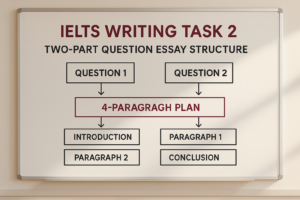
For a work and employment discussion question, your plan might look like this: introduction with opinion, body paragraph one on why people choose security, body paragraph two on why satisfaction matters more, conclusion restating that long-term wellbeing and motivation are stronger reasons. That is enough to guide the whole essay.
Planning also protects you from repetition. Once you know each paragraph’s job, you are less likely to restate the same idea in three different ways. This is especially important when you are nervous, because time pressure makes repetition more tempting. If you want a clearer preparation path before test day, you can also see our IELTS preparation plans and work with a more structured writing routine.
- Identify the essay type first.
- Choose your opinion before you start writing.
- Give each body paragraph one clear purpose.
- Save examples for support, not for replacing analysis.
Ready to find out your IELTS band score?
Take the IELTS Express Pre-Test for just $4.99 and get your personalised band prediction with a 14-day improvement plan.
FAQ: IELTS Writing Task 2 work and employment essays
Can I say both job satisfaction and job security are important?
Yes, but in a discussion essay you still need to make your own judgement clear. It is completely reasonable to say that both matter, then explain which one should take priority and why. The key is that the examiner should not finish reading your essay and still wonder what your position actually is.
Do I need real statistics or workplace research in this kind of essay?
No. IELTS Writing Task 2 does not require specialist knowledge or real data. You can use simple, believable examples and logical explanation. What matters more is relevance, organisation, and the ability to support your point clearly.
Is it better to choose a strong opinion or a balanced opinion?
Either can work if you can support it properly. A balanced opinion is often safer because many IELTS topics involve trade-offs, but a stronger opinion can also score well if the reasoning is clear and consistent. The real problem is not strong or balanced opinions. The real problem is vague opinions.
How can I practise this topic without memorising sample essays?
Study the structure, not the wording. Notice how the introduction paraphrases the question, how each body paragraph has one main job, and how the conclusion closes the argument. Then write your own version on a similar question and compare it to the model instead of trying to copy whole sentences.