If you are searching for an IELTS Speaking Part 3 practice test, you probably already know that Part 3 can feel very different from the rest of the speaking exam. The questions are longer, the ideas are more abstract, and the examiner usually expects more than one short opinion. That shift catches a lot of candidates off guard. Part 2 may go well, then Part 3 arrives and the answer quality drops because the discussion becomes broader and less personal.
Before you keep guessing whether Speaking is really the section limiting your score, take the IELTS Express Pre-Test to get a quick band prediction and see how your current level holds up under pressure.
What IELTS Speaking Part 3 is really testing
Part 3 is the discussion stage of the IELTS Speaking test. After your long turn in Part 2, the examiner asks broader follow-up questions linked to the same topic area. The goal is not to repeat your Part 2 story with different words. The goal is to explain opinions, compare ideas, discuss reasons, and sometimes talk about changes in society.
That is why candidates who sound comfortable in Part 1 and Part 2 can still struggle here. Part 3 rewards flexibility. You need enough language to explain an idea, but you also need enough structure to keep the answer moving. If you give only one sentence, the answer sounds thin. If you speak for too long without direction, the answer starts to wander.
If you want the wider scoring picture, the IELTS Speaking Test complete guide is a useful companion because it shows how Part 3 fits into the full interview.
How an IELTS Speaking Part 3 practice test should help you
A useful IELTS Speaking Part 3 practice test should do more than give you a list of random discussion questions. It should help you practise the real habits that raise scores. That means you need questions, but you also need a reliable way to answer them.
In strong Part 3 answers, three things usually happen. First, the speaker answers the question clearly. Second, the speaker adds a reason, example, or comparison. Third, the speaker extends the idea without losing focus. That pattern sounds simple, but it is exactly where many candidates improve once they stop treating Part 3 like a vocabulary test and start treating it like a short guided discussion.
IELTS Speaking Part 3 practice test questions
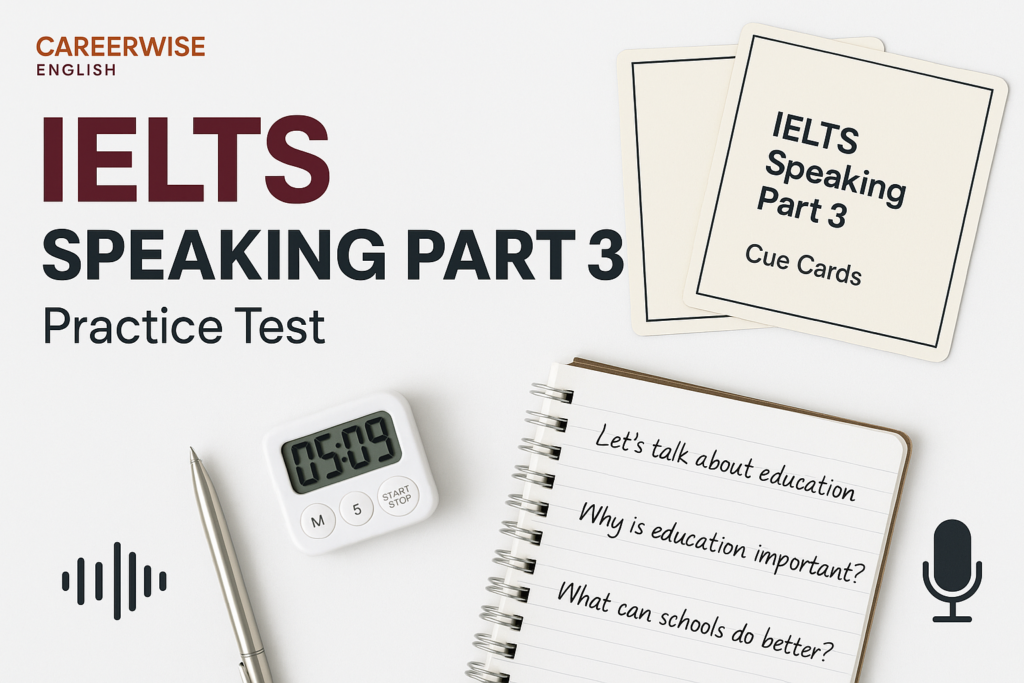
Imagine your Part 2 topic was about a useful skill you learned. In Part 3, the examiner might move into wider discussion about learning, education, and personal development. Here is a realistic IELTS Speaking Part 3 practice test set you can use:
- Do you think practical skills are more important than academic knowledge?
- What skills do young people need most today?
- Why do some people continue learning new skills later in life?
- How has technology changed the way people learn?
- Should schools focus more on real-world skills?
- Do employers value experience more than qualifications?
These questions are realistic because they move away from your personal story and into broader opinion. That is exactly what Part 3 does. If you want to practise these under timed conditions and hear how your speaking holds up across full test sections, access unlimited IELTS mock tests and record a full speaking run rather than isolated answers.
Sample answers that show the right level of development
Do you think practical skills are more important than academic knowledge?
I do not think one is always more important than the other because they often work together. Academic knowledge gives people a foundation, but practical skills help them apply that knowledge in real situations. For example, someone may understand business theory well, but they still need communication and problem-solving skills to work effectively with other people. So in my view, practical skills are essential, but they are strongest when they are supported by solid knowledge.
What skills do young people need most today?
I think communication, digital literacy, and adaptability are especially important now. The reason is that work and study environments change quickly, so people need to learn new systems and explain ideas clearly. In the past, one set of skills might have lasted for many years, but today flexibility matters much more. Young people who can adjust and keep learning usually have a better chance of succeeding.
How has technology changed the way people learn?
Technology has made learning much more accessible because people can study almost anything online. They can watch lessons, join courses, and practise skills without being in a traditional classroom. At the same time, I think technology has created new challenges because people can become distracted quite easily. So overall, it has improved access to learning, but it also requires more self-discipline.
Notice what these answers do well. They answer directly, explain the reason, and add one extra layer of development. They do not try to sound grand or memorised. They sound clear and controlled.
A simple structure for better Part 3 answers
If you freeze in Part 3, structure is usually the fastest fix. A very practical pattern is this:
- Answer: give your main view clearly in the first sentence
- Reason: explain why you think that
- Example or comparison: add one supporting idea
- Extension: show a second angle, result, or limitation if needed
This is not a script. It is just a route. For example, if the examiner asks whether schools should focus more on real-world skills, you can answer yes, explain that students need useful preparation for adult life, give examples such as financial planning or communication, then add that academic study still matters as well. That already sounds much more complete than a short opinion alone.
Many candidates improve quickly once they realise they do not need a perfect mini-essay. They need one clear opinion and enough support to make it convincing.
Why candidates struggle in Part 3 even when their English is decent
A lot of Part 3 problems are not pure language problems. They are thinking-under-pressure problems. The examiner asks a broad question, the candidate starts searching for the “best” answer, and then hesitation begins. By the time the speaker finally starts, the answer already feels tense.
Another issue is over-general language. Candidates say things like “technology is very important nowadays” or “education has many benefits”. Those statements are not wrong, but they are too broad to sound strong on their own. Part 3 answers become better when you narrow them slightly. Explain why technology matters, which benefit of education you mean, or what kind of change you are referring to.
If your answers often feel too short, the problem is usually not that you need more advanced vocabulary. The problem is that you need a second sentence with a reason and a third sentence with an example or result. That small shift makes a big difference.
How to practise with an IELTS Speaking Part 3 practice test at home
You do not need a full classroom set-up to get useful Part 3 practice. You do need a repeatable routine. A good home practice cycle looks like this:
- Step 1: choose one Part 2 topic area such as education, work, travel, or technology
- Step 2: write or collect six Part 3 discussion questions linked to that theme
- Step 3: answer each question aloud in 20 to 40 seconds
- Step 4: listen back and mark where your answer became vague, repetitive, or unfinished
- Step 5: repeat the same set with better structure and clearer examples
This works because it trains consistency, not luck. If you are close to test day and want more organised support, see our IELTS preparation plans and choose the level of help that fits your timeline.
Common Part 3 mistakes and how to fix them
The first common mistake is answering too personally. Part 3 sometimes begins with your opinion, but it usually needs a broader view as well. If the question is about society, education, or work, keep at least part of the answer at that wider level.
The second mistake is overcomplicating the answer. Some candidates think Part 3 requires a very formal style, so they reach for long words and stiff phrases. That often makes the answer slower and less natural. Clear spoken English is usually safer and stronger.
The third mistake is drifting away from the question. This happens when a candidate starts with one idea, then adds another and another without a clear connection. If that sounds familiar, return to the simple pattern from this guide, answer, reason, example, extension. It gives you enough space without letting the answer turn messy.
A seven-day plan to get more confident before the exam
If Part 3 is the section that worries you most, a short focused plan can help more than endless random practice. Try this:
- Day 1: practise one topic set and record every answer
- Day 2: review your recordings and note weak patterns, such as short answers or repetition
- Day 3: redo the same questions using the answer, reason, example pattern
- Day 4: switch to a new topic such as technology or work
- Day 5: focus on comparisons and causes, because they appear often in Part 3
- Day 6: do a full speaking test with Parts 1, 2, and 3 together
- Day 7: review again and repeat the two question types that still feel weak
That kind of practice builds calm. And calm matters, because Part 3 is often where nerves start to show.
Ready to find out your IELTS band score?
Take the IELTS Express Pre-Test for just $4.99 and get your personalised band prediction with a 14-day improvement plan.
Frequently Asked Questions
How long should an IELTS Speaking Part 3 answer be?
There is no fixed word count, but a good answer is usually longer than one short sentence. In most cases, 20 to 40 seconds is enough if the answer is clear and developed.
What is the best way to use an IELTS Speaking Part 3 practice test?
Use it actively. Answer the questions aloud, record yourself, and review whether you gave a clear opinion, a reason, and an example or comparison.
Do I need advanced vocabulary to score well in Part 3?
No. You need vocabulary that helps you explain ideas clearly. Controlled, natural language is much better than difficult words used awkwardly.
Why do my Part 3 answers become too short?
This usually happens because you stop after your first opinion. Add one reason and one supporting example or result. That often fixes the problem immediately.
Can I prepare for Part 3 without a teacher?
Yes. You can improve a lot with recorded practice, honest review, and a small set of repeated question themes. What matters most is regular spoken practice, not silent reading alone.
Your next step with Part 3 practice
A good IELTS Speaking Part 3 practice test should make the discussion stage feel more manageable, not more mysterious. Start with one topic set, answer each question clearly, and build every response with a reason and one extra layer of support. That is where stronger discussion answers usually begin.
If you want a clearer picture of whether Speaking is already near your target band, start with the pre-test, then record one full Speaking mock this week and listen to Part 3 with a cold ear. It is one of the quickest ways to hear what really needs fixing.