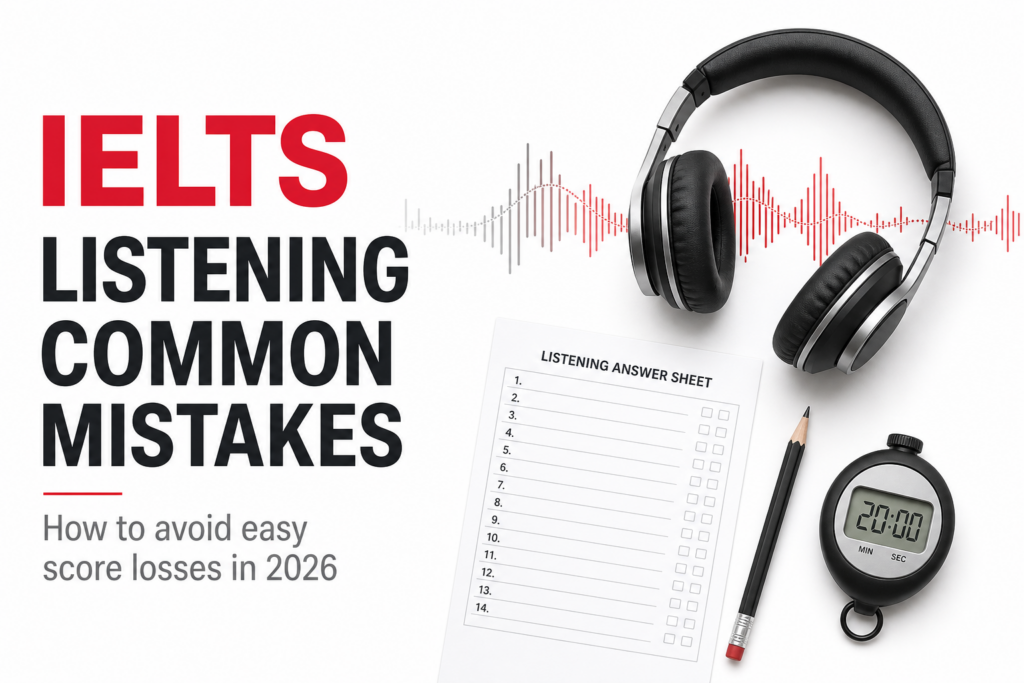
If you keep making IELTS Listening common mistakes, the problem is usually not that your English is too weak. More often, you are losing marks through habits that feel small in the moment but become expensive across all four parts of the test. Before you keep guessing where your score is slipping, take the IELTS Express Pre-Test to see whether Listening is the section quietly dragging your overall result down.
Listening can feel unfair because the recording moves on whether you are ready or not. One missed answer can trigger panic, and panic can damage the next three answers as well. The good news is that most common mistakes are predictable. Once you recognise them, you can train better habits and make your score much more stable.
Why IELTS Listening mistakes cost more marks than candidates expect
In Listening, mistakes often come in clusters. You do not only lose the answer you missed. You may also lose focus, stop reading ahead, mishear the next detail, or write the wrong form because you are still thinking about the previous gap. That chain reaction is one reason Listening scores can feel inconsistent from one practice test to the next.
This also explains why smarter technique matters so much. A candidate can understand most of the recording and still underperform because the exam rewards answer discipline, prediction, and recovery under pressure. If your process is messy, your score usually becomes messy too.
IELTS Listening common mistakes with reading instructions too late
One of the biggest IELTS Listening common mistakes is waiting for the audio to start before understanding the task properly. Candidates look at the page, notice the question type, but do not fully check the word limit, the grammar pattern, or the kind of information needed. Then the recording begins, and everything suddenly feels rushed.
A better approach is to use the short preparation time properly. Read the instruction first. Check whether the answer should be one word, two words, a number, or a short phrase. Then predict what kind of answer is likely to fit. If the sentence says “arrive on ____”, you are probably listening for a day or date. If it says “the cost is ____ dollars”, you are listening for a number.
- Check the word limit before the speaker starts
- Notice grammar clues around each gap
- Predict the answer type such as name, time, place, or number
- Keep your eyes moving ahead instead of staring at one line too long
Missing answers because you stop after one difficult question
Many candidates make the same emotional mistake: they miss one answer and mentally freeze. Instead of following the recording, they keep replaying the missed detail in their head. By the time they return to the test, the speaker has moved on and two more answers have already passed.
This is why recovery is such a valuable Listening skill. Strong candidates are not perfect. They are better at letting go quickly. If one answer disappears, leave it, stay with the speaker, and protect the next mark. That single habit often improves scores faster than trying to become “better at listening” in a vague general sense.
If you want more realistic practice for this skill, it helps to access unlimited IELTS mock tests and train yourself to keep moving even when one question goes badly.
Spelling and word-form errors that throw away easy marks
Some Listening mistakes happen even when you heard the answer correctly. The candidate understands the word but writes it with the wrong spelling, the wrong ending, or the wrong singular-plural form. That feels especially painful because the comprehension was there, but the mark still disappears.
Common examples include missing plural s, spelling names or places inaccurately, writing a verb where a noun is needed, or adding too many words when the instruction allows only one or two. In Listening, details matter. A word that is almost right is often still wrong.
To reduce this problem, review your errors by category. Ask whether the mistake came from hearing, spelling, grammar fit, or answer transfer. That gives you something practical to fix instead of simply feeling annoyed by the score.
Getting trapped by distractors and speaker corrections
The IELTS recording often includes information that sounds correct at first and then changes. A speaker may mention one date, then correct it. They may discuss one option, reject it, and choose another. Candidates who write the first familiar detail too quickly often lose marks here.
This does not mean you should wait forever before writing. It means you should listen for the speaker’s final meaning. In many questions, the first detail is only a distractor. The real answer comes after a correction phrase such as actually, no, sorry, instead, or we decided to.
- Do not trust the first number immediately
- Watch for correction language such as actually or rather
- Expect options to be discussed before one is chosen
- Stay calm when the recording changes direction
Failing to read ahead between sections and questions
Another very common issue is using the short pauses badly. Some candidates spend the break checking old answers even though those answers cannot be changed with confidence. Others simply rest because the pause feels like relief. Both habits waste the preview time that should help with the next group of questions.
Reading ahead matters because it lets you predict context, topic shifts, and answer type. If you know the next section is about accommodation, a campus tour, or a research project, your ears become more prepared for the vocabulary and ideas that are likely to appear. That preparation does not guarantee every answer, but it reduces surprise.
For a broader framework on how this section works, the IELTS Listening practice guide is useful because it connects test structure, review habits, and band improvement into one clearer system.
Writing answers that fit the audio but not the question
Sometimes the recording gives you the right idea, but you still write an answer that does not fit the sentence on the page. This often happens when candidates focus only on hearing the word and forget to check whether the form matches the grammar around the gap.
For example, if the sentence needs a plural noun and you write the singular, the answer may be rejected. If the line requires a number and unit, but you only write the number, that can also cause trouble. Listening is not only about recognising sound. It is also about matching the answer neatly to the task in front of you.
This is one reason prediction is so powerful. When you predict grammar and answer type before the speaker reaches the gap, you are less likely to force the wrong form into the sentence.
Weak note control in map, matching, and multiple-choice tasks
Candidates often think gap-fill questions are the main danger, but other task types can create just as much damage. Map labelling can go wrong when you lose direction language. Matching can collapse when you forget who said what. Multiple-choice can become messy when you choose the first option that sounds familiar instead of the final correct meaning.
Each task type needs its own discipline. In maps, track movement words such as opposite, next to, at the end of, and to the left of. In matching, keep the options visible and stay alert to how speakers are introduced. In multiple-choice, be patient. The recording often mentions several options before confirming the right one.
- Map labelling: focus on direction and sequence
- Matching: track names, opinions, and role changes carefully
- Multiple-choice: wait for the speaker’s final decision
- Form completion: protect spelling and word-limit accuracy
How to practise so the same listening mistakes stop repeating
Doing more tests is not enough if you repeat the same behaviours every time. A better method is to review each wrong answer and label the real cause. Was it prediction failure, spelling, distraction, panic, a distractor, or a grammar-fit issue? Once you know the pattern, your practice becomes much more useful.
A simple weekly routine works well for many candidates. Do one full Listening test under timed conditions. Review every wrong answer carefully. Then spend one shorter session drilling your weakest pattern. If your biggest issue is speaker correction, train that. If it is spelling, train that. Generic practice helps less than targeted repair.
If you need a more structured pathway, a clear study plan built around your weak Listening habits can help before test day.
A practical checklist to avoid IELTS Listening common mistakes on test day
You do not need a dramatic new personality to improve Listening. You need a small set of repeatable habits. Read instructions early. Predict answer type. Follow the speaker, not your frustration. Expect distractors. Protect spelling. Use pauses to read ahead. Those habits sound simple, but together they create a much calmer test performance.
It also helps to remember that Listening rewards discipline more than heroics. You are not trying to catch every sound perfectly. You are trying to stay organised enough to collect the marks that are already within reach.
Ready to find out your IELTS band score?
Take the IELTS Express Pre-Test for just $4.99 and get your personalised band prediction with a 14-day improvement plan.
FAQ: IELTS Listening common mistakes
What is the most common mistake in IELTS Listening?
One of the most common mistakes is losing focus after missing one answer. That often causes a chain reaction where candidates miss the next one or two answers as well.
Do spelling mistakes matter in IELTS Listening?
Yes. If the answer is spelled incorrectly, you can lose the mark even if you understood the recording. Spelling, plural endings, and word form all matter.
Why do I choose the wrong option in multiple-choice Listening questions?
This usually happens because the recording mentions a tempting option before rejecting it. You need to wait for the speaker’s final meaning rather than choosing the first familiar detail.
How can I stop making the same IELTS Listening mistakes?
Review each wrong answer by cause, not just by score. Identify whether the issue was spelling, prediction, distractors, panic, or grammar fit, then practise that exact weakness.
Should I read the questions before the recording starts?
Absolutely. Reading the questions early helps you predict answer type, understand the task, and prepare for the topic before the audio begins.
A calmer way to protect your Listening band score
Most IELTS Listening common mistakes are fixable because they come from behaviour, not fate. When you prepare with clearer habits, the section stops feeling so slippery. You begin to notice patterns, recover faster, and waste fewer easy marks.
That is the real goal before test day. Not perfection, but control. If you can stay organised, alert, and disciplined while the recording moves, your Listening score usually becomes far more dependable.