If you are searching for IELTS Speaking Part 2 improve from band 5 to 6 advice, you are probably dealing with a frustrating pattern. You have ideas in your head, but your answer becomes too short, too repetitive, or too uncertain once the two-minute task begins. This is common at band 5 level. The good news is that band 6 usually does not require perfect English. It requires clearer organisation, steadier fluency, and better development.
Before you keep guessing what your speaking score might be, take the IELTS Express Pre-Test to get a quick band prediction and see whether Speaking Part 2 is really the section pulling your result down.
Why band 5 answers usually get stuck
Band 5 speaking answers often have one basic problem. The candidate can communicate, but the answer is hard to follow or too limited. In Part 2, that usually shows up in a few familiar ways. The speaker starts with one clear idea, pauses for too long, repeats the same point, or finishes after less than a minute.
Another issue is that many candidates try to sound advanced too early. They search for difficult words while speaking, then lose fluency. Others go in the opposite direction. They use only very simple language, but they do not add enough detail to keep the answer moving. Both patterns can hold you around band 5.
How IELTS Speaking Part 2 improve from band 5 to 6 actually happens
To move from band 5 to 6, you do not need to become impressive overnight. You need to become more reliable. A band 6 answer usually sounds clearer from start to finish. It may still contain grammar mistakes or awkward phrases, but the examiner can follow the answer without much effort.
That means your target is practical. You need to organise your answer better, use simple linking language, and give enough detail to keep speaking for close to two minutes. In other words, improvement comes from control, not from decoration.
A useful way to think about the jump is this:
- Band 5: ideas are there, but they are thin, repeated, or hard to organise.
- Band 6: ideas are clearer, more connected, and supported with basic examples or reasons.
That is a manageable jump. You are not trying to sound like a native speaker. You are trying to sound organised, understandable, and steady under pressure.
Use a four-part structure every time
The fastest way to improve Part 2 is to stop treating it like one long speech. Use a four-part answer shape instead. This gives you a route to follow even when you feel nervous.
- Part 1, name the topic: say clearly what person, place, object, or event you chose.
- Part 2, give the background: explain when, where, or how it happened.
- Part 3, add detail: describe what happened, what it looked like, or why it stood out.
- Part 4, finish with meaning: explain why it mattered to you or what you learned from it.
This structure works because it prevents the answer from collapsing too early. Instead of giving three random sentences, you are moving step by step through a simple story. That is exactly what many band 5 candidates are missing.
If you want timed practice with this structure, access unlimited IELTS mock tests and record yourself answering several cue cards in one sitting. That quickly shows whether your structure still works when the clock starts.
What to do in the one-minute preparation time
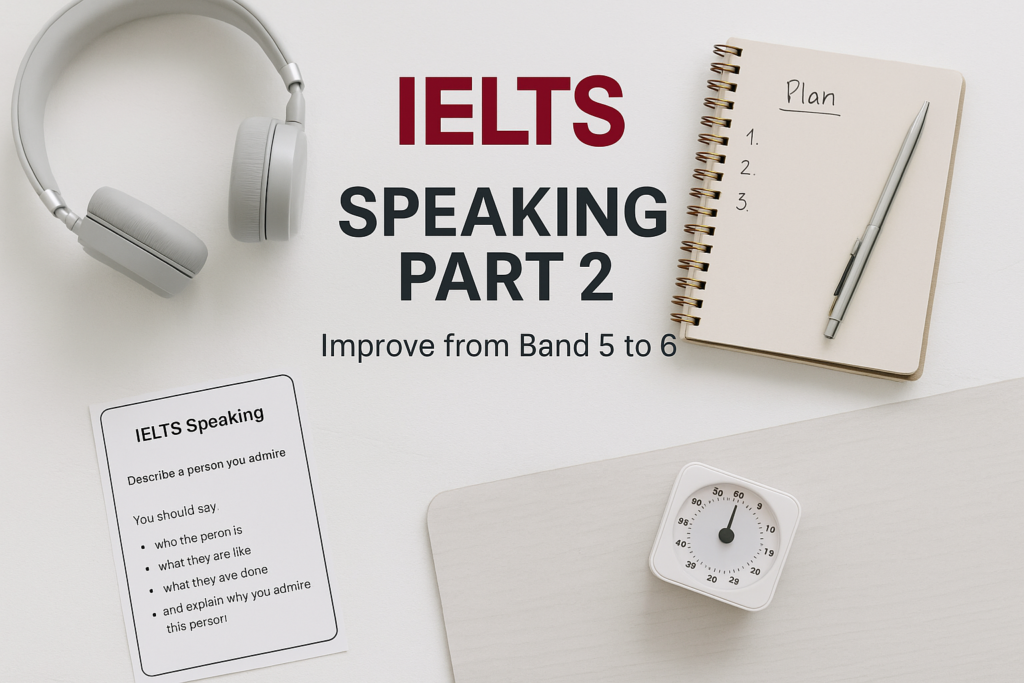
Many candidates waste the preparation minute by writing full sentences. That usually backfires. You do not have enough time to write a script, and reading from your notes will hurt fluency. A better plan is to write four short prompts, one for each part of the answer.
For example, if the cue card asks you to describe a useful skill, your notes could look like this:
- Skill: cooking
- When: learned at university
- Detail: saved money, cooked with friends
- Why important: more independent now
That is enough. Those notes give direction without trapping you in memorised wording. At band 5 level, this change alone can make a big difference because it reduces panic and helps your answer stay organised.
The key is not beautiful notes. The key is fast decisions. In one minute, choose one clear example and one clear reason it matters. That gives you something solid to build on.
How to make your answer longer without sounding repetitive
A lot of band 5 candidates know the basic answer, but they do not know how to extend it. They say what happened, then they stop. To reach band 6, you need to develop each main idea in a simple way.
There are five easy ways to extend almost any point:
- Description: what it looked like or what the situation was like
- Example: one specific moment
- Reason: why it mattered
- Feeling: how you felt at the time
- Result: what changed afterwards
Imagine you say, “I want to talk about a teacher who helped me.” Do not stop there. Add one moment when the teacher helped you, explain why that mattered, and say what changed because of it. Suddenly, you have a real answer instead of a short statement.
This is where many candidates improve fastest. They realise they do not need more topics. They need better development of the topic they already have.
Language that helps band 5 candidates sound more fluent
You do not need difficult vocabulary to get to band 6. In fact, simple and controlled language is usually safer. The best improvement often comes from using short linking phrases that keep the answer moving naturally.
Useful phrases include:
- To start: I would like to talk about…
- To continue: what I remember most is…
- To add detail: one thing that stood out was…
- To explain importance: the reason this matters to me is…
- To finish: overall, it was important because…
These phrases are helpful because they buy you a little thinking time and keep the answer organised. They are not magic. You still need real content. But they create smoother transitions, and that helps fluency and coherence.
What usually hurts candidates at this level is chasing big vocabulary. If a simple word comes to mind first, use it. A clear answer with ordinary words will normally score better than a broken answer full of half-remembered advanced phrases.
Common mistakes that stop the band score moving
Some mistakes appear again and again in weaker Part 2 answers. The first is memorising whole sample responses. That may feel safe, but examiners usually notice when an answer sounds learned rather than real. The second mistake is choosing an example that is too big. If the card asks about a memorable event, do not try to explain your whole childhood. Pick one event and stay with it.
Other common problems include:
- answering the bullet points like a checklist without adding real detail
- speaking too generally with words like good, nice, interesting, or beautiful
- stopping to fix every small grammar mistake
- finishing too early, then repeating earlier ideas
- using an opening that sounds formal and unnatural
If you recognise your own speaking in that list, that is actually useful. It means the problem is visible, and visible problems are easier to fix than vague ones.
A simple 7-day practice plan before your next test
Band improvement usually comes from repetition with feedback, not from reading endless tips. A short weekly plan is often enough to build better control.
- Day 1: answer three cue cards and record yourself without stopping.
- Day 2: listen again and mark where you paused too long or repeated ideas.
- Day 3: practise the same cards using the four-part structure.
- Day 4: focus only on extending ideas with examples and reasons.
- Day 5: do one full speaking test so Part 2 connects naturally with Parts 1 and 3.
- Day 6: choose your weakest cue card type and practise it again.
- Day 7: review your recordings and check whether your answers sound clearer and longer than at the start of the week.
This kind of practice works because it is honest. You hear your real habits. You stop guessing. That is usually when real progress starts.
If you need more structured support while you prepare, see our IELTS preparation plans and choose the level of guidance that fits your timeline.
Ready to find out your IELTS band score?
Take the IELTS Express Pre-Test for just $4.99 and get your personalised band prediction with a 14-day improvement plan.
Frequently Asked Questions
How can I improve IELTS Speaking Part 2 from band 5 to 6 quickly?
The fastest improvement usually comes from using a simple answer structure, recording yourself, and learning how to extend one idea with examples, reasons, and results. Most candidates improve faster when they stop memorising and start organising.
Do I need advanced vocabulary to reach band 6 in Part 2?
No. Band 6 is usually more about clarity than complexity. Simple words used well are better than difficult words that break your fluency or create mistakes.
Why do I always stop speaking too early in IELTS Speaking Part 2?
This usually happens because the answer has only basic description and no development. Once you learn to add an example, a reason, a feeling, and a result, the two-minute task becomes much easier to manage.
Is it okay to use personal stories in Part 2?
Yes. Personal stories are often the best choice because they are easier to remember and explain. Just keep the story simple and connected to the cue card topic.
What should I write during the one-minute preparation time?
Write short prompts, not full sentences. A topic, a background note, one or two details, and one reason the topic matters are usually enough to guide a stronger answer.
Your next step before test day
If your Part 2 score is sitting around band 5, that does not mean you are far away. In many cases, the gap to band 6 is not about intelligence or talent. It is about structure, control, and enough practice to make those habits feel normal.
Start with one reliable answer shape. Use shorter notes. Extend ideas instead of repeating them. Then test yourself under time pressure. That is the kind of practice that turns a fragile answer into a safer band 6 performance.