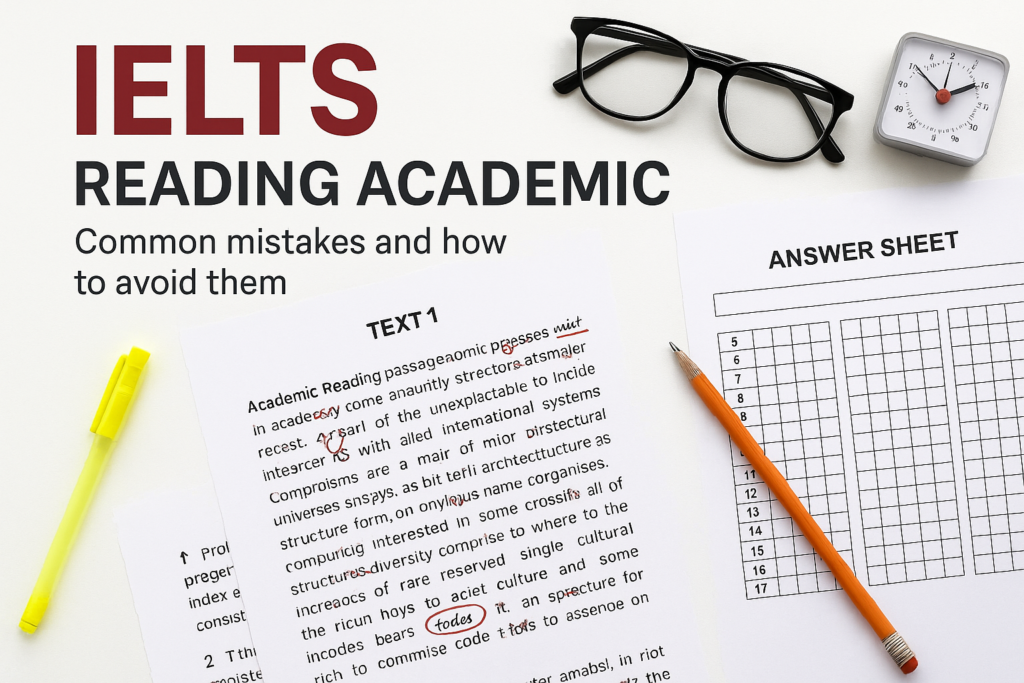
Many test takers lose marks in Reading not because the passages are impossible, but because they repeat the same avoidable habits. If you want to avoid the main IELTS Reading Academic common mistakes, you need more than extra practice. You need to understand where marks disappear, why errors happen under time pressure, and which habits actually improve accuracy. A good first step is to take the IELTS Express Pre-Test to find out your current band score before you change your study plan.
In IELTS Academic Reading, the most common mistakes are poor time control, matching answers from memory instead of the text, missing key limiting words, weak skimming strategy, and careless transfer errors. These problems lower scores because the test rewards precise reading, not general understanding alone.
Why IELTS Academic Reading scores drop even when your English is good
Strong English does help, but the Reading test checks a specific exam skill. You need to locate information fast, compare similar ideas, and notice small differences in meaning. A candidate can read English well in daily life and still lose marks because the test format is strict.
Academic passages also contain paraphrasing. The wording in the question often does not match the wording in the passage. If you search only for the exact same words, you may miss the correct section completely. This is one of the biggest traps for otherwise capable candidates.
Another issue is mental fatigue. By the second or third passage, candidates often rush. They stop checking instructions, guess from memory, or pick an answer that feels close enough. In IELTS Reading, close is not correct.
Common mistake 1: spending too long on one question
Time pressure damages more scores than difficult vocabulary. Some candidates stay on one confusing question for three or four minutes, hoping the answer will suddenly become obvious. That rarely works. It usually means you reach the final passage with too little time.
A better approach is to manage the section like a controlled sequence:
- Move quickly through easier questions first.
- Mark hard questions and return after collecting easier marks.
- Keep checking the clock after each question set, not after every single question.
- Leave one or two minutes at the end for transfer and review.
If you are regularly running out of time, build your practice around timed sets rather than untimed reading. For realistic exam training, many candidates improve faster when they access unlimited IELTS mock tests and track how long each question type takes.
Common mistake 2: ignoring keywords and limiting words
Many wrong answers look attractive because candidates notice one familiar topic word and ignore the rest of the question. In Reading, small words often control the meaning. Words such as only, mainly, before, after, some, or rarely can change the answer completely.
For example, a passage may say a method works in some conditions, but the question asks whether it works in all situations. If you read too quickly, you may choose the option that sounds generally true rather than exactly true.
Train yourself to underline or mentally note the words that limit meaning. This matters in True/False/Not Given, matching headings, sentence completion, and multiple choice. Precision is the difference between Band 6 and Band 7 behaviour.
Common mistake 3: looking for exact words instead of paraphrases
IELTS Academic Reading rewards your ability to recognise the same idea in different language. A question may mention children’s development, while the passage says cognitive growth in early years. If you search only for the original question words, you may miss the answer area.
To fix this, train in pairs. When you read a question, ask yourself, “How else could the passage say this?” Think about synonyms, formal academic wording, and changes in sentence structure. Over time, you will become faster at spotting paraphrases.
This is also why random reading alone is not enough. Focused IELTS training matters. If your overall preparation plan still feels messy, it helps to review a broader IELTS Reading practice approach so your daily work matches the test demands.
Common mistake 4: using general understanding to answer detail questions
Some candidates understand the passage topic well and then answer from memory of the main idea. That is risky. Detail questions require proof from the text. You should be able to point to the line or sentence that supports your answer.
This matters especially in:
- True/False/Not Given questions
- Summary completion
- Short answer questions
- Multiple choice items with similar options
If you cannot identify where the answer lives in the passage, you are probably guessing. In IELTS Reading Academic common mistakes, this is one of the most expensive because candidates often feel confident while being wrong.
A simple rule helps here. For every answer, ask: what exact words in the passage justify my choice? If you cannot answer that question, slow down and re-check.
Common mistake 5: misunderstanding True, False, and Not Given
This question type causes panic because the options seem similar. The difference becomes easier when you define each one clearly:
- True: the statement agrees with the writer’s meaning.
- False: the statement contradicts the writer’s meaning.
- Not Given: the passage does not give enough information to decide.
The usual mistake is choosing False when the correct answer is Not Given. Candidates see that the statement is not clearly supported and assume the opposite must be true. That logic does not work here. If the passage does not say it, you cannot invent the missing step.
To improve, compare the question statement with the passage sentence by sentence. Do not decide too early. Many traps depend on one changed detail such as a date, number, cause, or comparison.
Common mistake 6: weak skimming and scanning technique
Skimming does not mean reading carelessly. It means reading for structure first. You should know what each paragraph mainly does before you hunt for details. Without that map, scanning becomes random and slow.
Good candidates usually notice:
- the topic of each paragraph
- names, dates, and unusual terms
- contrast signals such as however, although, and while
- cause and effect language
- examples that support a larger idea
When you skim well, matching headings becomes easier and detail questions become faster because you know where to return. If you skim badly, every question feels like a new search from zero.
A practical study method is to skim a passage in one minute, then write a five-word label for each paragraph. This trains you to notice structure instead of getting trapped in every sentence.
Common mistake 7: careless answer transfer and spelling errors
Even after finding the right answer, some candidates lose marks during transfer. They write too many words, misspell a keyword, or ignore the instruction limit. If the instruction says NO MORE THAN TWO WORDS, then three words is wrong even if the meaning is fine.
These errors feel small, but they are painful because they happen after you have already done the hard part. To reduce them:
- check word limits every time
- copy from the passage carefully
- watch singular and plural forms
- be careful with hyphens, numbers, and dates
- reserve final review time for answer transfer, not fresh guessing
If your scores move up and down for no clear reason, transfer mistakes may be part of the problem.
How to build a safer Reading strategy before test day
Fixing IELTS Reading Academic common mistakes is easier when you stop treating every practice session the same way. Use targeted review. After each practice test, do not just mark answers right or wrong. Classify the reason for every error.
- Did you run out of time?
- Did you miss a limiting word?
- Did paraphrasing confuse you?
- Did you answer from memory instead of evidence?
- Did you make a transfer mistake?
That kind of review shows patterns. Once you know your pattern, your study plan becomes much more efficient. It can also help to compare your Reading work with your wider preparation plan and see our IELTS preparation plans if you want a more structured path toward your target band score.
Ready to find out your IELTS band score?
Take the IELTS Express Pre-Test for just $4.99 and get your personalised band prediction with a 14-day improvement plan.
FAQ: IELTS Reading Academic common mistakes
What is the most common mistake in IELTS Academic Reading?
The most common mistake is spending too long on difficult questions and losing control of the section timing. This creates pressure, increases guessing, and usually damages the final passage most of all.
Why do I understand the passage but still get answers wrong?
You may understand the general meaning but still miss the exact requirement of the question. IELTS Reading often tests detail, paraphrase recognition, and precise comparison, not broad understanding alone.
How can I improve True, False, Not Given questions?
Focus on the exact meaning of the statement and compare it carefully with the passage. Do not assume the opposite is true when information is missing. If the passage does not clearly confirm or contradict the statement, the answer is Not Given.
How long should I spend on each passage in IELTS Academic Reading?
A useful starting point is to keep strict awareness of time and avoid letting one question set consume too many minutes. Many candidates aim to stay moving and protect enough time for the final passage, which is often the most demanding.
A calm, accurate approach usually beats a fast, messy one
Most Reading score problems are not mysterious. They come from repeat mistakes that can be identified and fixed. If you improve timing, read questions more precisely, and insist on proof from the passage, your score becomes more stable.
Do not measure progress by how hard you worked. Measure it by whether your error pattern is shrinking. That is what good IELTS Reading improvement looks like. Start with one timed practice set, review every mistake honestly, and build from there.