If you are looking for an IELTS Speaking Part 2 technology cue card sample, you probably do not just want a model answer to copy. You want to hear what a clear, natural long-turn response sounds like, and you want to understand why it works. Technology topics appear often in IELTS because they let the examiner test description, opinion, and everyday explanation at the same time. Before you assume your speaking level is already close to your target, take the IELTS Express Pre-Test to get a quick band prediction and see whether your Part 2 performance is really strong enough.
What this technology cue card is really testing
When you get a technology-related cue card, the examiner is not checking whether you know advanced digital vocabulary. They are listening for fluency, organisation, vocabulary range, grammar control, and pronunciation. In other words, the topic is just the vehicle. Your spoken control is the real target.
This matters because many candidates hear the word technology and panic. They think the answer has to sound clever or technical. It does not. A good IELTS Speaking Part 2 technology cue card sample usually works because it is simple, personal, and easy to follow.
A common IELTS Speaking Part 2 technology cue card prompt
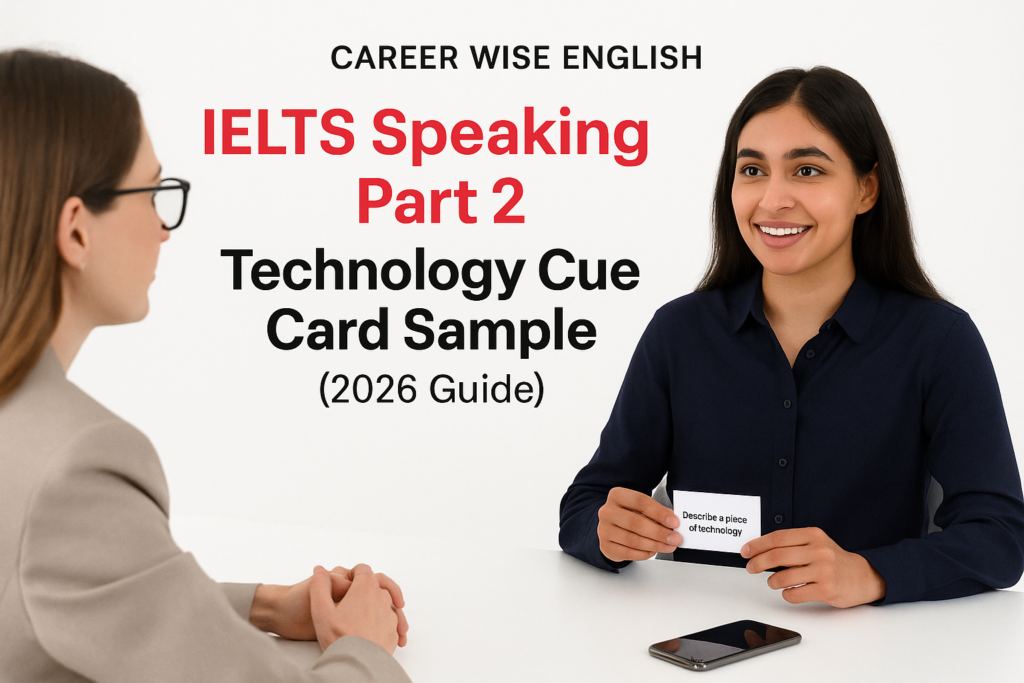
A very typical prompt looks like this:
- Describe a piece of technology that you use often.
- You should say what it is, when you started using it, what you use it for, and explain why it is important to you.
This cue card is popular because it gives you plenty to talk about. You can choose a smartphone, laptop, smartwatch, tablet, headphones, or even a study app. The safest choice is usually something you use regularly and can describe without forcing the story.
If you want a wider overview of the speaking interview before drilling into samples, the IELTS Speaking Test complete guide is a useful place to start.
Band-friendly sample answer for a technology cue card
Here is a natural sample answer built around a smartphone:
“I would like to describe my smartphone, which is probably the piece of technology I rely on most in daily life. I started using this phone about two years ago when my old one stopped working properly, and since then it has become part of almost every part of my routine.
I mainly use it for communication, study, and organisation. For example, I use it to reply to messages, check emails, join video calls, and manage my calendar. I also listen to podcasts and use vocabulary apps on it, so it is not only for entertainment. In fact, I often use it as a study tool because it helps me make use of small pockets of time during the day.
What makes it important to me is convenience. Instead of carrying several different devices, I can do almost everything in one place. It also helps me stay connected with family and friends, especially when I am busy. At the same time, I try to use it carefully because I know it can become distracting if I spend too much time on social media. Overall, I think it is one of the most useful tools I own because it saves time, keeps me organised, and makes daily tasks much easier.”
That answer works because it is personal, organised, and detailed without sounding memorised. If you want more test-like repetition after studying this example, access unlimited IELTS mock tests and practise several long turns in one sitting.
Why this sample answer works well
A strong IELTS Speaking Part 2 technology cue card sample usually has four things. First, it answers the task points clearly. Second, it stays on one topic instead of jumping around. Third, it adds detail through examples rather than vague filler. Fourth, it sounds like normal speech.
Notice that the sample answer does not try to impress the examiner with difficult jargon. It simply explains what the device is, when the speaker started using it, how it is used, and why it matters. That is enough. In IELTS, clarity beats forced sophistication almost every time.
A simple structure you can reuse in your own answer
If you want to build your own response, use this structure:
- Opening: name the technology clearly
- Background: say when or why you started using it
- Main uses: explain two or three practical uses
- Importance: say why it matters in your life
- Balanced comment: add one realistic thought, such as a small drawback or limitation
This framework helps because it gives your answer shape. You are not trying to invent a speech from nothing. You are moving through a simple sequence that feels natural under pressure.
If you are still building your wider exam strategy, the IELTS preparation plans can help you decide whether you need guided speaking practice or a broader full-test plan.
Best technology ideas to choose on test day
Not every piece of technology is equally easy to describe. The best choices are usually familiar objects with a clear role in your life. Good options include:
- a smartphone you use every day
- a laptop for work or study
- wireless headphones for listening practice
- a smartwatch that helps with exercise or reminders
- a tablet for reading or note-taking
- a study app that improved your habits
Try to avoid choosing something that sounds interesting but feels hard to explain. A simple phone answer is often stronger than a complicated answer about artificial intelligence or advanced software that you cannot describe smoothly.
Useful vocabulary for a technology cue card
You do not need advanced technical language, but a few useful phrases can make your answer clearer:
- user-friendly
- time-saving
- easy to carry around
- part of my daily routine
- helps me stay organised
- keeps me connected
- makes life more convenient
- can be distracting if overused
These phrases are helpful because they sound natural in speech. They also give you a quick way to explain value and impact without drifting into awkward or overly formal language.
Common mistakes candidates make with technology topics
The first mistake is becoming too general. Some answers stay at the level of, “Technology is important because it helps people.” That is too thin. You need real detail from your own life.
The second mistake is listing features like an advertisement. IELTS is not a product review. The examiner wants a connected answer, not a shopping description.
The third mistake is sounding memorised. If every sentence feels too polished, too balanced, or too perfect, the answer may seem rehearsed. A good response should sound prepared in structure, not memorised word for word.
The fourth mistake is ignoring the emotional or practical reason the technology matters. That final layer often makes the answer more human and easier to follow.
How to use your one-minute preparation time well
In the one-minute planning stage, do not try to write full sentences. That usually slows you down. Instead, note five anchors:
- what the technology is
- when you got it
- two or three main uses
- why it matters
- one small downside or caution
Those notes are enough to keep you moving for up to two minutes. The goal is not to read a script. The goal is to create a path so you do not freeze halfway through the answer.
If you struggle with long-turn planning in general, you may also want to study IELTS Speaking Part 2 tips and strategies for a wider method you can use across many cue cards.
How to extend the answer if you finish too early
Many candidates give a decent answer and then stop after forty seconds. If that happens, add one of these support layers:
- a specific example of when you used the technology
- a comparison with the past
- a small downside
- a reason it suits your lifestyle
- how it changed your habits
For example, after saying your smartphone helps you stay organised, you could add that it became especially useful when you were studying for an exam because you could set reminders, track tasks, and listen to English content while travelling. That kind of extension sounds natural and keeps the answer alive.
A short practice plan for technology cue cards
If technology is a weak topic for you, practise it in a focused way:
- Day 1: choose one device and make a one-minute note plan
- Day 2: record a two-minute answer and listen back
- Day 3: repeat the answer with better linking and clearer detail
- Day 4: switch to a different device but keep the same structure
- Day 5: do one full speaking mock under timed conditions
This works because you are training the method, not just memorising one topic. Once the structure is strong, you can adapt it to many technology-related cue cards.
Ready to find out your IELTS band score?
Take the IELTS Express Pre-Test for just $4.99 and get your personalised band prediction with a 14-day improvement plan.
Frequently Asked Questions
What is the best topic to choose for an IELTS Speaking Part 2 technology cue card?
The best choice is usually something familiar that you use often, such as a smartphone or laptop. It is easier to speak naturally when the object is part of your real life.
Do I need technical vocabulary for a technology cue card?
No. Clear everyday English is usually better than advanced technical language. The examiner wants a fluent, organised answer, not a complex product explanation.
How long should I speak in a technology cue card answer?
You should aim to keep speaking until the examiner stops you, but without rushing. A clear two-minute answer often includes the object, background, uses, importance, and one extra detail or reflection.
Can I mention a disadvantage of the technology?
Yes. A small balanced comment can make the answer sound more natural. For example, you can say that your phone is useful but also distracting if you use it too much.
How can I practise IELTS Speaking Part 2 technology cue card sample answers at home?
Use a timer, give yourself one minute to plan, then record a two-minute answer. Listen back and check whether your answer had clear structure, enough detail, and natural language.
Your next step with technology cue cards
An IELTS Speaking Part 2 technology cue card sample is most useful when you treat it as a model for structure, not as a script to memorise. Choose a familiar device, explain it in a simple sequence, and add details that are true to your own life.
If you practise that pattern a few times, technology topics become much less stressful. And once the topic feels normal, your fluency usually improves with it.