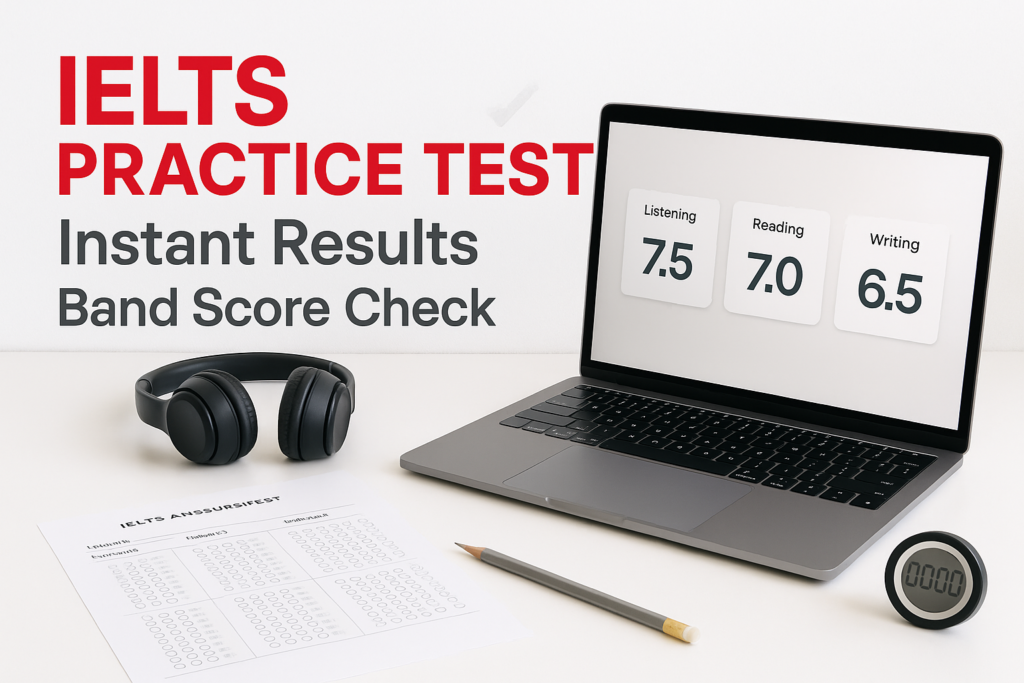
If you are looking for an IELTS practice test with instant results, you probably want a clear answer quickly: where your band score sits now, which section is weakest, and what to practise next. That is a smart starting point, especially if your test date is close or you need a section minimum for study, migration, or work. Before you book another full exam, take the IELTS Express Pre-Test to get a fast band estimate and a practical improvement plan.
Instant results are useful because they reduce guesswork. They do not replace the official IELTS test, and they cannot promise your final score. What they can do is show patterns. A timed practice test can reveal whether your problem is speed, vocabulary, question type control, writing structure, speaking fluency, or simple test familiarity.
IELTS Practice Test With Instant Results: What It Means
An IELTS practice test with instant results is a timed diagnostic test that gives feedback soon after completion. The result may include a band estimate, section-by-section performance, answer accuracy, and advice on what to study next. The best use is diagnosis, not prediction with false certainty.
For Listening and Reading, instant results are usually more direct because many answers are right or wrong. Writing and Speaking need more judgement, so good feedback should explain the likely band range and the reasons behind it. A score without explanation is less useful than a slightly broader band estimate with clear next steps.
- Use the result to identify your weakest section.
- Check whether your timing breaks down under pressure.
- Compare your section scores against your target requirement.
- Repeat practice only after fixing the main error pattern.
- Keep official IELTS as the final proof, not the first diagnostic step.
Why Instant IELTS Results Help Candidates Study Better
Many IELTS candidates spend weeks doing random practice. They complete a reading passage one day, watch a speaking video the next day, then write an essay without feedback. That feels productive, but it often hides the real problem. Instant results give structure because they show what happened under test-like conditions.
If your Listening score is strong but Reading drops badly, your plan should focus on reading speed and question matching. If Reading is fine but Writing stays low, more reading tests will not solve the issue. You need writing feedback, paragraph repair, grammar control, and clearer task response.
If you want repeated test-style practice after the first diagnosis, you can access unlimited IELTS mock tests and compare your results over time instead of relying on one attempt.
What A Good Instant Result Should Include
A useful instant result should do more than show a number. It should separate the four IELTS skills and show where marks are being lost. A candidate who needs Band 7 in each section needs different advice from a candidate who needs only an overall 6.5.
For Listening and Reading, look for answer accuracy, question type weaknesses, spelling mistakes, and timing data. For Writing, look for comments on task achievement, organisation, paragraph control, vocabulary range, grammar accuracy, and whether the answer fully addresses the question. For Speaking, look for fluency, pronunciation, grammar range, vocabulary, and whether answers are developed naturally.
The result should also tell you what to do next. “Practise more” is not enough. A helpful report might say, “Your Reading score is limited by True/False/Not Given questions” or “Your Task 2 body paragraphs need clearer topic sentences and examples”.
Instant Results Versus Official IELTS Scores
An instant practice result is not an official IELTS score. It is a guide. The official result comes only from an approved IELTS test. That distinction matters because candidates sometimes treat a practice band as a guarantee. It is better to treat it as a warning light or a confidence check.
Practice results can vary because test difficulty, concentration, typing speed, fatigue, and question familiarity all affect performance. One strong practice result is encouraging, but it should not be the only reason you book the real test. Look for consistency across several timed attempts.
For a broader explanation of scoring, read the IELTS band score framework. It explains why one weak section can block a candidate even when the overall result looks acceptable.
How To Use A Practice Test Before You Start Studying
The best time to take a diagnostic practice test is before you build your study plan. This may feel uncomfortable because you may not feel ready. That is exactly why it helps. A first test shows your current level before preparation changes the picture.
Take the test under realistic conditions. Use a timer. Do not pause the audio. Do not check vocabulary during Reading. Write the essay within the time limit. For Speaking, record your answers instead of only thinking about what you would say. The closer the practice conditions are to the real test, the more useful the result becomes.
After the test, do not jump straight into another one. Review the result and choose one priority for the next week. If you try to fix every section at once, your study becomes scattered.
How To Read Your Section Results
Start with the section that is furthest from your target, not the section you enjoy most. If your goal is Band 7 each and your practice results are Listening 7.5, Reading 6.0, Writing 6.5, and Speaking 7.0, Reading is the immediate risk. Writing is next. Listening and Speaking should be maintained, not ignored.
Also check whether the problem is accuracy or timing. A candidate who answers correctly when untimed but loses marks under exam timing needs speed practice. A candidate who finishes early but makes many errors needs method and question type control.
If the result shows a wide gap between receptive skills and productive skills, such as strong Listening and Reading but weaker Writing and Speaking, that is common. It usually means you understand more English than you can produce accurately under pressure.
Turning Instant Results Into A 14-Day IELTS Plan
A simple 14-day plan works better than a vague long-term promise. Use the first two days to review the practice result and identify the largest score leak. Then spend days three to eight on targeted skill repair. That might mean Task 2 paragraph development, Reading matching headings, Listening map labelling, or Speaking Part 2 fluency.
Use days nine to twelve for timed practice. Repeat the problem question types and compare performance with the first test. Use day thirteen for a full mixed review. Use day fourteen for another timed diagnostic or mock test to see whether the weakness has improved.
If you need structured support, compare IELTS preparation plans and choose the option that gives feedback on the section that is actually holding your score down.
Common Mistakes With Online IELTS Practice Tests
The first mistake is taking too many tests without review. Practice tests are measurement tools. They show what is happening, but they do not automatically teach the skill. If you repeat the same mistakes across five tests, the problem is not effort. The problem is the study method.
The second mistake is trusting a score that has no explanation. If a platform gives you a Writing band but no reason, you cannot act on it. You need to know whether the issue is the answer, paragraphing, grammar, vocabulary, or task format.
The third mistake is practising in easy conditions. Pausing audio, using a dictionary, taking long breaks, or writing without a timer can make the result look better than your real test performance. Honest practice is more useful than comfortable practice.
When You Should Take A Full Mock Test
A full mock test is useful when you have already fixed the largest weakness from your first diagnostic. It shows whether you can maintain performance across all four sections. This matters because IELTS is tiring. A candidate may do well on a single Reading passage but lose accuracy when it follows Listening and comes before Writing.
Full mock tests are also useful before booking the official test. If your target is Band 7 each, you want practice results close to that level in every section, not only one lucky high score. Consistency matters more than one impressive attempt.
The IELTS mock test guide explains how to use mock tests to predict readiness without overreacting to a single result.
Final Checklist Before You Trust Your Result
Before you rely on an instant result, check how the test was marked, whether it covered the correct IELTS module, whether timing was realistic, and whether the feedback explains your next step. A fast result is only valuable if it is also useful.
Use instant results to make better decisions. If the score is far below your target, start with diagnosis and repair. If it is close, focus on section minimums and test-day consistency. If it is already above the target, use mock tests to protect the result under pressure.
The goal is not to collect practice scores. The goal is to know your current level, fix the right weakness, and walk into the official test with fewer surprises.
Ready to find out your IELTS band score?
Take the IELTS Express Pre-Test for just $4.99 and get your personalised band prediction with a 14-day improvement plan.
FAQ: IELTS Practice Test With Instant Results
Is an IELTS practice test with instant results accurate?
It can give a useful band estimate, especially for Listening and Reading. Writing and Speaking need expert judgement, so treat the result as a guide rather than an official score.
Can I use instant IELTS results for university or migration?
No. Universities, employers, and migration bodies usually require an official test result from an accepted provider. Instant practice results are for preparation and planning.
How often should I take IELTS practice tests?
Take one diagnostic test first, then study the main weakness before taking another. Repeating tests every day without review usually gives poor improvement.
What should I do if my instant result is below my target?
Find the section with the largest gap, review the error pattern, and build a short plan around that skill. Do not book the official test until practice results are close to your target.
Are instant IELTS results useful for Writing and Speaking?
Yes, if the feedback explains why the band estimate was given. A number alone is weak feedback. Look for comments on task response, fluency, grammar, vocabulary, and organisation.