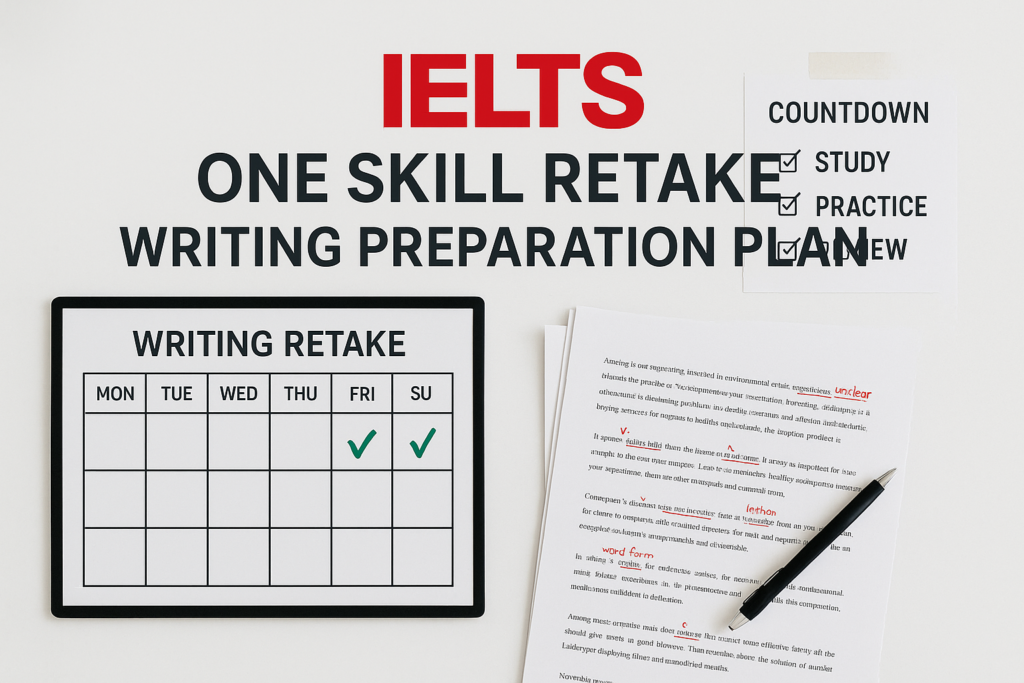
IELTS One Skill Retake Writing preparation plan should not look like general IELTS revision. If Writing is the only score you need to fix, your time has to go into diagnosis, correction, timed production, and examiner-focused checking. Before you book the retake, take the IELTS Express Pre-Test to estimate your current Writing band range and identify whether your main risk is task response, coherence, vocabulary, grammar, or time control.
One Skill Retake can be a useful option because you are not spreading effort across Listening, Reading, Speaking, and Writing again. That advantage disappears if you simply write more essays without understanding why the previous score fell short. A good plan gives every practice task a purpose. You should know what you are testing, what feedback you need, and what change you expect to see in the next draft.
This guide is written for candidates who have already taken IELTS and are preparing to retake Writing only. It works for Academic and General Training, but you should adapt the Task 1 section to your version. For broader support, Career Wise English focuses on practical IELTS preparation for candidates who need a clear score improvement plan rather than random practice.
Start With The Real Reason Your Writing Score Dropped
The first step is to separate the visible problem from the scoring problem. Many candidates say, I need better vocabulary, when the real issue is that their ideas are underdeveloped. Others say grammar is the problem, but their grammar is actually accurate enough while their paragraphing is unclear. If you fix the wrong weakness, a retake can produce the same result.
Review your last official score beside three recent timed essays. Look for repeated patterns. Did you answer all parts of the question? Did your paragraphs have one clear central idea? Did you support claims with explanations rather than examples alone? Did grammar mistakes make meaning unclear, or were they small errors in otherwise strong sentences?
- If your ideas are thin, focus on planning and explanation.
- If your structure is hard to follow, focus on paragraph control and linking.
- If your vocabulary sounds memorised, focus on precise everyday academic language.
- If grammar errors change meaning, focus on sentence accuracy before range.
- If you run out of time, focus on repeatable timing routines.
Set A Retake Target That Matches The Missing Band
Your preparation plan should match the size of the gap. A candidate moving from Writing 6.0 to 6.5 needs different work from a candidate trying to move from 6.5 to 7.0. At lower band levels, basic task completion, paragraph shape, and sentence control often create the fastest gains. At higher band levels, the difference is usually precision: clearer position, stronger development, fewer awkward sentences, and better control of complex ideas.
Do not judge progress only by how confident you feel after writing. Confidence can rise because a topic is familiar, not because your Writing is stronger. Track measurable evidence: planning time, word count control, number of complete body paragraphs, teacher corrections repeated, and whether your conclusion actually matches your introduction.
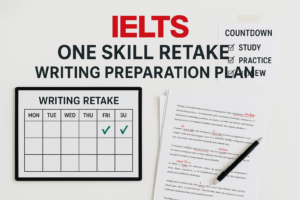
Build A 14-Day Writing Retake Calendar
A short retake plan needs rhythm. In the first two days, complete one Task 1 and one Task 2 under strict timing, then diagnose them carefully. From days three to six, work on your weakest marking area with short drills. If task response is weak, practise writing thesis statements, topic sentences, and explanation chains. If grammar is weak, rewrite old sentences until meaning is clean.
From days seven to ten, alternate timed tasks with correction sessions. Do not write a new essay every day if you never repair the old one. A corrected rewrite teaches more than a pile of untouched drafts. From days eleven to thirteen, complete two full Writing tests under test conditions. Day fourteen should be light: review your checklist, common error list, and timing plan, then rest enough to think clearly on test day.
Use Task 2 As The Main Score Lever
Task 2 carries more weight than Task 1, so it deserves most of your retake attention. A good Task 2 answer has a clear position, relevant ideas, developed reasoning, logical paragraphs, and controlled grammar. It does not need memorised phrases or dramatic introductions. It needs to answer the question directly and stay controlled for 40 minutes.
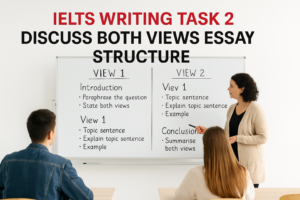
For essay structure, choose a system you can repeat under pressure. Discuss both views, agree-disagree, advantages-disadvantages, problem-solution, and two-part questions each need slightly different handling. If this is your weak point, review the IELTS Writing Task 2 discuss both views essay structure guide and compare how clearly your own paragraphs handle both sides of a question.
Do Not Neglect Task 1 In A Writing Retake
Task 1 is smaller, but it can still damage your Writing score if it is disorganised or incomplete. Academic candidates need to select key features, compare data, and avoid listing every number. General Training candidates need to match purpose, tone, and bullet points. In both versions, the examiner is looking for control, not length.
Make a simple Task 1 checklist. Did you include an overview or clear purpose? Did you group information logically? Did you compare where comparison was needed? Did your tone fit the letter situation? Did you avoid copying too much language from the prompt? Ten minutes of checklist-based review after each Task 1 can remove repeated mistakes quickly.
Practise Under Retake Conditions
Because One Skill Retake focuses on a single section, candidates sometimes treat it casually. That is risky. You still need to perform on the day, manage nerves, read the prompt accurately, and produce two complete answers. Practise the exact sequence: Task 1 for about 20 minutes, Task 2 for about 40 minutes, then five minutes for targeted checking if your timing allows.
Use realistic timed practice rather than open-ended writing sessions. If you need repeated test conditions before booking, access unlimited IELTS mock tests and track whether your Writing performance is stable across more than one attempt. One strong essay is encouraging. Consistent control is safer.
Turn Feedback Into A Correction System
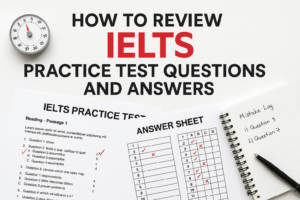
Feedback only helps if it changes the next draft. After every corrected task, create a small error log with three columns: mistake, correction, and next action. Keep it short. If your list has 40 items, you will ignore it. Choose the five errors most likely to cost marks again.
For example, if your teacher marks unclear topic sentences, your next action is not write more essays. Your next action is to draft ten topic sentences for different question types and check whether each one clearly answers the prompt. If the error is verb tense, rewrite ten old sentences. If the error is weak explanation, expand five body paragraph ideas from one sentence into three logical steps.
Avoid Memorised Templates In The Retake
Templates can make Writing look organised, but they often hide weak thinking. Examiners see memorised introductions and generic linking phrases every day. A phrase such as this essay will discuss both sides and provide a conclusion does not add much value. It uses words without answering the question.
Use flexible structures instead. For an opinion essay, state your opinion clearly and give two reasons. For a discussion essay, explain both views and show your view. For a problem-solution essay, connect each problem to a realistic solution. Simple, accurate, question-specific writing usually beats a polished paragraph that could fit any topic.
Know When EOR Is Better Than Retake
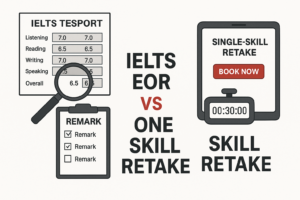
Some candidates should not rush into One Skill Retake immediately. If your Writing score is much lower than reliable teacher feedback and recent practice results, an Enquiry on Results may be worth considering. If your score matches your practice pattern, retake preparation is usually more practical than hoping for a marking change.
The choice depends on evidence, not frustration. The IELTS EOR vs One Skill Retake comparison can help you decide whether a review or a fresh Writing attempt is the better path for your deadline and score history.
Use A Final Week Checklist
In the final week, stop trying to learn everything. Your goal is to make your Writing predictable. Prepare a checklist for Task 1 and Task 2. For Task 2, include: answer the exact question, state a clear position, write two controlled body paragraphs, explain each main idea, avoid unsupported examples, and check sentence endings. For Task 1, include: cover the task fully, organise logically, use accurate comparisons, and control tone or overview.
Also decide your checking order. Many candidates waste final minutes rereading passively. Check high-value errors first: subject-verb agreement, singular and plural nouns, verb tense, articles where meaning matters, punctuation between clauses, and whether each paragraph has a clear job. Checking should be active and targeted.
What To Do On Retake Test Day
On test day, keep the plan boring. Read the prompt twice. Underline the task words mentally. Plan before writing. Do not chase a fancy opening sentence. Start with a clear answer and protect your body paragraphs. If one idea is weak, choose a simpler idea you can explain well. IELTS Writing rewards clarity more than ambition.
If anxiety rises, return to the checklist. What is the question asking? What is my position? What is paragraph one proving? What is paragraph two proving? Have I answered every bullet point or both parts of the essay prompt? This kind of self-talk keeps your attention on controllable actions.
When You Need Guided Support
If you have taken IELTS more than once and Writing remains stuck, guided feedback can save time. The issue is often not effort. It is that you are repeating the same essay habits without seeing them clearly. A teacher can show whether your answer is underdeveloped, off-task, too memorised, grammatically risky, or simply badly timed.
Before paying for a retake, compare support options and timing. You can see our IELTS preparation plans if you want a clearer route from your current Writing band to your target score. Choose support based on the gap, deadline, and amount of feedback you need, not just the number of practice tests included.
Final Advice Before You Book Writing One Skill Retake
Book the retake only when your practice evidence is moving in the right direction. You do not need perfection, but you do need a repeatable plan. If your last three timed tasks still show the same weakness, delay if your deadline allows and fix that weakness first. If your timing is stable and your corrected drafts show improvement, the retake may be the right next step.
The best IELTS One Skill Retake Writing preparation plan is focused, honest, and practical. Diagnose the cause, practise the right skill, correct old mistakes, and rehearse test-day timing. Writing improves when practice becomes specific. That is what turns one more attempt into a better attempt.
Ready to find out your IELTS band score?
Take the IELTS Express Pre-Test for just $4.99 and get your personalised band prediction with a 14-day improvement plan.
FAQ: IELTS One Skill Retake Writing Preparation Plan
How long should I prepare for IELTS Writing One Skill Retake?
Many candidates need 10 to 14 focused days if the gap is small and the weakness is clear. If your Writing score is more than 0.5 below target, allow longer and get feedback before booking.
Should I practise Task 1 or Task 2 more?
Task 2 should usually receive more time because it carries more weight, but Task 1 still matters. A weak Task 1 can lower the final Writing score, especially if it is incomplete or poorly organised.
Can I improve Writing by memorising essays?
No. Memorised essays are risky because the prompt will change. Learn flexible structures, useful sentence patterns, and topic-specific vocabulary, but write a fresh answer to the actual question.
Is One Skill Retake accepted everywhere?
Acceptance depends on the institution, migration pathway, professional body, or test user. Check the exact rule before relying on a One Skill Retake result for an application.
What is the biggest mistake before a Writing retake?
The biggest mistake is writing many new essays without correcting the reason for the previous score. Diagnosis and targeted correction matter more than volume.