
An IELTS General Training invitation letter sample answer is useful only if you understand why it works. The greeting, purpose, supporting details and closing must fit the relationship in the question. A friendly invitation to a former classmate should not sound like a business proposal, while an invitation to a visiting professional needs a more respectful register. This guide uses an original practice task, a complete model letter and a paragraph-by-paragraph explanation to help you write your own response.
Use the model as a guide to decisions, not a script to memorise. Real tasks can change the event, reader and information you must include. Start with the situation on your test paper, then choose language that would make sense to that particular person. For broader preparation options, visit Career Wise English.
1. Read the invitation task before choosing your tone
Here is an original practice prompt: You have recently moved to a new town and would like a friend to visit you. Write a letter to your friend. In your letter, explain why you would like your friend to visit, describe what you could do together, and suggest when your friend should come. This is a practice example, not a recalled examination question or an official IELTS task.
Three decisions come before writing. First, the recipient is your friend, so an informal greeting and warm language are appropriate. Second, your purpose is to invite them, not simply to describe your new home. Third, each bullet point needs a clear answer. A detailed description of the town cannot compensate for forgetting to suggest a time.
Underline the action in each bullet: explain, describe and suggest. Beside each, write one practical idea. For example: you miss spending time together; you could visit the market and walk beside the river; the first weekend in November would work because you have Friday off. These notes are enough to build a coherent letter without inventing a complicated story.
In your own timed practice, aim for a letter that gives the recipient enough information to respond. They should know what you are inviting them to do, why you want them there and which dates you have in mind. That simple reader-focused check is more useful than adding impressive but unrelated vocabulary.
2. IELTS General Training invitation letter sample answer
The following model answers all three bullets using a friendly, consistent voice. Its details are deliberately ordinary: clear communication matters more than an unusual event or an elaborate travel itinerary.
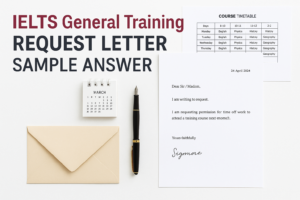
Dear Maya,
How have you been? I’ve finally settled into my new place in Brighton, and I’d love you to come and stay for a weekend. It’s been far too long since we last caught up properly, and I’d really like to show you around the town I now call home.
There’s plenty for us to do here. On Saturday morning, we could explore the farmers’ market near my apartment and pick up something for lunch. If the weather is good, I’d also like to take you along the coastal walking track. There’s a lovely little café at the end, so we could reward ourselves with coffee and cake. In the evening, we could just cook at home and catch up.
Would the first weekend in November suit you? I’ve arranged to have that Friday off, so you could arrive in the afternoon and avoid travelling late. You’re very welcome to use my spare room, and I can meet you at the station. If that weekend doesn’t work, let me know which dates would be better.
I really hope you can make it. Send me a message when you’ve checked your calendar.
All the best,
Alex
Notice what the answer does not include: a subject heading, a postal address, a memorised essay introduction or a statement about the importance of friendship in society. It begins as a letter to a known person and stays focused on the invitation. The arrangements support the purpose rather than turning into a separate narrative.
3. Why the model covers the task clearly
The opening paragraph establishes both the invitation and the reason for it. “I’d love you to come and stay” states the purpose directly. “It’s been far too long since we last caught up” explains the personal reason, while showing the town gives the visit a second, natural motivation. The reader does not have to wait until the final paragraph to discover why the letter was written.
The middle paragraph develops two activities and adds a quieter evening option. Each detail helps the friend imagine the visit. The market supplies lunch, the walk ends at a café, and cooking at home creates time to talk. This is development, not a disconnected list of attractions. You do not need to propose five different activities when two well-explained ideas would do.
The final main paragraph suggests a specific weekend and explains why it works. It also gives accommodation and collection details. Those extra details are useful because they remove practical obstacles to accepting the invitation. They remain brief, however, so the letter does not lose focus. A flexible alternative makes the suggestion sound friendly rather than demanding.
Paragraphing follows the reader’s questions: Why are you writing? What would we do? When should I come? This makes the organisation easy to follow without adding “Firstly”, “Secondly” and “In conclusion”. For a useful contrast in purpose and phrasing, compare the recent General Training apology letter sample answer. An apology needs acknowledgement and repair; an invitation needs a welcoming proposal and usable arrangements.
4. Adapt the register without copying fixed sentences
An invitation can be informal, semi-formal or formal depending on the recipient. To a close friend, “Would you like to come over next Saturday?” sounds natural. To a colleague you know reasonably well, “I’d be delighted if you could join us for dinner next Friday” may fit better. To an external speaker, “I am writing to invite you to speak at our staff training day” makes the professional purpose clear.
Do not decide the tone from the word “invitation” alone. Read the relationship and context. A neighbour you have never met is different from a neighbour who has become a close friend. If the prompt leaves limited detail, choose a reasonable level of politeness and keep it consistent from greeting to sign-off.
For a named friend, “Dear Maya” and “All the best” work together. A formal opening followed by slang creates an awkward shift. Equally, filling a friendly letter with “I hereby request your esteemed presence” makes the relationship sound unnatural. Choose familiar words that communicate accurately rather than trying to make every sentence more complex.
Grammar can still vary in a simple letter. Use a direct statement for the purpose, a modal verb for a suggestion and a conditional for an alternative. For example: “I’m organising a small dinner”; “We could eat on the balcony”; “If it rains, we can move inside.” Each structure has a job. There is no benefit in forcing a difficult sentence into a place where a shorter one is clearer.
5. Plan, write and check your own invitation letter
Practise with a short sequence you can repeat. Read the prompt, identify the recipient and make one note for each bullet. Decide the purpose sentence before you begin. Then write a greeting, an opening paragraph, two or three focused body paragraphs and a brief closing. Leave a few minutes to check the task and language rather than using every available moment to add more ideas.
During the check, look first for missing information. Have you actually invited the person? Is the reason understandable? Are the event details specific enough? If a date is requested, “sometime soon” may be too vague. If the question asks what the visitor should bring, do not assume a description of the food answers that point.
Next, check small errors that can confuse arrangements. Compare the day and date, keep future plans consistent, and check singular and plural forms such as “a spare room” and “two tickets”. Review verb patterns: “I look forward to seeing you” uses an -ing form after “to” here, whereas “I hope to see you” uses the infinitive. Correcting these recurring patterns is more useful than replacing ordinary words with unfamiliar synonyms.
Use IELTS mock tests to build timed practice into your preparation. For repeated exam-style practice, explore the unlimited IELTS mock tests option. If you need a more structured study route, review the course packages and choose support around your actual weaknesses. Before selecting any package, check its current inclusions rather than assuming that every option provides individual letter feedback.
A useful follow-up drill is to rewrite only the opening and closing for a different recipient. Keep the event the same, but change a friend into a former manager. Then rewrite the arrangements paragraph for a visitor with limited time. This teaches flexible task response without encouraging memorisation of a complete answer.
6. Frequently asked questions
Should I memorise this invitation letter sample answer?
No. Learn how it connects purpose, bullet points and register, then practise with different situations. A memorised answer can miss the actual task or include details that do not fit the recipient. Keep useful short phrases in your vocabulary notebook, but make decisions from the question you are given.
Can I use contractions in an invitation to a friend?
Yes, contractions such as “I’d”, “we’re” and “doesn’t” can suit an informal letter. The important point is consistency: natural friendly language should continue throughout the response. Avoid text-message abbreviations, which are a different style from an ordinary personal letter.
Do I need to write my address at the top?
For this practice format, concentrate on the greeting, letter body and sign-off rather than adding postal-address blocks. Follow any instructions printed with your actual task. An address does not replace a clear purpose sentence or meaningful development of the required points.
How much detail should each bullet point receive?
Give every bullet a clear answer and enough support to make it useful. Equal sentence counts are not necessary. A requested date may need one precise sentence, while describing activities may take several. Check that no bullet is merely mentioned without explanation and that extra details still serve the invitation.
Can this model guarantee a particular band score?
No sample answer guarantees a score for your own writing. This model illustrates task coverage, organisation and appropriate tone; it is not an official examiner-rated script. Your progress depends on how accurately and flexibly you apply those principles under timed conditions. Keep a record of repeated mistakes and use your next letter to correct them.