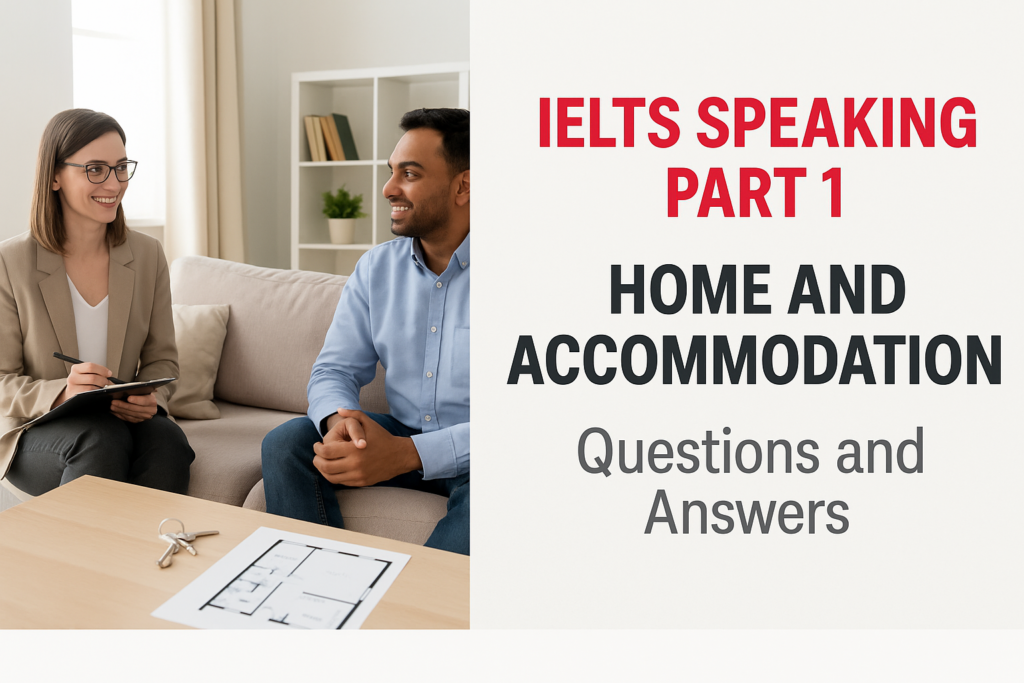
If you are practising IELTS Speaking Part 1 Home And Accommodation questions and answers, you need more than memorised lines about your house. The examiner is checking whether you can answer familiar questions naturally, extend ideas without drifting, and use everyday vocabulary accurately. Before you build a study plan, take the IELTS Express Pre-Test to check your current band range and get a focused 14-day improvement plan.
Home and accommodation is common in IELTS Speaking Part 1 because it is personal, simple on the surface, and surprisingly easy to answer badly. Many candidates give one-sentence replies. Others try to sound formal and end up using unnatural phrases. The better approach is to answer directly, add one clear reason or detail, and sound like a real person speaking to an examiner.
What IELTS Speaking Part 1 Home And Accommodation Questions Test
IELTS Speaking Part 1 is a short interview about familiar topics. Home and accommodation questions usually ask where you live, what your home is like, who you live with, what you like about your area, and whether you may move in the future.
The examiner is not judging your home. They are judging your spoken English. A strong answer shows control of tense, everyday vocabulary, pronunciation, and simple development. You do not need dramatic stories. You need clear, natural answers that last long enough to show your ability.
- Answer the exact question first.
- Add one reason, example, or small detail.
- Use natural vocabulary for rooms, location, neighbours, rent, space, and transport.
- Avoid memorised answers that sound too polished.
- Keep Part 1 answers short, usually two to four sentences.
IELTS Speaking Part 1 Home And Accommodation Questions and Answers
Below are common questions with sample answers. Use them as models, not scripts. If an answer is true for you, adapt the ideas and vocabulary. If it is not true, change it so it matches your real situation.
Do you live in a house or an apartment?
I live in an apartment at the moment. It is not very large, but it is close to public transport and shops, so it is convenient for daily life. I like that I can get most things done without travelling far.
What is your favourite room in your home?
My favourite room is the living room because it gets the most natural light. I usually study there in the morning, and it feels more comfortable than sitting in my bedroom all day.
Who do you live with?
I live with my family. We all have different schedules, so the home is not always busy, but we usually eat together in the evening. That makes the place feel warm and familiar.
What do you like about the area where you live?
I like the area because it is quiet but still practical. There are cafes, supermarkets, and a train station nearby. For me, that balance is important because I need a peaceful place to study.
Would you like to move to a different home in the future?
Yes, probably. I would like a place with a little more space, especially a separate study area. At the moment, I can manage, but a bigger home would make working and studying easier.
How To Structure A Natural Part 1 Answer
A useful structure is answer, reason, detail. First, give a direct answer. Then explain why. Finally, add a small detail that makes the answer sound specific. This keeps the response clear without making it too long.
For example, if the examiner asks, “Do you like your home?” a weak answer is, “Yes, I like it.” A stronger answer is, “Yes, I do. It is small, but it is bright and easy to keep tidy. I also like the location because I can walk to the station.” This answer is still simple, but it gives the examiner more language to assess.
If you want timed practice across all sections, access unlimited IELTS mock tests and check whether your speaking answers stay natural when you are under pressure.
Vocabulary For Home And Accommodation Answers
You do not need rare vocabulary for this topic. Good Part 1 vocabulary is accurate and flexible. Words such as spacious, cramped, convenient, noisy, peaceful, furnished, rented, shared, residential, central, and well connected can help, but only if they fit your real answer.
It is also useful to talk about parts of a home. You might mention a balcony, study area, living room, kitchen, storage space, garden, driveway, or shared facilities. For location, you can talk about transport, supermarkets, parks, neighbours, traffic, safety, rent, and distance from work or study.
- “My apartment is quite compact, but it is easy to maintain.”
- “The area is well connected, so commuting is not too stressful.”
- “I live in a shared house, which helps reduce the rent.”
- “The main problem is noise from the road.”
- “I would prefer a home with more natural light.”
For broader speaking support, review the IELTS Speaking Part 1 sample answers guide and compare how strong answers stay clear without becoming memorised.
Common Mistakes With Home And Accommodation Answers
The first mistake is giving answers that are too short. Part 1 is not a yes-or-no test. If you only say, “Yes, I do,” the examiner cannot hear enough grammar, vocabulary, or fluency. Add a reason or example.
The second mistake is using language that sounds unnatural. Phrases such as “my residence is extremely magnificent” do not help. They sound memorised and may be inaccurate. Say “my home is comfortable” or “my apartment is modern” if that is what you mean.
The third mistake is over-explaining. Part 1 answers should not become speeches. If you talk for a full minute on a simple question, the examiner may need to interrupt you. Aim for a complete answer, not a long answer.
Grammar Patterns That Help You Sound More Fluent
Home questions often need present simple, present perfect, comparatives, and future language. You may say where you live now, how long you have lived there, what is better or worse than another place, and what you would like in the future.
Useful patterns include “I have lived there for…”, “It is more convenient than…”, “I would prefer…”, and “If I could change one thing…”. These patterns are simple, but they give your answer shape.
For example: “I have lived in this apartment for about two years. It is more convenient than my previous place because it is closer to the city. If I could change one thing, I would make the kitchen bigger.” That answer uses several grammar forms naturally, without sounding forced.
How To Practise Without Memorising Scripts
Write down ten common home and accommodation questions. Record yourself answering each question once without notes. Then listen again and check whether each answer has a direct response, one reason, and one detail.
Next, repeat the same questions with slightly different wording. For example, change “Do you like your home?” to “What do you like about your home?” This trains flexibility. IELTS examiners can ask familiar questions in different ways, so you need to respond to meaning, not memorise exact sentences.
If your speaking score is important for migration, study, or registration, compare IELTS preparation plans and choose support that gives you feedback on fluency, pronunciation, grammar control, and answer development.
Band 7 Style Home And Accommodation Answers
A Band 7-style answer is not perfect. It may still have small errors. The key difference is that the answer is clear, extended enough, and mostly natural. The speaker can explain simple ideas without long pauses or repeated correction.
Question: Is your home suitable for studying?
Most of the time, yes. My bedroom has a small desk, and the area is quiet in the evenings, so I can concentrate. The only problem is that there is not much space, so I have to keep my books and notes very organised.
Question: What would you change about your home?
I would probably add a balcony or a small outdoor area. I spend a lot of time indoors, especially when I am studying, so it would be nice to have a place where I could sit outside for a short break.
Question: Do many people in your country live in apartments?
Yes, especially in large cities. Apartments are usually more affordable than houses, and they are often closer to work, universities, and public transport. In smaller towns, houses are still more common.
Final Practice Checklist
Before your next speaking practice session, prepare ideas for your current home, your ideal home, your neighbourhood, people you live with, and changes you would like to make. Do not write full scripts. Write short notes and practise turning them into spoken answers.
When you answer, listen for clarity. Did you answer the question? Did you give a reason? Did you include one specific detail? Did your vocabulary sound natural? These small checks matter more than learning complicated words.
Home and accommodation is a friendly Part 1 topic if you keep it personal and direct. Use clear everyday language, extend each answer slightly, and practise enough that you can respond calmly even when the question is worded differently from the one you expected.
Ready to find out your IELTS band score?
Take the IELTS Express Pre-Test for just $4.99 and get your personalised band prediction with a 14-day improvement plan.
FAQ: IELTS Speaking Part 1 Home And Accommodation Questions and Answers
How long should my IELTS Speaking Part 1 answers be?
Most Part 1 answers should be two to four sentences. Give a direct answer, add a reason, and include one small detail. Do not turn a simple question into a long speech.
Can I memorise home and accommodation answers?
You can prepare ideas and vocabulary, but you should not memorise full answers. Memorised responses often sound unnatural, and they may not answer the exact question the examiner asks.
What vocabulary should I use for home and accommodation?
Use natural words for your living situation, such as apartment, rented, shared, spacious, compact, quiet, convenient, neighbourhood, transport, balcony, and study area. Accuracy is more important than rare vocabulary.
What if I do not like my home?
It is fine to say that, as long as you explain politely and clearly. For example, you might say your home is convenient but noisy, or affordable but too small. Honest answers are usually easier to develop.
How can I practise IELTS Speaking Part 1 at home?
Record short answers to common questions, listen back, and check whether each answer has a clear answer, reason, and detail. Then practise the same topic with different question wording.