How to improve IELTS Reading from band 7 to 8 is a very different problem from moving from band 5 to 6. At band 7, you already understand most passages and most question types. The missing band is usually lost through timing pressure, overconfidence, weak review habits, and a few repeated traps. Before you add more random practice tests, take the IELTS Express Pre-Test to check whether your current gap is accuracy, speed, vocabulary, or question-type control.
A band 8 Reading score needs a higher level of consistency. You cannot rely on one strong passage or a lucky set of familiar topics. You need a method that protects easy marks, handles difficult questions calmly, and turns practice mistakes into specific fixes.
How To Improve IELTS Reading From Band 7 To 8: The Real Difference
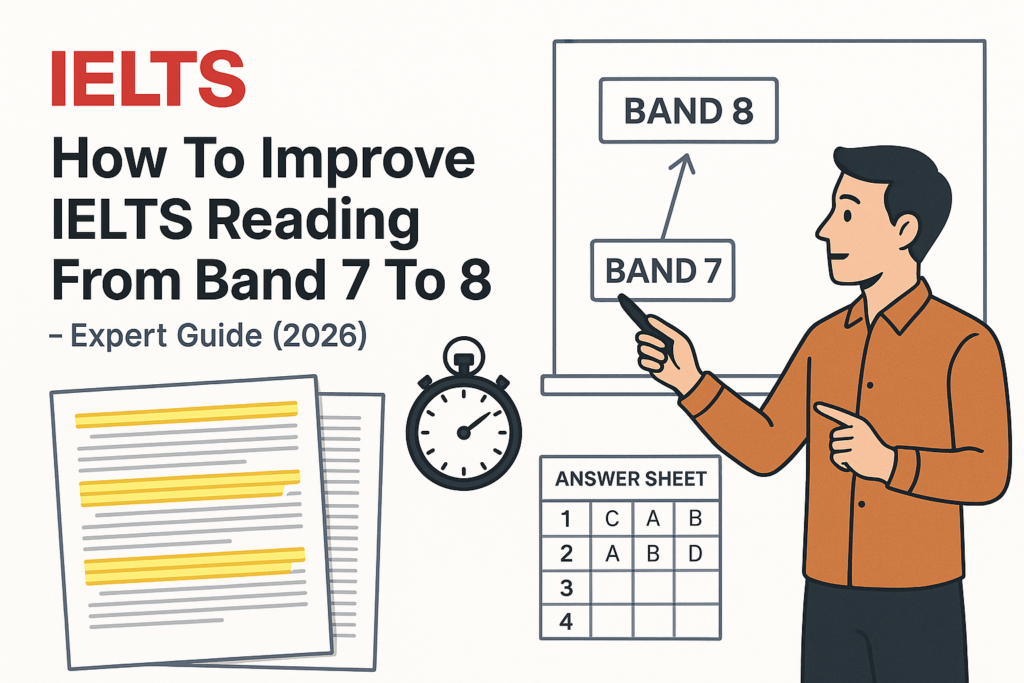
The difference between band 7 and band 8 is often smaller than candidates think, but it is less forgiving. In Academic Reading, band 8 usually requires around 35 correct answers out of 40. In General Training Reading, the required number is usually higher. The exact conversion can vary slightly by test, but the message is clear: there is not much room for careless errors.
At band 7, you may understand the passage but still lose marks because you choose an answer from memory, miss a qualifier, ignore a plural, or spend too long on one hard question. Band 8 requires better control of these small risks.
- Protect easy questions before fighting difficult ones.
- Review every wrong answer by cause, not only by correct answer.
- Practise under time pressure often enough to expose real habits.
- Build question-type methods for headings, matching, True False Not Given, and sentence completion.
- Improve vocabulary through passage review, not isolated word lists alone.
Start With A Reading Error Audit
If you are already near band 7, more practice is useful only when it gives you evidence. Complete one timed Reading test and record every wrong answer. Do not write only the correct option. Write why your answer was wrong.
Use simple categories: vocabulary problem, time pressure, question-type confusion, missed paraphrase, wrong location, careless grammar, or overthinking. After two tests, patterns will appear. A candidate who loses six marks to True False Not Given needs a different plan from someone who loses six marks in the final passage because of timing.
For a broader Reading method, connect this audit with the IELTS Reading Practice guide so your band 8 plan is not just a pile of practice papers.
Stop Reading Every Line At The Same Speed
Band 8 candidates do not read every sentence with equal attention. They skim for structure, scan for location, and slow down only when the answer area matters. This matters because IELTS Reading is partly a time-management test.
Use the title, paragraph openings, names, dates, numbers, and repeated nouns to build a rough map of the passage. Then use the question to decide where to read carefully. If you try to understand every sentence before looking at the questions, you may use too much time before the real work begins.
The goal is not to read faster in a vague way. The goal is to control your speed. Move quickly through background explanation. Slow down around contrast words, definitions, results, causes, and direct answer areas.
Improve Accuracy Before You Chase Speed
Many band 7 candidates think speed is the only problem. Often the deeper issue is unstable accuracy. If you answer quickly but make repeated small mistakes, extra speed simply gives you more time to be wrong.
Practise some sets untimed first. Your job is to prove that your method can reach a high accuracy level without time pressure. Once your accuracy is stable, add the timer again. This sequence is especially useful for question types that punish small wording differences.
To test your method in realistic conditions, access unlimited IELTS mock tests and review each test by error type, not only by total score.
Master True False Not Given
True False Not Given is a common band 8 blocker because the difference between False and Not Given can be subtle. True means the statement agrees with the passage. False means it contradicts the passage. Not Given means the passage does not provide enough information to decide.
Do not use outside knowledge. Do not decide from general logic. Force yourself to point to the exact words that prove the answer. If you cannot prove agreement or contradiction, Not Given becomes more likely.
Watch for qualifiers such as all, most, some, only, always, usually, first, main, and most important. These words often decide the answer. A passage may say that a method is useful in some cases, while the statement says it is always useful. That difference matters.
Handle Matching Headings With Paragraph Purpose
Matching headings is not a keyword task. A paragraph may mention several topics, but the correct heading summarises the main purpose. At band 7, candidates often choose a heading because it contains a word from the paragraph. At band 8, that habit is dangerous.
Before checking the options, write a very short mental summary of the paragraph. Ask: what is this paragraph doing? Is it explaining a cause, describing a problem, giving evidence, showing a change, or comparing two views?
If two headings look possible, choose the one that covers the whole paragraph. The wrong option is often too narrow, based on an example, or focused on one attractive sentence.
Use Paraphrase Review To Build Vocabulary
Band 8 Reading is not about knowing every word. It is about recognising meaning when IELTS changes the wording. The passage may say “a rapid fall”, while the question says “a sudden decline”. The passage may say “limited evidence”, while the answer option says “not enough proof”.
After each practice test, make a two-column paraphrase list. On the left, write the words from the question. On the right, write the matching words from the passage. This is more useful than copying random new vocabulary because it trains the exact skill the test rewards.
Also record signal words. Contrast markers, cause-and-effect words, and comparison language often guide you to the answer. Words such as however, although, despite, led to, resulted in, compared with, and whereas deserve attention.
Build A Safer Timing System
A simple Reading timing plan is 15 minutes for Passage 1, 20 minutes for Passage 2, and 25 minutes for Passage 3. This is only a guide, but it stops Passage 1 from stealing time you need later. If you are taking General Training, adjust timing based on the section difficulty and your test format.
Do not spend four minutes on one uncertain question. Make the best evidence-based choice, mark it, and move on. Many candidates lose band 8 because one difficult question costs them three easier marks later.
If your timing remains unstable, see our IELTS preparation plans and choose support that includes timed review and section-specific diagnosis.
Learn To Review Like A Band 8 Candidate
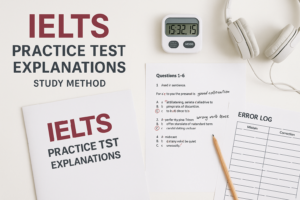
Good review is uncomfortable because it shows patterns. Do not simply check the answer key and move on. For every wrong answer, answer four questions: where was the answer in the passage, what phrase proved it, why was my answer tempting, and what rule will I use next time?
This turns errors into decisions you can change. For example, if you repeatedly choose answers before reading the full sentence, your rule may be: always read the sentence before and after the answer area. If you miss plural forms, your rule may be: check grammar after locating the answer.
Keep this review short but honest. A one-page error log used properly is better than ten completed tests with no diagnosis.
A Four-Week Band 7 To Band 8 Reading Plan
In week one, complete two timed tests and build your error audit. Identify the two question types causing the most lost marks. Do not start by changing everything. Fix the biggest leaks first.
In week two, practise those question types in focused sets. Work untimed first, then timed. Record the exact trap in every wrong answer. In week three, add full passages and practise your timing system. In week four, complete full Reading sections under test conditions and compare your score, timing, and error pattern with week one.
If the score improves but one question type still causes trouble, keep that as your main repair target. If the score does not improve, the problem may be vocabulary depth, passage mapping, or review quality rather than effort.
Common Band 7 Habits That Block Band 8
The first habit is trusting memory. You remember seeing a word in the passage and choose an answer without returning to the exact sentence. Band 8 needs evidence, not memory.
The second habit is over-reading. You spend too long trying to understand every detail, even when the question only needs one located answer. The third habit is weak answer checking. Spelling, word limits, singular and plural forms, and grammar still matter.
The fourth habit is practising only comfortable question types. If you avoid matching information or True False Not Given because they feel annoying, they will probably stay weak. Band 8 preparation should target the questions you least want to practise.
Final Checklist Before Your Next Reading Test
Before test day, check that you can explain your method for each major question type. Know how you will skim, how you will locate answers, how long you will spend on each passage, and how you will handle uncertain questions.
During the test, stay evidence-based. The answer must come from the passage, not from your memory or opinion. Protect easy marks, manage time, and review only where review is likely to change an answer.
Moving from band 7 to band 8 is not about reading everything perfectly. It is about making fewer avoidable mistakes and using your time with more control. That is a trainable skill.
Ready to find out your IELTS band score?
Take the IELTS Express Pre-Test for just $4.99 and get your personalised band prediction with a 14-day improvement plan.
FAQ: How To Improve IELTS Reading From Band 7 To 8
How many correct answers do I need for IELTS Reading band 8?
In Academic Reading, band 8 usually needs around 35 correct answers out of 40. General Training often requires a higher number. The exact conversion can vary slightly, so focus on building a safer margin.
Why am I stuck at band 7 in IELTS Reading?
You may be losing marks through repeated question-type traps, timing pressure, weak paraphrase recognition, or careless answer transfer. An error audit will show which pattern is costing the most marks.
Can I improve from band 7 to 8 in one month?
Yes, it is possible if your current score is already close and your mistakes are specific. One month is enough to improve timing, review habits, and weak question types, but only if practice is targeted.
Should I read more books to improve IELTS Reading?
General reading can help vocabulary over time, but it is not enough by itself. To reach band 8, you also need IELTS-specific question practice, paraphrase review, and timed test control.
What is the best way to review IELTS Reading mistakes?
Find the exact evidence in the passage, identify why your answer was tempting, classify the mistake, and write one rule for next time. This is more useful than only checking the correct answer.