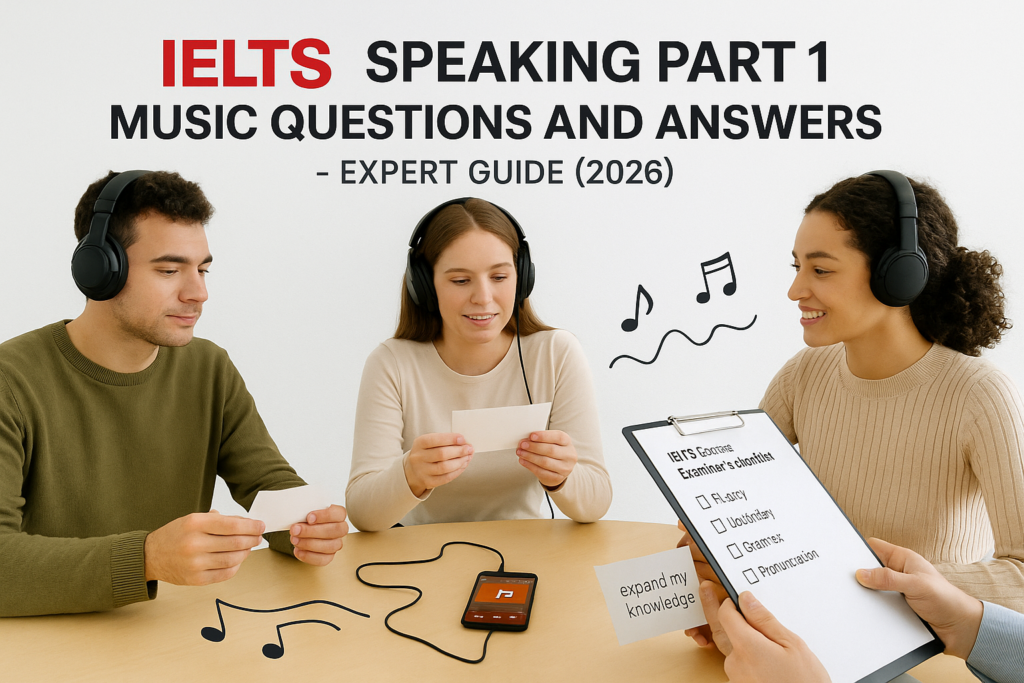
IELTS Speaking Part 1 Music questions and answers are common because music is personal, familiar, and easy for the examiner to vary. You may be asked what music you like, when you listen to music, whether your taste has changed, or whether music is important in your country. Before you practise a long list of model answers, take the IELTS Express Pre-Test to check your current speaking band range and see whether answer length, fluency, or vocabulary is the main issue.
Part 1 music questions do not require technical music knowledge. You do not need to discuss complex genres, famous composers, or music theory. The examiner is checking whether you can answer ordinary personal questions clearly, naturally, and with enough detail. A strong answer is usually short, direct, and specific.
IELTS Speaking Part 1 Music Questions And Answers: What To Expect
Music usually appears as a light Part 1 topic. The examiner may ask about your preferences, habits, childhood memories, concerts, popular music in your country, or whether you prefer listening alone or with other people. These questions feel simple, but they still test fluency, grammar, vocabulary, and pronunciation.
The biggest risk is giving answers that are either too short or too rehearsed. If you only say “I like pop music”, the answer does not show much language. If you give a memorised speech about the history of music, it may sound unnatural and may not answer the question.
- Answer the exact question first.
- Add one clear reason.
- Include a short example if it fits.
- Use natural music vocabulary, not forced advanced words.
- Stop before the answer becomes a prepared speech.
How To Structure A Part 1 Music Answer
A reliable structure is direct answer, reason, and detail. For example: I usually listen to pop and acoustic music because it helps me relax after work. I do not follow every new song, but I like music that is easy to listen to while I am travelling or cooking.
You can also use contrast. For example: I used to listen to very loud music when I was younger, but now I prefer calmer songs because I spend most of my day in a busy environment. Contrast makes your answer more flexible and gives the examiner more grammar to assess.
If you want a broader system for answer length and development, read the IELTS Speaking Part 1 tips and strategies guide and compare your music answers with the recommended Part 1 shape.
Sample Answers About The Music You Like
Question: What kind of music do you like?
I mostly like pop music and acoustic songs because they are easy to listen to. If I am studying or travelling, I usually choose something calm rather than anything too loud.
Question: Who is your favourite singer or band?
I do not really have one favourite singer, but I enjoy artists with clear voices and meaningful lyrics. I tend to remember individual songs more than the name of the performer.
Question: Has your taste in music changed?
Yes, quite a bit. When I was younger, I preferred energetic songs, but these days I usually listen to slower music because it helps me relax.
Sample Answers About Listening Habits
Question: When do you usually listen to music?
I usually listen to music when I am travelling, cooking, or doing simple tasks at home. It makes boring routines feel more enjoyable, especially if I am tired.
Question: Do you listen to music while studying or working?
Sometimes, but only if the task is not too difficult. If I need to concentrate deeply, I prefer silence because lyrics can distract me.
Question: Do you prefer listening to music alone or with others?
I usually prefer listening alone because I can choose exactly what I want. With friends, music is more about the atmosphere, so I do not mind what is playing as much.
To practise these answers under realistic pressure, access unlimited IELTS mock tests and train yourself to answer without pausing too long or over-planning each sentence.
Sample Answers About Live Music And Concerts
Question: Have you ever been to a concert?
Yes, I have been to a few small concerts. I enjoyed the atmosphere more than I expected because live music feels more energetic than listening through headphones.
Question: Would you like to go to more concerts?
Yes, if the tickets are affordable. I like live music, but big concerts can be expensive and crowded, so I would probably choose a smaller venue.
Question: Is live music popular in your country?
Yes, especially in large cities. People go to concerts, festivals, and smaller live performances in cafes or bars, although the popularity depends on the type of music.
Sample Answers About Music In Your Country
Question: What music is popular in your country?
Pop music is probably the most popular, especially among young people. Traditional music is also important at festivals and cultural events, but people may not listen to it every day.
Question: Do older and younger people like the same music?
Not always. Younger people often follow new songs online, while older people may prefer music they grew up with. However, some songs are popular across different age groups.
Question: Is music important in daily life?
Yes, I think so. People use music to relax, celebrate, exercise, or improve their mood. It is not essential in a practical sense, but it makes daily life more enjoyable.
Useful Vocabulary For Music Answers
You do not need unusual vocabulary for this topic. You need accurate words and phrases that sound natural in a short answer. Simple, flexible vocabulary is often stronger than forced complex language.
- Genre: a type of music, such as pop, rock, jazz, classical, or hip-hop.
- Lyrics: the words of a song.
- Melody: the main tune of a song.
- Catchy: easy to remember after hearing it.
- Relaxing: making you feel calm.
- Upbeat: positive and energetic.
- Live music: music performed in front of an audience.
- Background music: music playing while you do something else.
Use these words only when they fit the answer. For example, you could say, “I like songs with catchy melodies because I can remember them easily,” or “I prefer background music when I am cooking.”
Grammar Patterns That Work Well For Music Topics
Frequency language is useful for music answers. You can say I usually listen to music, I sometimes play music while working, I hardly ever go to concerts, or I listen to music almost every day. These phrases help your answer sound specific.
Past and present contrast is also helpful. You might say, “I used to listen to rock music, but now I prefer acoustic songs.” This shows tense control without making the answer complicated.
Comparatives are useful for preferences. You can say live music is more exciting than recorded music, slow songs are more relaxing than upbeat songs, or listening alone is more convenient than choosing music with a group.
Common Mistakes With Music Answers
The first mistake is giving a list instead of an answer. If the question asks what music you like, do not only name five genres. Choose one or two and explain why. The reason is usually more valuable than the list.
The second mistake is sounding too formal. Music is an everyday topic, so phrases like “I utilise musical compositions to enhance my psychological state” sound unnatural. Say it clearly: “I listen to music because it improves my mood.”
The third mistake is pretending to know more than you do. You do not need to be a music expert. If you are not very interested in music, say that honestly and explain when you do listen to it. A simple honest answer can still be strong.
If your Speaking score is stuck because your answers sound short, memorised, or unclear, see our IELTS preparation plans and choose support that includes spoken feedback, not only sample answers.
How To Answer If You Do Not Like Music
It is completely acceptable to say that music is not a big part of your life. The key is to develop the answer. For example: I do not listen to music very often because I usually prefer podcasts or silence. However, I sometimes play music when I am exercising or travelling.
This answer works because it is honest and still gives detail. You are not expected to love every topic in Part 1. You are expected to communicate clearly, even when the topic is not your favourite.
If the examiner asks a follow-up question, connect music to ordinary situations: shops, public transport, exercise, films, celebrations, or family events. That gives you enough content without inventing a fake passion.
A Seven-Day Practice Plan For Music Questions
On day one, record ten short answers about your music preferences. Keep each answer under thirty seconds. On day two, improve each answer by adding one clear reason. On day three, practise questions about listening habits and focus on frequency language.
On day four, practise past and present answers about how your music taste has changed. On day five, practise live music and concert questions. On day six, mix music with other Part 1 topics so you can change topic smoothly. On day seven, record a full Part 1 practice test and note three repeated problems.
The aim is not to memorise perfect answers. The aim is to build flexible control so you can answer naturally when the examiner changes the wording.
How To Sound Natural Instead Of Rehearsed
Natural answers often include small real-life details. Instead of saying you love all music, mention when you listen, what you avoid, or how your choice depends on your mood. These details make the answer sound believable.
Use simple linking words such as because, but, so, and for example. They are enough for Part 1. Formal essay connectors can make a speaking answer sound stiff and memorised.
It is also fine to correct yourself naturally. If you start with one idea and then adjust it, that can sound more conversational than a perfectly memorised sentence. The goal is clear communication, not performance.
Final Checklist Before Your Speaking Test
Before test day, make sure you can answer questions about your favourite music, when you listen, live music, music in your country, childhood music, and whether your taste has changed. Practise answering at a natural speed and stop before the answer becomes too long.
Check that your answers include reasons, examples, and flexible vocabulary. Avoid memorising full responses. If you can listen carefully, answer the exact question, and add one useful detail, music can become one of the safest Part 1 topics.
Ready to find out your IELTS band score?
Take the IELTS Express Pre-Test for just $4.99 and get your personalised band prediction with a 14-day improvement plan.
FAQ: IELTS Speaking Part 1 Music Questions And Answers
What music questions are common in IELTS Speaking Part 1?
Common questions include what kind of music you like, when you listen to music, whether your taste has changed, whether you enjoy live music, and what music is popular in your country.
How long should my music answers be?
Most Part 1 answers should be two to four sentences. Give a direct answer, add one reason, and include a short example or detail if it fits naturally.
Can I say I do not like music?
Yes. IELTS does not require you to love music. Say honestly that you do not listen often, then explain when you might hear music or what you prefer instead.
Should I memorise music sample answers?
No. Practise useful ideas and phrases, but avoid memorising complete answers. The examiner may ask the question in a different way, so flexible answers are safer.
What vocabulary is useful for IELTS music topics?
Useful words include genre, lyrics, melody, catchy, relaxing, upbeat, live music, background music, concert, performer, and traditional music.