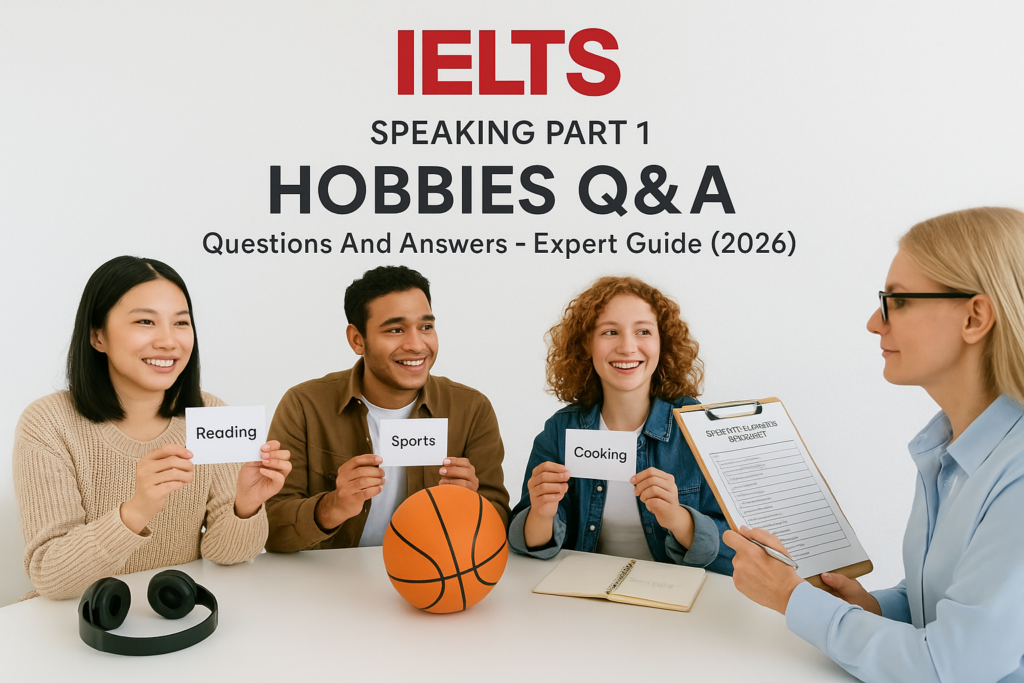
IELTS Speaking Part 1 Hobbies questions and answers are useful because hobbies are familiar, personal, and easy for examiners to vary. You may be asked what you do in your free time, whether your hobbies have changed, what hobbies are popular in your country, or whether you prefer doing activities alone or with other people. Before you memorise model answers, take the IELTS Express Pre-Test to check your current speaking band range and find the habits that may be limiting your answers.
Part 1 is not looking for a long speech. The examiner wants short, natural answers that respond directly to the question and show enough language for assessment. Hobbies are a good topic because you can use present simple, frequency language, comparisons, reasons, preferences, and short examples without sounding forced.
IELTS Speaking Part 1 Hobbies Questions And Answers: What To Expect
Hobbies questions usually appear near the start of the speaking test. The topic feels simple, but simple topics can still expose weak fluency. If you only say “I like reading” or “I play football”, your answer may be too short. If you give a prepared one-minute speech, it may sound memorised.
A good Part 1 answer is usually two to four sentences. Start with a direct answer, then add a reason, detail, or example. Keep the tone conversational. You are not giving a presentation; you are answering an examiner’s question clearly.
- Answer the exact question first.
- Add one reason or example.
- Use natural hobby vocabulary.
- Show frequency, preference, and comparison language.
- Stop before the answer becomes a prepared speech.
How To Structure Hobbies Answers In Part 1
The safest structure is answer, reason, detail. If the examiner asks what you do in your free time, you might say: I usually read or go for a walk after work because it helps me relax. I do not have much free time during the week, so I prefer simple hobbies that do not need a lot of planning.
You can also use contrast. For example: I used to play team sports when I was younger, but these days I mostly exercise alone because my schedule is less predictable. Contrast helps you show a wider range of language while still sounding natural.
If you want broader help with answer length and development, read the IELTS Speaking Part 1 tips and strategies guide and compare your answers with the recommended Part 1 shape.
Sample Answers About Your Favourite Hobby
Question: What is your favourite hobby?
My favourite hobby is cooking because it helps me relax after a busy day. I usually try simple recipes during the week, but on weekends I sometimes spend more time making something new.
Question: How often do you do this hobby?
I do it several times a week, although it depends on my schedule. If I am busy, I just cook something quick, but I still enjoy the process.
Question: Why do you enjoy it?
I enjoy it because it feels creative but also practical. At the end, I have something useful, and it is a nice break from staring at a screen.
Sample Answers About Free Time
Question: What do you usually do in your free time?
In my free time, I usually listen to music, watch short videos, or go for a walk. I prefer activities that help me switch off because my work or study routine can be quite intense.
Question: Do you have much free time?
Not really during the week. I usually have more time on weekends, so I try to use that time for exercise, meeting friends, or doing something away from my phone.
Question: Do you prefer relaxing at home or going out?
It depends on how tired I am. If I have had a long week, I prefer staying at home, but if the weather is good, I like going out for coffee or a walk.
To practise these answers under realistic pressure, access unlimited IELTS mock tests and train yourself to answer quickly without over-planning every sentence.
Sample Answers About Hobbies From Childhood
Question: What hobbies did you have when you were a child?
When I was a child, I liked drawing and playing outside with friends. I was not very serious about either activity, but I enjoyed anything that felt active or creative.
Question: Have your hobbies changed since you were younger?
Yes, they have changed quite a lot. I used to prefer energetic hobbies, but now I enjoy quieter activities such as reading, cooking, or walking because they fit my lifestyle better.
Question: Do children today have different hobbies?
Yes, I think many children spend more time on digital hobbies now, such as gaming or watching online videos. Some still play sport, but screens are a much bigger part of free time than before.
Sample Answers About Social And Solo Hobbies
Question: Do you prefer hobbies alone or with other people?
I like both, but it depends on the hobby. Reading or exercising alone helps me relax, while playing sport or eating out is more enjoyable with friends.
Question: Are hobbies a good way to make friends?
Yes, definitely. Shared hobbies give people something easy to talk about, so it can feel less awkward than meeting someone with no common interest.
Question: What hobbies are popular in your country?
Sport is very popular, especially football, cricket, swimming, or going to the gym. Many people also enjoy cooking, watching films, travelling, and spending time with family.
Useful Vocabulary For Hobbies Answers
You do not need rare vocabulary for hobbies. You need accurate phrases that sound natural in a short answer. It is better to use simple words well than to force advanced words into every sentence.
- Free time: time when you are not working or studying.
- Relaxing: helping you feel calm.
- Creative: involving ideas, design, music, art, cooking, or making things.
- Active: involving movement or exercise.
- Social hobby: an activity you do with other people.
- Indoor hobby: an activity done inside, such as reading or cooking.
- Outdoor hobby: an activity done outside, such as hiking or cycling.
- Take up a hobby: start doing a new hobby.
Use vocabulary only when it fits the question. For example, if the examiner asks whether you would like to try a new hobby, you can say, “I would like to take up photography because it would encourage me to notice places more carefully.”
Grammar Patterns That Work Well For Hobbies Topics
Frequency language is very useful. You can say I usually, I often, I sometimes, once or twice a week, every weekend, or hardly ever. These phrases make your answer more specific and help you avoid very short responses.
Past and present contrast is also useful. You might say, “I used to play basketball at school, but now I mostly go to the gym.” This shows tense control and gives the answer a natural story.
Comparatives can help with preferences. You can say reading is more relaxing than watching videos, team sports are more social than going to the gym, or cooking at home is cheaper than eating out. These simple structures are enough for strong Part 1 answers.
Common Mistakes With Hobbies Answers
The first mistake is answering too briefly. If the examiner asks what you do in your free time and you only say “I watch TV”, the answer gives very little evidence of fluency, vocabulary, or grammar. Add a reason or detail.
The second mistake is sounding too formal. Hobbies are an everyday topic, so language such as “I engage in leisure pursuits to enhance my mental wellbeing” sounds unnatural. Say it clearly: “I like walking because it clears my head.”
The third mistake is memorising impressive answers. A memorised hobbies answer may not match the exact question. If the examiner asks whether your hobbies have changed, but you deliver a prepared answer about your favourite hobby, the response will feel disconnected.
If your Speaking score is not moving, see our IELTS preparation plans and choose support that includes spoken feedback, not only lists of possible topics.
A Seven-Day Practice Plan For Hobbies Questions
On day one, record ten short answers about your current hobbies. Keep each answer under thirty seconds. On day two, improve each answer by adding one reason. On day three, practise childhood hobby questions and focus on past tense accuracy.
On day four, practise social and solo hobby questions using comparison language. On day five, build a list of natural phrases for frequency and preferences. On day six, mix hobbies with other Part 1 topics so you can change topic smoothly. On day seven, record a full Part 1 practice and note three repeated problems.
The aim is flexible control, not a perfect script. If you can answer hobbies questions with direct responses, natural reasons, and small details, the topic becomes much easier to manage.
How To Sound Natural Instead Of Rehearsed
Natural answers often include small limits. Instead of saying you always love a hobby, say when you do it, why you sometimes stop, or how it fits your real schedule. These details make the answer sound more believable.
Use common linking words such as because, but, so, and for example. They are enough for Part 1. Formal essay connectors can make a speaking answer sound stiff.
It is also fine to give a simple answer. IELTS Speaking is not a test of unusual hobbies. A clear answer about walking, cooking, music, gaming, sport, or reading can score well if the language is accurate and developed.
Final Checklist Before Your Speaking Test
Before test day, make sure you can answer questions about your favourite hobby, free time, childhood hobbies, popular hobbies, new hobbies, and whether you prefer activities alone or with others. Practise answering at a natural speed and stop before the answer becomes too long.
Check that your answers include reasons, examples, and flexible vocabulary. Avoid memorising full responses. If you can listen carefully, answer the exact question, and add one useful detail, hobbies can become one of the safest Part 1 topics.
Ready to find out your IELTS band score?
Take the IELTS Express Pre-Test for just $4.99 and get your personalised band prediction with a 14-day improvement plan.
FAQ: IELTS Speaking Part 1 Hobbies Questions And Answers
What hobbies questions are common in IELTS Speaking Part 1?
Common questions include what you do in your free time, what your favourite hobby is, whether your hobbies have changed, what hobbies are popular in your country, and whether you prefer doing hobbies alone or with other people.
How long should my hobbies answers be?
Most Part 1 answers should be two to four sentences. Give a direct answer, add one reason, and include a small example or detail if it fits naturally.
Can I say I do not have any hobbies?
Yes, but you should still develop the answer. You can say you are busy, then explain what you do to relax when you have time, such as walking, watching films, cooking, or talking with friends.
Should I memorise IELTS hobbies answers?
No. Practise useful ideas and vocabulary, but avoid memorising complete answers. The examiner may ask the question in a different way, so flexible answers are safer.
What vocabulary is useful for hobbies topics?
Useful phrases include free time, relaxing, creative, active, indoor hobby, outdoor hobby, social hobby, take up a hobby, once or twice a week, and helps me switch off.