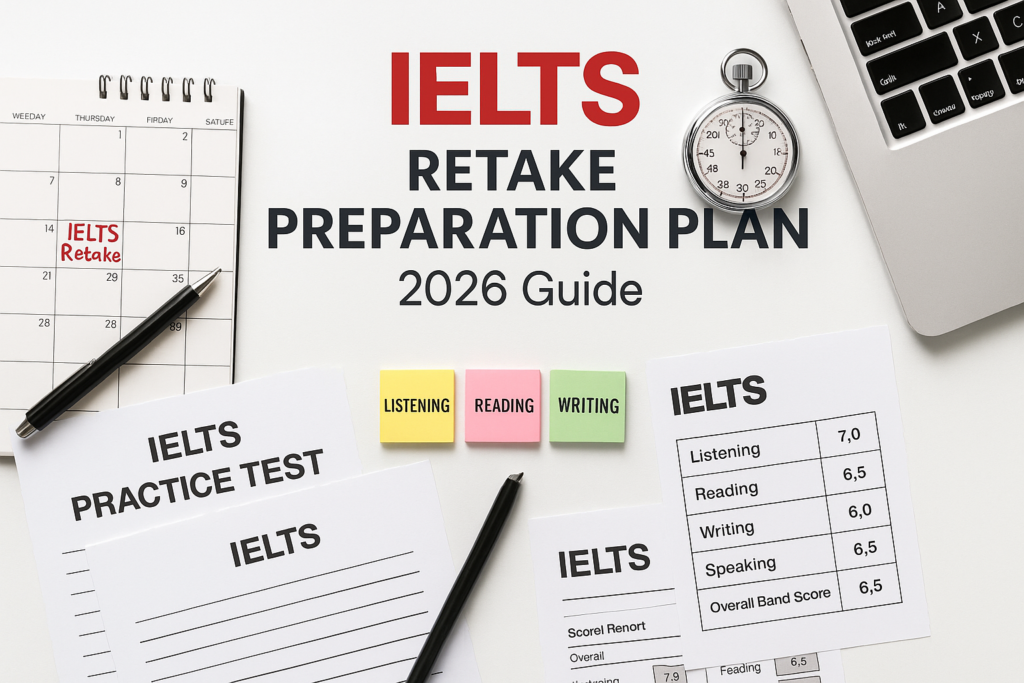
IELTS retake preparation plan is what you need when your last result was close, disappointing, or uneven across sections. A retake can absolutely make sense, but only if the next attempt is built from evidence rather than frustration. Before you pay another test fee, take the IELTS Express Pre-Test to estimate your current band range and identify which skill is most likely to block your target score.
Many candidates rush into another IELTS booking because they feel they were unlucky. Sometimes that is true. More often, the result shows a pattern: Writing is half a band low, Reading timing breaks down, Listening loses marks to spelling, or Speaking answers sound too short under pressure. A strong retake plan turns the old score report into a practical map for the next two to six weeks.
IELTS Retake Preparation Plan: Start With The Score Report
Your previous IELTS result is not just a number. It is your first diagnostic tool. Write down your overall score, each section band, your target score, and any section minimums required for university, migration, nursing, teaching, employment, or visa purposes. The section minimums matter because a strong overall score may still fail your real requirement.
For example, if you need 7.0 in each band and your result was Listening 8.0, Reading 7.5, Writing 6.5, and Speaking 7.0, your retake plan should not treat all four skills equally. Writing is the bottleneck. You still need to maintain the other sections, but most of your improvement energy belongs where the score is short.
- Record your required overall band and section minimums.
- Mark every section that is below target.
- Separate a half-band gap from a full-band gap.
- Check whether your next deadline allows one retake or more.
- Decide whether you need a full retake or an accepted one-skill option.
Do Not Retake Before You Know The Cause
A retake without diagnosis is just a second attempt at the same problem. If your Writing score was low, ask whether the issue was task response, structure, grammar accuracy, vocabulary range, or timing. If your Speaking score was low, ask whether answers were too short, too memorised, unclear, or hard to develop under examiner follow-up.
For Reading and Listening, the cause is often more specific than “I need more practice”. You may be losing marks to True False Not Given, matching headings, spelling, plural nouns, distractors, map questions, or rushing at the end. The fix depends on the pattern.
If you need realistic evidence before booking, access unlimited IELTS mock tests and compare your practice scores against the exact retake target. Mock tests are most useful when you review why marks were lost, not only whether the total improved.
Choose A Retake Timeline That Matches The Gap
The right timeline depends on how far you are from the target. If you missed by half a band in one section, a focused two-week plan may be realistic, especially if the weakness is clear and you can practise consistently. If you are one full band short in Writing or Speaking, you may need a longer plan with feedback, because productive skills usually do not improve reliably through repetition alone.
Deadlines can create pressure, but they should not control the whole decision. If you book too soon, you may only confirm the same score. If you wait too long, you may miss an application, visa, or course deadline. A good retake date gives you enough time to complete targeted practice, one or two mock tests, and correction of repeated errors.
Build Your Weekly Retake Schedule
A useful IELTS retake schedule is not simply “study every day”. It should name the skill, the task, the target, and the review method. For example, Monday might be Writing Task 2 planning and one timed essay, Tuesday might be Reading matching headings and error review, Wednesday might be Speaking Part 2 recording and feedback, and Thursday might be Listening spelling and distractor practice.
Keep maintenance practice for your stronger sections. If Listening and Reading are already above target, complete shorter timed sets to protect speed and confidence. Spend deeper sessions on the section below target. The aim is to lift the weak score without letting another score drop.
For a broader preparation structure, use the IELTS Preparation Complete Guide alongside your retake schedule, then adapt it to your deadline and score gap.
Writing Retake Strategy
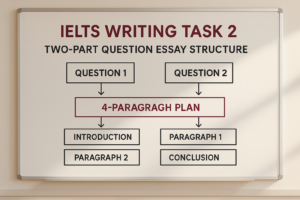
Writing is one of the most common reasons candidates retake IELTS. The problem is that writing more essays does not automatically raise the band. You need to know what is holding the score down. A Task 2 essay may lose marks because the position is unclear, ideas are underdeveloped, paragraphs are not controlled, examples are too general, or grammar errors make meaning difficult.
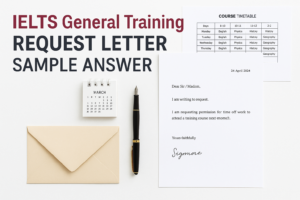
For Task 1, Academic candidates need accurate overview, comparisons, data selection, and reporting language. General Training candidates need the correct letter tone, clear purpose, and complete bullet coverage. In both test types, timed practice matters, but feedback matters more. If nobody checks your work, you may practise the same mistake twenty times.
If Writing is your bottleneck, see our IELTS preparation plans before booking repeated retakes without correction. The cheaper path is often one focused feedback block, not three more test fees.
Speaking Retake Strategy
Speaking retakes require a different kind of practice. You cannot prepare only by reading sample answers. You need to speak, record, listen back, and notice whether your answers are direct, developed, natural, and easy to follow. Part 1 answers should be short but not empty. Part 2 needs a clear story or structure. Part 3 needs opinions with reasons and examples.
Memorised answers can hurt your score if they do not match the question. Instead, practise flexible answer shapes: direct answer, reason, example, contrast, and short conclusion. Record yourself under time limits so you know whether pressure changes your fluency.
For more detail on oral performance, review the IELTS Speaking Test complete guide and connect the advice to your last Speaking band.
Reading And Listening Retake Strategy
Reading and Listening improvement often comes from reducing avoidable errors. In Reading, check whether you lose marks because you read too slowly, misunderstand paraphrase, ignore keywords, or choose answers from memory instead of evidence. In Listening, review spelling, word limits, plurals, distractors, and concentration after pauses.
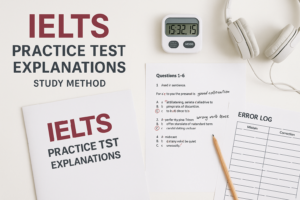
Timed practice is important, but blind repetition is not enough. After each test, write a short error log. The log should say what happened and what you will do differently next time. “Wrong answer” is not useful. “Chose False because I missed the word ‘some’ in the passage” is useful.
Should You Use IELTS One Skill Retake?
IELTS One Skill Retake can be useful when it is accepted by the organisation you are applying to and only one section is below target. However, acceptance is not universal. Before relying on it, confirm whether your university, migration authority, employer, or professional body accepts One Skill Retake for your specific purpose.
If the option is accepted and your other section scores are strong, a one-skill plan can be efficient. If it is not accepted, or if more than one section is unstable, you may need a full retake. For policy details and cautions, read the IELTS One Skill Retake Policy Australia guide before choosing your booking strategy.
A 14-Day Retake Preparation Plan
Day one should be diagnosis. Review your score report, complete a short mock or diagnostic task, and choose the main skill target. Days two to five should focus on fixing the biggest weakness with deliberate practice. For Writing, that may mean planning, paragraph control, and feedback. For Speaking, it may mean recording Part 2 and Part 3 answers. For Reading or Listening, it may mean question-type drills and error logs.
Days six and seven should include a timed section test and review. Days eight to ten should repeat targeted practice based on the new errors. Day eleven should be a full or near-full mock test. Day twelve should be review and correction. Day thirteen should be lighter practice, confidence work, and test-day logistics. Day fourteen should be rest, simple revision, and sleep. Do not overload the final day with new methods.
When To Delay The Retake
Delaying a retake is sometimes the smartest move. If your practice scores are still below target, if you have not received feedback on the weak section, or if your mistakes are the same as last time, another booking may be premature. A retake should be a controlled attempt, not an emotional reaction.
That does not mean waiting forever. Set a clear condition for booking: two practice results at or above target, a corrected Writing sample that meets the band criteria more consistently, or a Speaking recording that shows longer and clearer answers. Evidence gives you confidence.
Final Checklist Before Booking Your Retake
Before you book, confirm the test type, accepted test provider, deadline, section requirements, score validity, and whether One Skill Retake is accepted. Check your ID, location, result release timing, and any document submission deadline. Then confirm that your practice evidence supports the booking.
The safest IELTS retake preparation plan is simple: diagnose the last result, focus on the section that matters most, practise under real conditions, get feedback where self-study is weak, and book only when your evidence says the next score is ready.
Ready to find out your IELTS band score?
Take the IELTS Express Pre-Test for just $4.99 and get your personalised band prediction with a 14-day improvement plan.
FAQ: IELTS Retake Preparation Plan
How long should I prepare before retaking IELTS?
If you missed by half a band in one section, two to four focused weeks may be enough. If you are one full band short or need Writing or Speaking improvement, a longer plan with feedback is usually safer.
Should I retake IELTS immediately after a bad result?
Only if you know what went wrong and your practice evidence shows improvement. If the cause is unclear, diagnose the problem first so you do not repeat the same score.
Is IELTS One Skill Retake better than a full retake?
It can be better if only one section is below target and your accepting organisation allows it. Always confirm acceptance before booking because rules vary by purpose and institution.
What should I do if my Writing score is stuck?
Get feedback on real timed essays. Writing often stays stuck because candidates repeat the same task response, organisation, grammar, or vocabulary problems without seeing them clearly.
How many mock tests should I take before a retake?
Take enough to prove your target score is stable, not just possible. One lucky mock result is weak evidence. Two or more reviewed practice results near or above target are safer.