IELTS Reading Matching Headings practice guide questions can feel frustrating because several headings often look partly correct. The task is not asking you to match words. It is asking you to identify the main purpose of each paragraph. Before you spend another week doing random reading passages, take the IELTS Express Pre-Test to check whether your current problem is speed, accuracy, vocabulary, or question-type technique.
Matching headings is one of the clearest tests of paragraph-level reading. You need to understand what a paragraph is mainly doing, not only what details it contains. A paragraph may mention a problem, an example, a person, a date, or a result, but the correct heading usually describes the central idea that holds those details together.
IELTS Reading Matching Headings Practice Guide: What The Task Tests
In matching headings questions, you receive a list of headings and a set of paragraphs or sections from the passage. Your job is to choose the best heading for each paragraph. There are usually more headings than paragraphs, which means some headings are distractors.
The task tests skimming, main-idea recognition, paraphrase awareness, and your ability to ignore attractive details. It is common for a wrong heading to include a word from the paragraph. That does not make it correct. The right heading normally summarises the whole paragraph, while the wrong heading often focuses on one small part.
- Read for the paragraph’s main function, not isolated words.
- Expect paraphrasing between the passage and the heading list.
- Use topic sentences carefully, but check the whole paragraph.
- Remove headings only when you are confident.
- Do not spend too long fighting one difficult paragraph.
Start With The Heading List, But Do Not Memorise It
Read the heading list before the passage so you know the possible themes. However, do not try to memorise every heading. That can overload your working memory and slow you down. Instead, underline the key idea in each heading.
For example, if a heading says “The unexpected benefits of early testing”, the key idea is not only testing. It is unexpected benefits. If another heading says “Problems caused by early testing”, the word testing appears again, but the meaning is different. Matching headings rewards attention to this difference.
If your broader Reading method still feels scattered, review the IELTS Reading Practice guide and connect this question type to a full speed-and-accuracy system.
Skim Each Paragraph For Its Job
A paragraph usually has a job. It may introduce a topic, explain a cause, describe a problem, compare two views, give evidence, show a result, or offer a solution. Your first reading should identify that job. You are not trying to understand every word.
Look at the first sentence, the final sentence, and repeated ideas. In many IELTS passages, the topic sentence gives a strong clue, but you still need to check whether the rest of the paragraph supports, contrasts, or develops that opening idea.
A useful question is: if I had to explain this paragraph to someone in seven words, what would I say? That short summary often points you toward the correct heading.
Use Main Ideas, Not Keyword Matches
The most common mistake is choosing a heading because it repeats a word from the paragraph. IELTS writers know candidates do this, so they often place familiar words in distractor headings. A paragraph about declining bee populations might mention farming, climate, chemicals, and research. The correct heading depends on the main point, not the most visible noun.
When two headings seem possible, ask which one covers the whole paragraph. A narrow heading may describe one example. A broader heading may explain why the example is there. The broader heading is often correct if the paragraph uses the example to support a larger idea.
To practise under realistic pressure rather than comfortable untimed reading, access unlimited IELTS mock tests and review each matching headings error by trap type.
A Step-By-Step Method For Matching Headings
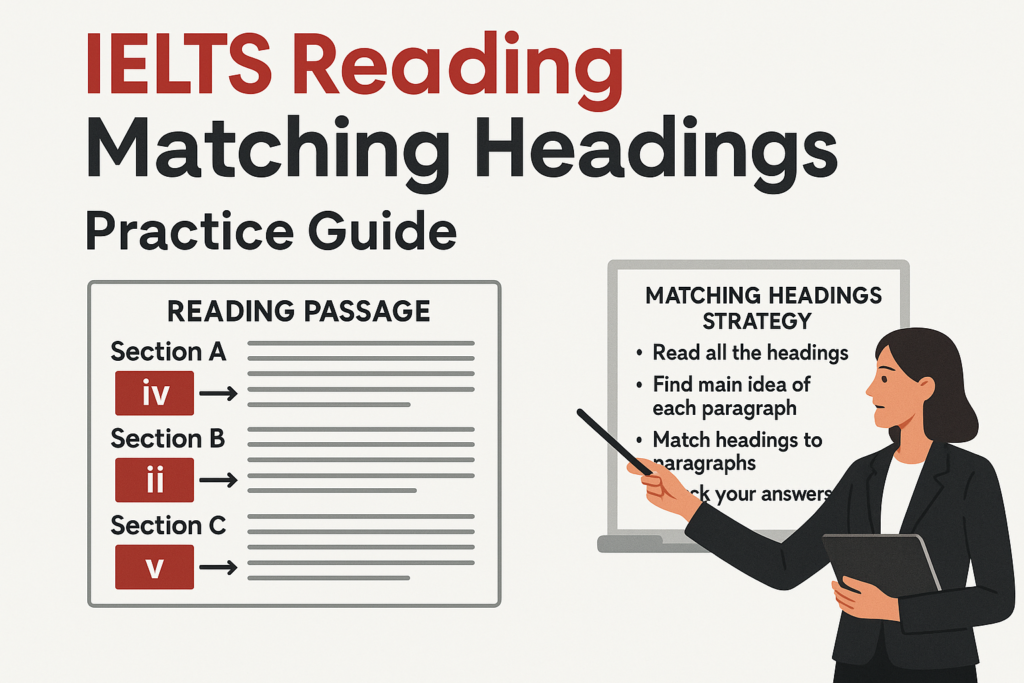
First, read the instructions and check whether any heading has already been used as an example. Second, read the heading list and mark the core meaning of each heading. Third, skim the target paragraph and write a very short mental summary.
Fourth, compare that summary with the heading list. Eliminate headings that focus on details, examples, or ideas that appear only briefly. Fifth, choose the best match and move on. If you are unsure between two headings, mark both lightly and return after completing easier paragraphs.
This process is simple, but it prevents panic. Many candidates lose marks because they jump between the passage and headings repeatedly without a decision system.
How To Handle Similar Headings
Similar headings are the real challenge. You may see two headings with almost the same topic but different direction. One may focus on causes, another on effects. One may describe a criticism, another a solution. One may refer to past change, another to future prediction.
Circle the direction words: cause, result, benefit, problem, comparison, change, decline, increase, warning, solution, explanation, evidence. These words often decide the answer. If the paragraph explains why something happened, a heading about results may be tempting but wrong.
Do not decide too early. Read enough of the paragraph to see whether the writer is explaining, contrasting, or concluding. Similar headings become easier when you identify the paragraph’s job first.
Timing Strategy For The Reading Test
Matching headings can consume too much time if you chase perfection. Set a rough limit. If a paragraph is not clear after a reasonable skim, make a provisional choice, mark it, and continue. Later paragraphs may reveal the structure of the passage and make the earlier choice easier.
Do not reread every paragraph from the beginning each time you check a heading. That is slow. Use your short summary and key direction words. If you must return, reread only the sentences that show the paragraph’s main function.
If timing is your main Reading weakness, see our IELTS preparation plans and choose support that includes timed review, not only more practice passages.
Common Traps In Matching Headings Questions
One trap is the example trap. A paragraph may include a vivid example, such as one scientist, one country, or one study. The heading about that example may look attractive, but the paragraph may actually be about a wider trend.
Another trap is the repeated-word trap. A heading repeats a word from the paragraph but changes the meaning. A third trap is the partial-match trap. The heading is true for one sentence but does not summarise the paragraph.
There is also the opposite trap. Sometimes candidates ignore a correct heading because it uses different vocabulary from the paragraph. IELTS often paraphrases. If the paragraph says “a rapid fall in numbers”, the heading may say “a sudden decline”. Train yourself to match meaning, not wording.
How To Review Your Practice Answers
Checking the answer key is not enough. For every wrong answer, write down why your choice was wrong. Was it too narrow, too broad, based on a repeated word, or based on a sentence you misunderstood? This turns practice into improvement.
Then write a one-sentence summary of the paragraph and compare it with the correct heading. If your summary is close to the correct heading, your method is improving even if you made a small choice error. If your summary is about a minor detail, you need to practise paragraph function.
Keep an error log for ten matching headings sets. Patterns will appear quickly. Some candidates always choose headings that are too specific. Others ignore contrast words or final sentences. Fix the pattern, not just the individual question.
A Seven-Day Matching Headings Practice Plan
On day one, complete one untimed matching headings set and focus only on paragraph summaries. On day two, repeat with a timer and note where you slow down. On day three, practise identifying direction words in heading lists before reading the passage.
On day four, review similar headings and write the difference between each pair. On day five, complete two timed sets and mark uncertain answers. On day six, review only your wrong answers and classify the trap. On day seven, complete a full Reading section and check whether matching headings still takes too much time.
This plan is short but diagnostic. It tells you whether the issue is reading speed, vocabulary, paragraph logic, or test decision-making.
Practice Example: How To Think Through A Paragraph
Imagine a paragraph that begins by describing how city parks were once designed mainly for beauty. It then explains that modern planners now use parks to reduce heat, manage stormwater, and improve public health. A weak heading might be “The history of city parks” because the paragraph starts with history.
A stronger heading would focus on the change in purpose. The paragraph is not mainly about history. It is about how parks now have practical environmental and health roles. This is the kind of shift you need to notice in the real test.
When you practise, force yourself to explain why the correct heading is better than the second-best heading. That explanation builds the skill you need on test day.
Final Checklist Before Test Day
Before the test, make sure you can identify the main idea of a paragraph without translating every word. Check that you can separate examples from central claims, notice contrast words, and choose between similar headings based on direction.
During the test, stay calm and systematic. Read the headings, skim for the paragraph’s job, choose the best summary, and move on when needed. Matching headings becomes much safer when you stop hunting keywords and start reading for purpose.
Ready to find out your IELTS band score?
Take the IELTS Express Pre-Test for just $4.99 and get your personalised band prediction with a 14-day improvement plan.
FAQ: IELTS Reading Matching Headings Practice Guide
How do I practise IELTS Reading matching headings questions?
Practise by summarising each paragraph in a few words before checking the heading list. Then review mistakes by trap type, such as keyword matching, partial matches, or choosing an example instead of the main idea.
Should I read the passage or headings first?
Read the headings first briefly so you know the possible themes, but do not memorise them. Then skim each paragraph for its main function and compare that idea with the heading list.
Why are matching headings questions difficult?
They are difficult because several headings may contain words or ideas from the paragraph. The correct answer must summarise the whole paragraph, not only one detail or example.
How much time should I spend on matching headings?
Do not let one paragraph consume too much time. Make a provisional choice if needed, continue with easier paragraphs, and return later if the passage structure becomes clearer.
Can I use keywords to answer matching headings questions?
Keywords can help you notice topics, but they should not decide the answer. IELTS often uses repeated words in distractors, so you need to match meaning and paragraph purpose.