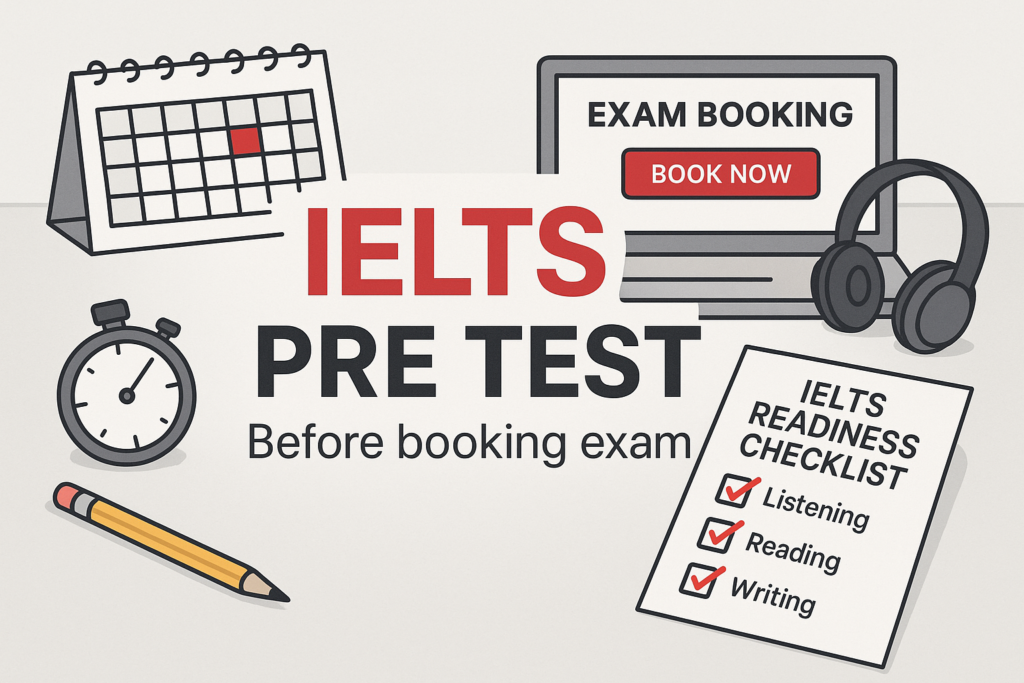
If you are thinking about taking an IELTS pre test before booking exam day, that is usually a smart move. The official IELTS test costs money, takes planning, and can affect migration, study, work, or registration deadlines. Before you choose a date based on hope, take the IELTS Express Pre-Test to get a quick band prediction and a focused 14-day improvement plan.
A pre-test is not about delaying forever. It is about checking whether your current Listening, Reading, Writing, and Speaking level is close enough to your target score. If you are already near the band you need, booking may make sense. If one section is clearly below target, a short delay with targeted practice can save you from an expensive retake.
What Is An IELTS Pre Test Before Booking Exam Day?
An IELTS pre-test is a diagnostic check you complete before paying for the official test. It helps estimate your current band level, highlight weak sections, and show whether your preparation is ready for real exam timing. It should be practical, not decorative. A useful pre-test gives you evidence you can act on.
The best pre-test approach covers all four skills or at least the sections most likely to block your target score. For many candidates, Writing and Speaking create the biggest surprises because they require human judgement, structure, and performance under pressure. Listening and Reading can also expose timing, spelling, and question-type problems.
- It checks your likely current band range.
- It shows which section needs the most work.
- It helps you decide whether to book now or prepare longer.
- It reduces the risk of paying for a test too early.
- It gives your study plan a clear starting point.
Why You Should Not Book IELTS On Guesswork
Many candidates book IELTS because a deadline is coming, a friend said the test was easy, or they feel they have studied enough. That can work if your level is already stable. But if you have not checked your section scores, you may be guessing with real money and real consequences.
IELTS does not reward general confidence. You need to meet the score required for your goal, often in every section. A candidate who feels fluent may still lose marks in Writing Task 2 because the essay lacks a clear position. A candidate who reads well may still run out of time in Reading. Guesswork hides these risks until the official result arrives.
If you want to test your timing and stamina before choosing a real exam date, unlimited IELTS mock tests can help you compare practice performance with your target score.
When A Pre-Test Is Most Useful
A pre-test is most useful when you have a clear target score and limited time. Migration applicants may need section minimums. University applicants may need an overall band plus minimum section scores. Nurses, engineers, accountants, teachers, and other professionals may need English evidence for registration or skills assessment.
It is also useful if you have studied for a few weeks but cannot tell whether you are improving. Doing more practice without measurement can feel productive, but it may not change the score. A diagnostic forces you to look at the exact section that needs attention.
You should also consider a pre-test if you have failed IELTS before. A previous result gives useful data, but it may be outdated if you have studied since then. A fresh pre-test can show whether the weak section has actually moved.
What A Good IELTS Pre-Test Should Include
A good pre-test should be close enough to IELTS conditions to be useful. It should not be a random vocabulary quiz or a short grammar exercise pretending to predict your band score. IELTS is a skills test, so your pre-test should check skills.
For Listening and Reading, use timed question sets that reflect common IELTS formats. For Writing, complete a real Task 1 or Task 2 response under time pressure. For Speaking, record answers or complete a live-style interview so fluency, coherence, pronunciation, and answer development can be checked.
The result should lead to a plan. If the pre-test only says “keep practising”, it is not specific enough. You need to know whether to fix essay structure, Speaking extension, Reading time management, Listening spelling, grammar accuracy, or vocabulary range.
How To Use Your Pre-Test Result
Start by comparing the result with your target. If your target is Band 7 in every section and your pre-test suggests Band 6 in Writing, do not ignore it because your Reading is strong. IELTS planning is usually controlled by the weakest section.
Next, decide whether the gap is small, moderate, or large. A small gap may need two weeks of focused correction. A moderate gap may need a more structured preparation block. A large gap may mean you should delay the exam and rebuild core skills before spending money on the official test.
If you need guided support after your pre-test, compare IELTS preparation plans and choose the option that matches your target score and deadline.
Should You Take A Full Mock Test Or A Short Pre-Test?
A full mock test is best when you need a realistic exam rehearsal. It checks timing, stamina, and how your score holds up across all four skills. It is useful when your official test is approaching and you want to know whether you can perform under pressure.
A shorter pre-test is useful earlier in the process. It can quickly show whether you are roughly near your target or whether one section needs urgent work. For busy students, a short diagnostic is often enough to decide whether booking now is sensible.
The right choice depends on timing. If you have several weeks before a deadline, start with a pre-test and then move into full mock tests. If your exam is already booked, use full mock tests to practise pacing and reduce surprises.
Common Signs You Are Not Ready To Book Yet
You may not be ready to book if your Writing is unfinished under time, your Speaking answers stop after one sentence, or your Reading score changes wildly from test to test. These are not small details. They are signs that the official exam may expose unstable performance.
Another warning sign is relying only on passive study. Watching videos, reading tips, and saving vocabulary lists can help, but they do not prove you can produce answers under test conditions. IELTS readiness requires output: essays, spoken answers, timed reading, and listening accuracy.
If you do not know your weakest section, you are probably not ready to choose a date confidently. A pre-test gives you that information before the booking fee is gone.
How Close Should Your Pre-Test Score Be?
Ideally, your pre-test score should be at or slightly above your target before you book. This gives you a buffer for exam-day nerves, difficult topics, or small mistakes. If your target is Band 7 and your pre-test is consistently around Band 6, booking immediately is risky.
For Listening and Reading, look for consistency across several practice sets. One strong result is encouraging, but repeated results are more reliable. For Writing and Speaking, look for feedback on the scoring criteria, not only a general feeling that the answer sounds good.
A pre-test does not guarantee the official result. It reduces uncertainty. That is the point. You are trying to make a better booking decision, not predict the future perfectly.
How To Build A 14-Day Plan After The Pre-Test
Use the first two days to review the pre-test and identify the main score blocker. Do not try to fix every skill equally. If Writing is the lowest section, spend more time on planning, paragraph structure, grammar correction, and timed essays. If Speaking is weak, record answers and practise extension, examples, and pronunciation clarity.
Use the middle of the plan for targeted drills. For Reading, practise the question types that caused errors. For Listening, work on spelling, distractors, and note completion. For Writing and Speaking, get feedback where possible because self-correction is harder in productive skills.
Use the final days for exam-style practice. Complete timed tasks, review mistakes, and decide whether the official test date is sensible. For a wider overview of exam structure and timing, the IELTS exam guide can help you check what each section expects.
What If Your Deadline Is Soon?
If your deadline is close, a pre-test becomes even more important. You may not have time for a full preparation course, but you still need to know where to focus. A weak section can sometimes improve quickly if the problem is strategy or structure. It usually takes longer if the problem is grammar range, vocabulary control, or fluency.
Be realistic. If your pre-test result is far below the required score, booking immediately may only create another failed attempt. If you are close, a short high-focus plan may be worth it. The decision should come from evidence, not panic.
Final Checklist Before You Book IELTS
Before booking, confirm the test type you need, your exact target score, your deadline, and your current level. Check whether you need Academic or General Training. Check whether your organisation requires section minimums. Then compare your pre-test result with the target.
If the result is close, book with a clear final practice plan. If the result is not close, delay if your situation allows and fix the weakest section first. The official exam should be a measured step, not a gamble.
Ready to find out your IELTS band score?
Take the IELTS Express Pre-Test for just $4.99 and get your personalised band prediction with a 14-day improvement plan.
FAQ: IELTS Pre Test Before Booking Exam
Should I take an IELTS pre-test before booking the official exam?
Yes, it is a sensible step if you are unsure about your current band level. A pre-test helps you decide whether to book now or prepare longer.
Can a pre-test predict my exact IELTS score?
No pre-test can guarantee the exact official result, but a good diagnostic can estimate your range and show which section is most likely to limit your score.
How long before IELTS should I take a pre-test?
Take one as early as possible, ideally several weeks before your intended test date. This gives you time to fix weak sections before booking or sitting the exam.
Is a short pre-test enough or do I need a full mock test?
A short pre-test is useful for early diagnosis. A full mock test is better when you are close to booking and need to check timing, stamina, and exam readiness.
What should I do if my pre-test score is below target?
Focus on the weakest section first, build a short targeted study plan, and retest before booking if your deadline allows. Do not rely on hope alone.