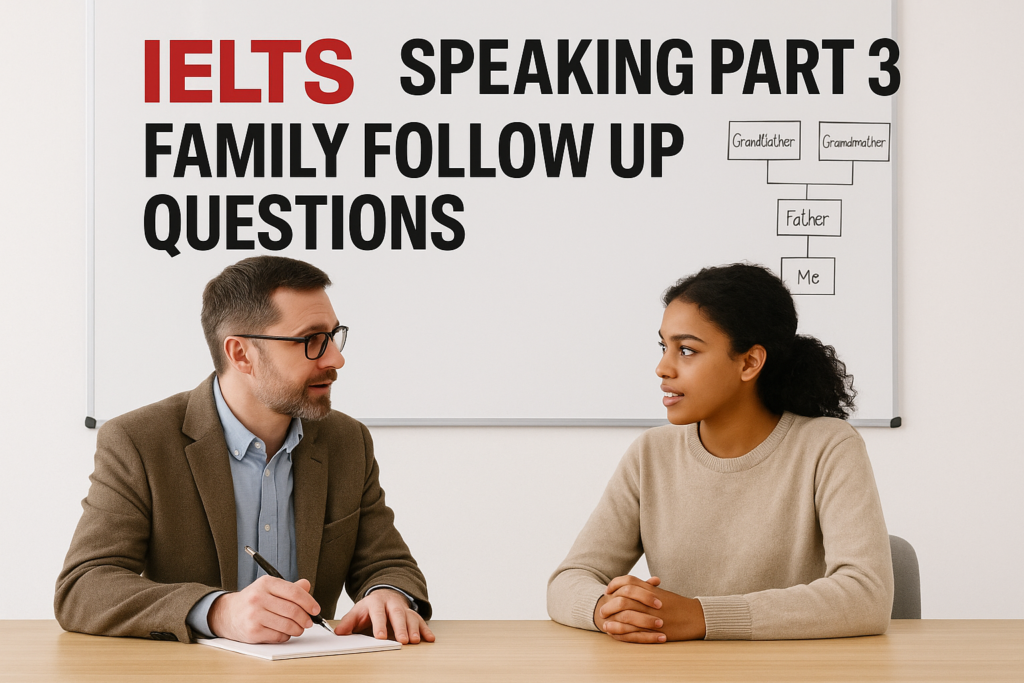
If you are preparing for IELTS Speaking Part 3 Family follow up questions, expect the examiner to move beyond simple questions about who is in your family. Part 3 usually asks you to discuss family roles, parenting, grandparents, independence, marriage, children, work pressure, technology, and the way family life is changing. Before you practise a list of memorised answers, take the IELTS Express Pre-Test to check your current band level and see which speaking skills need the most attention.
Family is a familiar topic, but that can make it risky. Many candidates answer too personally and too briefly. They say, “My family is important,” and then stop. A stronger Part 3 answer explains why families matter, how responsibilities are changing, what social pressures affect family life, and whether these changes are positive or negative. You do not need expert knowledge of sociology. You need clear ideas, natural examples, and enough language to compare generations, explain causes, and give balanced opinions.
What Family Questions In Part 3 Are Testing
Part 3 tests your ability to discuss general ideas. If Part 2 asks you to describe a family member, Part 3 may ask whether families are smaller than in the past, whether grandparents should help raise children, or whether young adults should live independently. The topic becomes broader, so your answer needs more development than a personal story.
A useful answer normally has four parts: a direct answer, a reason, an example, and a result. If the examiner asks whether family relationships are weaker today, you could say they are different rather than simply weaker. Then explain that people may live further apart because of study or work, but technology allows them to stay in contact. Add a realistic example, such as video calls with relatives overseas, and finish by saying that closeness now depends more on effort than location.
- Answer the exact question first.
- Move from your personal view to a wider social point.
- Use realistic examples from modern family life.
- Finish with a result, comparison, or judgement.
For the full speaking test structure, read the IELTS Speaking Test complete guide while you practise this topic.
How To Build A Band 7 Family Answer
A Band 7 answer is usually clear, balanced, and specific. You do not need dramatic opinions or complicated vocabulary. You need to show that you can explain a family issue from more than one angle. The safest pattern is answer, explain, example, extend.
For example, if the question is “Do you think parents are stricter today than in the past?”, you might say parents are strict in different ways. In the past, many parents focused on manners, discipline, and household duties. Today, parents may be more concerned about education, screen time, safety, and future career choices. Add an example such as parents monitoring phones or paying for extra classes. Then extend the answer by saying modern parenting can be more protective because the world feels more competitive.
If you want to test this answer shape under exam pressure, use unlimited IELTS mock tests and record several Part 3 family answers in one session. You will quickly hear whether your ideas stay organised when the examiner changes the question.
Common IELTS Speaking Part 3 Family Follow Up Questions
Use these questions to practise flexible thinking. Do not memorise full scripts. Prepare useful ideas for each theme so you can adapt naturally on test day.
- Are families in your country smaller than in the past?
- Should grandparents help look after children?
- Do young people spend enough time with their families?
- How has technology changed family communication?
- Should parents make important decisions for their children?
- Is it better for young adults to live alone or with family?
- How are family roles changing today?
- Do you think family meals are still important?
- What problems can happen when both parents work full time?
- Will family life change more in the future?
Sample Answer: Are Families Smaller Than In The Past?
In many places, families are smaller than they were in the past. One reason is that the cost of housing, childcare, and education has increased, so many couples delay having children or choose to have fewer children. Work pressure also plays a role because people may want to build a stable career before starting a family. For example, a couple living in a large city may decide that one child is more realistic than three. I do not think this means people care less about family. It usually means family decisions are shaped by money, time, and lifestyle.
This answer works because it avoids a simple yes or no. It explains causes and finishes with a balanced judgement. That gives the examiner more language to assess.
Sample Answer: Should Grandparents Help Raise Children?
Grandparents can play a very positive role in raising children, especially when parents are busy with work. They can provide emotional support, practical help, and a sense of family history. For example, a grandparent may pick children up from school or teach them traditional values and stories. However, it can become difficult if grandparents and parents disagree about discipline, food, or education. So I think grandparents should be involved, but the main decisions should still belong to the parents.
Notice the careful ending. The answer supports grandparents helping, but it also recognises limits. This is useful in Part 3 because family questions often involve responsibility, respect, and generational differences.
Sample Answer: Has Technology Changed Family Communication?
Technology has changed family communication a lot. It helps relatives stay connected even when they live in different cities or countries. Video calls, messaging apps, and shared photos can make distance feel less serious. However, technology can also reduce face-to-face conversation at home. Some families sit together physically but spend most of their time looking at separate screens. Overall, I would say technology is helpful when it supports real communication, but it becomes a problem when it replaces attention and conversation.
This answer gives both a benefit and a drawback. It sounds natural because it reflects how many families actually use technology today.
Vocabulary For Family Discussion
Useful family vocabulary should help you explain relationships, roles, responsibility, and change. Avoid rare words that you cannot use naturally. Clear phrases used accurately are better than impressive language used awkwardly.
- family responsibility: duties that family members have towards each other.
- generation gap: differences in opinions, habits, or values between older and younger people.
- work-life balance: the ability to manage career demands and family time.
- emotional support: encouragement, care, and understanding from family members.
- financial pressure: money stress that affects family decisions.
- traditional family roles: older expectations about what mothers, fathers, children, or grandparents should do.
- independent living: living away from parents and managing your own responsibilities.
Use these phrases inside complete answers. Instead of only saying “generation gap”, say: “The generation gap can make family decisions difficult because parents and children may have different views about careers, marriage, or independence.” That sentence is simple, but it shows control.
How To Extend Short Family Answers
If your answer is too short, add one useful layer. You can explain a cause, give a result, compare older and younger generations, mention cost, or connect the issue to education, work, housing, technology, or culture. Family questions are easy to extend because they are connected to everyday life and social change.
For example, if you say parents are busy, explain why. They may work long hours, commute, manage bills, or worry about school fees. If you say young people should live independently, explain the benefit and the drawback. Independence can teach responsibility, but living with family can save money and provide emotional support. If you say family meals are important, explain that they create routine, conversation, and a chance for children to learn manners and values.
- Compare past and present family life.
- Compare independence and family support.
- Mention housing, childcare, technology, migration, work, or education.
- Explain how family choices affect children, parents, grandparents, and society.
If your answers are organised but still sound basic, the IELTS Speaking Part 3 tips and strategies guide can help you build stronger discussion habits.
Common Mistakes With Family Follow Up Questions
The first mistake is giving only personal examples. Personal experience is useful, but Part 3 needs a wider discussion. If the examiner asks whether families are changing, do not only describe your household. Use your household briefly as an example, then explain the general trend.
The second mistake is being too sentimental. Saying “family is everything” may be true for you, but it does not answer many IELTS questions. A stronger answer explains why families matter in practical terms: care, money, education, emotional support, childcare, identity, and decision-making.
The third mistake is using extreme claims. Saying young adults should always leave home or always stay with parents is too simple. A better answer explains that the best choice depends on income, culture, study, work, safety, and maturity. Balanced answers give you more room to show language.
- Do not turn every answer into a personal story.
- Do not give emotional statements without explanation.
- Do not ignore money, housing, work, or cultural expectations.
- Do not memorise answers that fail to match the exact question.
Family Answer Frames You Can Reuse
Reusable frames help you start clearly without sounding robotic. For change questions, try: “Family life has changed mainly because work, housing, and technology have changed.” Then add your example. For responsibility questions, try: “I think the responsibility should be shared, but not equally in every situation.” This lets you discuss parents, children, grandparents, schools, or governments.
For balance, try: “There are benefits, but it depends on the family’s financial situation and cultural expectations.” This frame works for living with parents, grandparents helping with childcare, and parents making decisions for children. For future questions, try: “Family life may become more flexible, but people will still need emotional support and close relationships.” That gives you a natural prediction without sounding dramatic.
These frames are not scripts. They are starting points. Practise them with different questions until you can change the examples naturally.
Practice Plan For This Topic
Start with six questions and answer each one for 45 to 60 seconds. Record yourself. Then listen for three things: whether you answered directly, whether you gave a clear example, and whether your final sentence finished the idea. If your answer stops too early, repeat it with one extra cause or result.
On the second round, change the angle. Move from “Should grandparents help raise children?” to “Should grandparents make decisions about children’s education?” Then try “Should governments support families with childcare?” This trains flexibility, which is exactly what Part 3 requires. You can also compare your responses with the IELTS Speaking Part 3 sample answers to see how developed answers are shaped.
If your test is close and you need a structured plan, see our IELTS preparation plans so you can choose the right level of speaking support instead of guessing what to practise next.
How To Sound Natural When Discussing Family
Natural answers usually sound specific, not dramatic. Instead of saying, “Families are very important for everyone,” say, “Families often provide childcare, financial help, emotional support, and advice during major decisions.” That sentence gives the examiner clearer content.
Use moderate language when the issue is complex. Phrases like “in many families”, “it depends on the cost”, “for some young adults”, and “one possible problem” can help you avoid overgeneralising. This matters because family expectations are shaped by culture, income, housing, migration, education, and personal maturity.
Also remember that family topics can connect to wider social issues. Housing affects whether young adults live with parents. Work pressure affects childcare. Technology affects communication. Migration affects grandparents and extended family. These connections help you build longer, more mature Part 3 answers.
Ready to find out your IELTS band score?
Take the IELTS Express Pre-Test for just $4.99 and get your personalised band prediction with a 14-day improvement plan.
FAQ: IELTS Speaking Part 3 Family Follow Up Questions
How long should my Part 3 family answers be?
Most strong answers are around 35 to 60 seconds. Answer directly, explain one clear idea, give a realistic example, and add a result or comparison. Very short answers usually do not show enough language.
Can I talk about my own family in Part 3?
Yes, but keep personal examples brief. Use them to support a wider point about families, parents, children, grandparents, culture, work, or society. Part 3 needs broader discussion than Part 1.
What vocabulary is useful for family questions?
Useful phrases include family responsibility, generation gap, work-life balance, emotional support, financial pressure, traditional family roles, and independent living. Use them in natural sentences, not as a memorised list.
Should I give both sides in family answers?
Often, yes. Family topics usually involve trade-offs between independence and support, tradition and change, or work and childcare. A balanced answer can sound more mature if your final view is still clear.
What if I do not have a strong opinion about the family question?
You can give a moderate answer. Say what the answer depends on, such as age, money, culture, housing, or responsibility. Then give one realistic example and finish with a clear judgement.