If you are preparing for Engineers Australia skills assessment or registration pathways, IELTS Reading General for Engineering Australia can feel more important than people first expect. Reading is not usually the section candidates fear most, but it often becomes the section where avoidable timing mistakes and weak question control quietly drag the overall result down. Before you assume your reading score is already safe, take the IELTS Express Pre-Test to get a quick band prediction and a clearer picture of what still needs work.
What IELTS Reading General for Engineering Australia usually means in practice
For engineering candidates, IELTS is rarely just an academic target. It is tied to migration, professional recognition, or a career move that already has deadlines attached. That changes how you should think about the Reading test. You are not studying for interest alone. You are trying to secure a result that supports your next step in Australia.
In General Training Reading, the challenge is not only English level. It is the mix of short notices, workplace texts, instructions, and longer articles, all under tight time pressure. Many engineering professionals have strong technical knowledge but lose marks because they read too deeply, trust familiar keywords too fast, or spend too long on one confusing item.
That is why IELTS Reading General for Engineering Australia is really about controlled execution. You need to understand the task types, protect your timing, and make accurate decisions even when a passage feels dull or slightly unclear.
Why reading matters for engineering candidates applying in Australia
Engineering professionals often focus heavily on Writing or Speaking because those sections feel more exposed. That makes sense, but Reading still matters because a weak score in one band can block the whole result. If you need a specific overall score with section minimums, one careless Reading paper can create an expensive delay.
Reading also matters because the section looks deceptively simple. The language in General Training is often more everyday than Academic Reading, but the traps are still there. Instructions can be strict, answer limits can catch you out, and similar wording can push you towards the wrong option.
If you want a broader picture of score requirements and section planning, IELTS for Engineering Australia complete guide is a useful companion to this article.
How the General Training Reading test is structured
The IELTS General Training Reading test has three sections and forty questions in sixty minutes. Section 1 usually focuses on everyday social survival texts such as notices, adverts, forms, or short workplace information. Section 2 often moves into work-related texts, including policies, training notes, or staff guidance. Section 3 is usually one longer text with more detailed comprehension demands.
This matters because each section asks for a slightly different reading habit. In the early sections, success often depends on scanning quickly and matching details accurately. In the final section, you need better control of argument, meaning, and paraphrase. Strong candidates adjust their reading style as the paper changes.
If you treat every part of the test the same way, you usually waste time. The best IELTS Reading General for Engineering Australia strategy is flexible rather than rigid.
The biggest reading problems engineering professionals run into
Many engineering candidates are careful, analytical people. That can help, but it can also create a trap. Some candidates over-read because they want total certainty before answering. Others assume that because a question looks practical or work-related, it should be answered from general logic rather than from the exact words in the text.
The most common problems are:
- spending too long checking one answer twice or three times
- missing key limiting words such as only, mainly, or before
- choosing an answer because of one matching keyword instead of full meaning
- losing speed in Section 3 after a slow start
- ignoring word limits in completion tasks
These are not intelligence problems. They are exam-behaviour problems. That is good news, because behaviour can be trained. If you want realistic full-paper practice while fixing those habits, access unlimited IELTS mock tests and review not just your score, but also where your timing started to slip.
A practical timing plan for IELTS Reading General for Engineering Australia
A sensible timing plan helps you avoid turning one awkward question into a whole-section collapse. Many candidates do well with a rough split of 15 minutes for Section 1, 20 minutes for Section 2, and 25 minutes for Section 3. The exact numbers can vary, but the principle stays the same: do not donate too much time to the easier sections.
Section 1 should usually feel efficient. These texts are shorter, and the marks matter just as much as later ones. Section 2 often needs a little more care because workplace texts can contain denser instructions. Section 3 deserves enough time because the reading load is heavier and the paraphrasing is usually more demanding.
A good working method looks like this:
- read the task instructions carefully before touching the text
- scan for names, numbers, headings, or unusual terms first
- answer easier items quickly and mark harder ones for return
- move on when a question starts burning too much time
- leave a final minute or two for checking word limits and transfer accuracy
This is especially useful for busy professionals who are balancing test preparation with work. If your schedule is tight and you want more structured help, it is worth comparing guided IELTS preparation options that fit your timeline.
How to handle workplace texts and instructions more accurately
Engineering candidates are often comfortable with manuals, procedures, and technical documentation in real life. Ironically, that can create overconfidence in Section 2. In IELTS, workplace-style texts still need close reading because one small detail can change the answer completely.
When you read staff instructions, safety notices, schedules, or process descriptions, pay attention to:
- sequence words such as first, then, and after
- restriction words such as must, only, and unless
- who the instruction applies to
- whether the text is describing a rule, an option, or an exception
A common mistake is reading for the general topic instead of the exact condition. For example, a workplace notice may mention safety equipment for all visitors, but the question may ask about a requirement that applies only to contractors. If you do not track that distinction, the wrong answer can still look reasonable.
The safest habit is simple: prove each answer from the text. Do not answer from memory, work experience, or common sense alone.
How to improve accuracy in the longer final section
Section 3 often feels hardest because the text is longer and the ideas are less practical. By that stage, fatigue can also creep in. This is where many candidates start rushing, especially if earlier sections took too long.
To manage the final section better, shift from broad scanning to more deliberate control. Start with a quick skim so you know the general topic and paragraph flow. Then let the questions guide where you need close reading. Do not try to understand every sentence equally.
This section often rewards three habits:
- spotting paraphrases instead of searching for exact repeated words
- checking whether the question wants a detail, an opinion, or the main point
- staying calm when two options look similar and returning to the relevant lines for proof
If your score drops sharply in the final section, the problem is often timing plus tired decision-making rather than vocabulary alone. That is fixable with deliberate review.
A weekly reading practice plan for engineering candidates
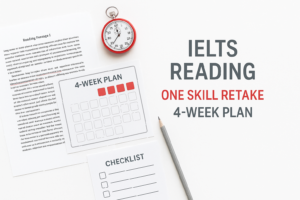
You do not need a complicated study system. You need a routine that fits around work and still gives you proper feedback. A good weekly plan for IELTS Reading General for Engineering Australia could look like this:
- Day 1: complete one full timed General Training Reading test
- Day 2: review every wrong answer and label the mistake type
- Day 3: redo one weak question type, such as matching information or sentence completion
- Day 4: practise one Section 2 or Section 3 text with special focus on timing control
- Day 5: complete a second timed test and compare the error pattern with Day 1
This works because it combines measurement and repair. Too many candidates collect scores without fixing the behaviour that produced them. If you keep a short error log, patterns become obvious quite quickly.
For example, you may discover that your real issue is not reading speed overall, but repeated mistakes in completion tasks or too much hesitation in Section 2. Once you know that, your practice becomes sharper and less frustrating.
What score-ready behaviour looks like before test day
Before test day, the goal is not one lucky high score. The goal is repeatable control. You want to see that your timing is stable, that your mistakes are becoming less random, and that you can recover when one passage feels awkward.
Good signs include:
- you are finishing the paper without last-minute panic
- you are losing fewer marks to word limits and transfer errors
- you can explain why wrong answers were wrong
- your score is holding across several recent tests, not just one
If those signs are not there yet, do not guess that the real exam will somehow go better. Tighten the process first. With Reading, calm consistency usually beats heroic effort.
Ready to find out your IELTS band score?
Take the IELTS Express Pre-Test for just $4.99 and get your personalised band prediction with a 14-day improvement plan.
FAQ: IELTS Reading General for Engineering Australia
Is IELTS Reading General for Engineering Australia easier than Academic Reading?
The language is usually more everyday, but that does not make the test easy. Many candidates still lose marks because of timing, paraphrasing, and strict question instructions.
What is the best way to prepare for IELTS Reading General if I work full-time as an engineer?
A short, structured weekly plan works best. Two timed tests each week, combined with serious review of mistakes, is usually more effective than doing small amounts of random practice every day.
Do engineering candidates need special reading vocabulary for the IELTS General test?
Not in a narrow technical sense. You need solid everyday reading control, good awareness of paraphrase, and the discipline to follow instructions exactly under time pressure.
How can I stop running out of time in IELTS General Training Reading?
Use a section-based timing plan, move on from stubborn questions sooner, and review where your timing breaks down in practice tests. Most time problems come from decisions, not from reading speed alone.
Your next step for a safer Reading score
IELTS Reading General for Engineering Australia becomes much more manageable once you stop treating it like a test of raw intelligence and start treating it like a system. Learn the section patterns, protect your timing, and insist on proof from the text before you trust an answer.
That is the kind of preparation that protects section minimums and keeps your wider Australia plan moving. If you want a quick reality check before your next practice cycle, start with the pre-test and measure where your reading score really stands now.