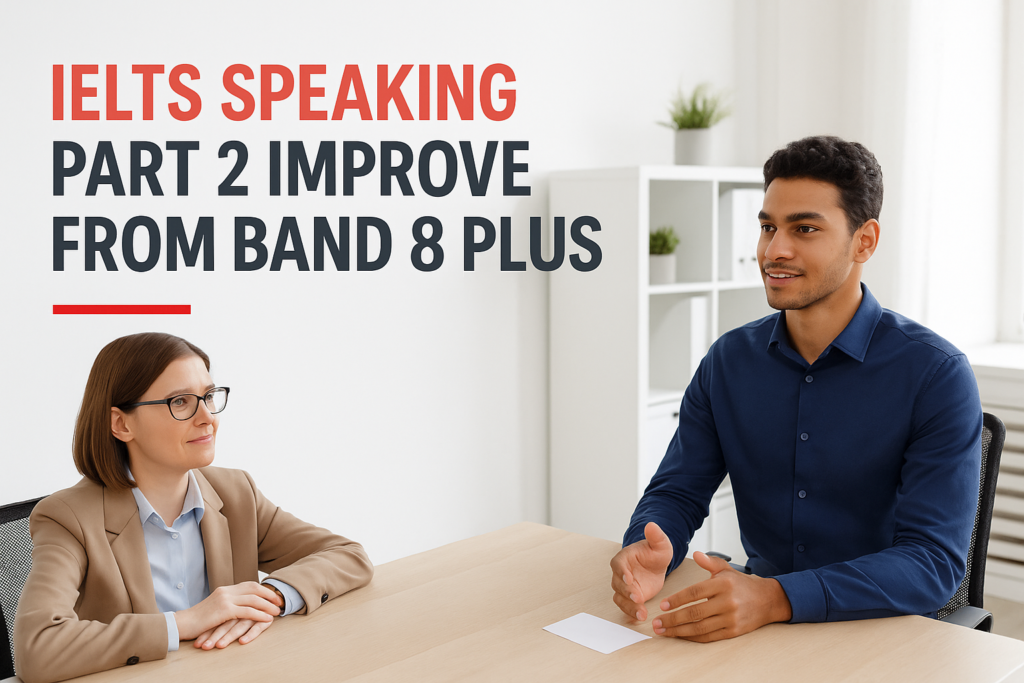
If you are searching for IELTS Speaking Part 2 improve from band 8 plus, you are already playing a different game from most candidates. You are not trying to survive the long turn. You are trying to sound more precise, more natural, and more controlled than someone who has simply memorised a good framework. At this level, small weaknesses matter. An answer can still be fluent and impressive, but if it feels slightly over-rehearsed, too broad, or a touch inflated, it may stop short of the very top bands.
Before you keep guessing whether Speaking is already strong enough or still leaving marks on the table, take the IELTS Express Pre-Test to get a quick band prediction and see where your current speaking performance starts to lose precision.
What changes when you try to move beyond band 8 in Part 2
Moving from a solid band 8 to band 8.5 or 9 is rarely about speaking longer or using harder words. Most high-band candidates already have enough fluency, enough range, and enough confidence to sound strong. The real shift is refinement. Your answer needs to feel fully owned. It should sound like a real person thinking clearly in real time, not a well-trained candidate performing a polished routine.
That matters because examiners at this level can hear the difference between smooth language and genuinely flexible language. A strong band 8 answer may still lean on safe patterns. A band 8.5 or 9 answer usually feels lighter. The speaker chooses detail more intelligently, changes pace naturally, and develops the story without sounding mechanical.
Why strong candidates still get stuck at band 8
Many candidates who aim for the top bands make the same mistake, they assume the answer needs more complexity. So they add heavier vocabulary, longer sentences, and extra reflection. Sometimes that works. Quite often it makes the answer less alive. The language stays accurate, but the delivery loses ease.
Another common issue is over-management. Candidates who know the exam well may control the answer so tightly that nothing surprising is allowed to happen. Every story beat arrives on schedule. Every feeling is explained. Every conclusion is polished. It sounds competent, but slightly airless. In Part 2, very high bands usually come from control without stiffness.
If you want to compare this long-turn refinement with the broader speaking score picture, the IELTS Speaking Part 2 band score guide is a useful companion because it clarifies what examiners are hearing across different levels.
IELTS Speaking Part 2 improve from band 8 plus by fixing detail selection
At high level, detail selection becomes one of the clearest separators. Strong but slightly limited candidates often include too many details of equal weight. They tell you where they went, who was there, what time it started, what the weather was like, what they wore, what happened next, and what happened after that. Nothing is wrong, but nothing lands strongly either.
A better approach is selective detail. Choose the details that create shape. If the cue card is about a person, one small behaviour may reveal more than five pieces of biography. If the topic is about an event, one vivid turning point is usually more memorable than a full timeline. The answer becomes cleaner because each sentence earns its place.
This is where high-band speaking starts to resemble good storytelling. You are not being dramatic. You are choosing what matters. That choice helps fluency because you are not carrying unnecessary material through the whole two minutes.
Make your long turn sound less prepared and more natural
Candidates chasing the top bands often prepare too well. That sounds odd, but it is true. They have practised enough cue cards to know the typical answer shape, so they begin to sound like themselves on a very organised day rather than themselves in a real conversation. The examiner may still reward the quality, but the answer can lose some natural freshness.
One fix is to leave a little room for discovery. Instead of planning every paragraph of the answer in your head, plan only the backbone. Know the topic, the central moment, and the final reflection. Then let the connecting language emerge naturally while you speak. That keeps the answer flexible and reduces the polished-but-rehearsed effect.
Another fix is to use simpler transitions. Candidates at this level sometimes overuse phrases such as what I found particularly interesting was or another aspect worth mentioning is. Those are not terrible, but if every section opens that way, the answer starts to sound staged. Plain spoken English often sounds stronger.
How high-band candidates use pacing and pauses well
Pacing is one of the easiest things to overlook when you are trying to improve IELTS Speaking Part 2 from band 8 plus. Some candidates speak too quickly because they want to prove fluency. Others stay so careful that the answer feels over-measured. Neither problem is dramatic, but both affect the overall impression.
Higher-level pacing usually has contrast. A speaker may move faster through background detail, slow slightly for the key moment, then pause briefly before the final reflection. Those shifts help the answer sound human. They also help pronunciation, because stress and rhythm become clearer when every sentence is not delivered at the same speed.
If you want to hear whether your pacing actually holds up across repeated speaking tasks rather than in one lucky answer, access unlimited IELTS mock tests and record several Part 2 responses in one sitting. That is where rushed habits and rehearsed patterns usually show themselves.
Vocabulary at this level should get sharper, not flashier
When candidates try to move beyond band 8, vocabulary often becomes a trap. They know enough language to sound advanced, so they push for even more unusual wording. The result can be technically strong but slightly unnatural. In a very high-band answer, vocabulary usually feels exact rather than showy.
For example, instead of searching for a rare adjective, it is often better to choose a precise everyday word and support it with context. Saying a person was dryly funny, guarded, soft-spoken, or surprisingly direct can sound stronger than using an abstract adjective you would never use outside exam practice. Precision gives the examiner a clearer picture. It also sounds more believable.
The same principle applies to collocation. Very high bands often come from natural word partnerships, not only from difficult vocabulary. Phrases such as drifted off topic, spoke with complete ease, or settled into the story sound lived-in. They are hard to fake, which is one reason they help.
Build reflections that feel earned, not decorative
Most solid band 8 candidates know they need some reflection near the end of Part 2. The problem is that reflection can become generic. They say the experience was meaningful, unforgettable, or eye-opening, but the answer has not really earned those labels. The language sounds good, but the emotional logic feels thin.
To improve, tie the reflection directly to the story detail that came before it. If the cue card is about a person you admire, explain the specific moment that changed your view of them. If it is about a place, explain exactly why the atmosphere stayed with you. If it is about a decision, explain what you understood only afterwards. That kind of reflection sounds real because it grows from the answer instead of being attached at the end like a decoration.
If you need a stronger comparison point for how top-band answers stay grounded while still sounding impressive, the IELTS Speaking Part 2 sample answers page is worth revisiting with a stricter ear.
A practical practice loop for moving beyond band 8
At this level, random practice stops being efficient. You improve faster when each repetition has a single purpose. A useful loop is to take one cue card, record it once naturally, then review only one feature at a time. First check detail selection. Then record again and focus only on pacing. Then repeat and focus only on reflection quality. This isolates the fine adjustments that make the real difference.
A short weekly pattern could look like this:
- Day 1: record one clean baseline answer with no stopping
- Day 2: cut weak or unnecessary details and re-record
- Day 3: work on stress, pause placement, and speed variation
- Day 4: refine vocabulary so it sounds more natural, not more difficult
- Day 5: rebuild the ending reflection so it feels specific
- Day 6: answer a fresh cue card using the same principles
- Day 7: compare both answers and write one note about what still sounds slightly managed or rehearsed
If you want more guided feedback instead of doing all of that alone, see our IELTS preparation plans and choose the support level that matches how close your test date is.
Ready to find out your IELTS band score?
Take the IELTS Express Pre-Test for just $4.99 and get your personalised band prediction with a 14-day improvement plan.
Frequently Asked Questions
Is it realistic to improve IELTS Speaking Part 2 from band 8 plus?
Yes, but the gains are usually subtle. At this level, improvement often comes from better precision, more natural pacing, stronger detail selection, and reflections that sound genuinely connected to the story.
What usually stops a band 8 candidate from reaching band 8.5 or 9 in Part 2?
The answer often sounds a little too managed. It may be fluent and accurate, but slightly rehearsed, slightly overloaded with equal detail, or too polished in a way that reduces naturalness.
Should I use more advanced vocabulary to move beyond band 8?
Usually not. More useful gains come from sharper vocabulary choice and more natural collocations. Exact language tends to sound better than language that is impressive but not fully comfortable.
How can I tell if my Part 2 answer sounds rehearsed?
Record the same cue card more than once. If the answer sounds nearly identical each time, with the same transitions and the same emotional beats, it is probably too fixed. Real high-level speaking keeps some flexibility.
What is the best way to practise at this level?
Use focused repetition. Keep the cue card the same and improve one feature at a time, such as pacing, detail choice, or reflection quality. That is usually more effective than jumping between many random topics.
Your next move if band 8 is already your floor
If band 8 already feels normal for you, the next step is not to become more dramatic. It is to become more exact. Strip out details that do not matter, keep the answer alive rather than over-planned, and let your strongest language sound natural instead of displayed. That is where very high-band Part 2 answers usually separate themselves.
In other words, you do not need a bigger performance. You need a cleaner one. Once you treat IELTS Speaking Part 2 improve from band 8 plus as a refinement job rather than a vocabulary race, the path gets much clearer.