









What Does CLB 7 Mean in IELTS Terms?
Canadian Language Benchmarks (CLB) are the standard used by Immigration, Refugees and Citizenship Canada (IRCC) to measure language ability for immigration purposes. If you are planning to move to Canada through Express Entry, a Provincial Nominee Program, or another skilled worker pathway, you will almost certainly need to prove your English proficiency using an approved test — and IELTS General Training is one of the most common choices.
Understanding the IELTS CLB 7 Canada equivalent band score is essential because CLB 7 is a frequent threshold in Canadian immigration. It is the minimum language level for several federal economic programmes, and reaching it can open doors to valuable Comprehensive Ranking System (CRS) points. This guide explains exactly what CLB 7 translates to in each IELTS skill, why it matters for your application, and how to achieve it.
Before diving into the details, it helps to know where you currently stand. You can take the IELTS Express Pre-Test for a quick, affordable snapshot of your current band level across all four skills.
CLB 7 to IELTS Band Score Conversion Table
IRCC publishes an official equivalency chart that maps CLB levels to IELTS General Training band scores. For CLB 7, the required IELTS scores are:
- Listening: 6.0
- Reading: 6.0
- Writing: 6.0
- Speaking: 6.0
In other words, CLB 7 corresponds to an overall profile of 6.0 in every IELTS General Training component. There is no “overall” band requirement — Canada evaluates each skill independently. A score of 5.5 in any single skill would drop you below CLB 7 for that component, which could affect your eligibility or CRS point total.
It is important to note that the CLB-to-IELTS mapping differs between the Academic and General Training modules for Reading and Writing. The IRCC only accepts IELTS General Training for immigration purposes. If you take the Academic version, your scores may not convert the same way, and some programmes will not accept them at all.
Why CLB 7 Matters for Canadian Immigration
CLB 7 is not an arbitrary number — it is a genuine gatekeeper for multiple immigration pathways. Here are the main programmes where CLB 7 plays a direct role:
Federal Skilled Worker Program (FSWP)
The FSWP requires a minimum of CLB 7 across all four language skills. If you score below 6.0 in any IELTS component, you do not meet the basic eligibility for this programme, regardless of your education or work experience.
Canadian Experience Class (CEC)
For the CEC, the minimum depends on your National Occupational Classification (NOC) skill level. For NOC 0 or A occupations, you need CLB 7 in all skills. For NOC B occupations, the minimum drops to CLB 5.
Express Entry CRS Points
Even when CLB 7 is the minimum, scoring higher gives you more CRS points. The jump from CLB 7 to CLB 9 in all skills can add over 100 points to your Express Entry profile, which often makes the difference between receiving an Invitation to Apply (ITA) and missing the cut.
Provincial Nominee Programs (PNPs)
Many PNPs set their own language thresholds. Some align with the federal CLB 7 minimum, while others — particularly those targeting semi-skilled workers — accept lower levels. Always check the specific requirements of the province you are targeting.
How CLB 7 Affects Your CRS Points
The Comprehensive Ranking System rewards language ability generously. At CLB 7, you start earning meaningful points, but the real gains come as you push higher. Here is how first official language points work for a single applicant:
- CLB 7 (IELTS 6.0 each): 4 points per skill = 16 total for language
- CLB 9 (IELTS L: 8.0, R: 7.0, W: 7.0, S: 7.0): 6 points per skill = 24 total, plus up to 50 skill transferability points
The difference between CLB 7 and CLB 9 can be worth well over 100 CRS points when you factor in skill transferability combinations (language plus education, or language plus Canadian work experience). This is why many candidates who meet the CLB 7 minimum still retake IELTS to push for higher bands.
If you want a structured way to assess and improve each skill, check out our complete IELTS preparation guide with skill-by-skill strategies.
Is CLB 7 Hard to Achieve?
CLB 7 — an IELTS band 6.0 in each skill — is a solid intermediate level. It means you can handle reasonably complex language in everyday and workplace contexts. Most candidates who have used English regularly in professional or academic settings for several years can reach this level with focused preparation.
However, it is common for candidates to be strong in some skills and weaker in others. For instance, many test-takers score 6.5 or 7.0 in Listening and Reading but struggle to reach 6.0 in Writing. The Writing section has the lowest average band score globally, and it is the most frequent bottleneck for CLB 7.
The key is to identify your weakest skill early and give it extra attention during your preparation. A diagnostic test is the fastest way to find out where you stand.
Step-by-Step Strategy to Reach IELTS 6.0 in Each Skill
Listening
IELTS Listening is the same for Academic and General Training. To reach band 6.0, you need to answer approximately 23–25 out of 40 questions correctly. Focus on:
- Practising with recordings that include a range of accents (British, Australian, North American)
- Learning to identify signpost language that signals when the answer is coming
- Building your ability to listen for detail while also catching the overall message
Reading
General Training Reading uses different passage types than Academic. Section 1 contains short factual texts (notices, advertisements), Section 2 has workplace-related documents, and Section 3 is a longer, more complex passage. To hit band 6.0:
- Practise skimming and scanning techniques for Sections 1 and 2
- Build vocabulary around employment, training, and general interest topics
- Work on True/False/Not Given questions — these are the most commonly missed question type
Writing
General Training Writing Task 1 asks you to write a letter (formal, semi-formal, or informal). Task 2 is an essay. For band 6.0:
- Make sure your letter matches the correct tone and covers all bullet points
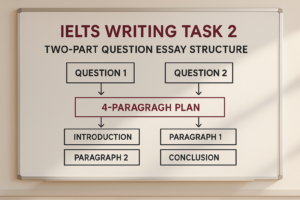
- Structure your essay with a clear introduction, body paragraphs, and conclusion
- Use a mix of simple and complex sentence structures
- Proofread for common errors in articles, prepositions, and subject-verb agreement
Speaking
The Speaking test is a face-to-face interview with three parts. Band 6.0 requires you to communicate ideas clearly, though with some hesitation and occasional errors. To prepare:
- Practise speaking for two minutes on random topics (Part 2 style)
- Record yourself and listen back for fluency and pronunciation
- Learn to extend your answers with reasons and examples rather than giving short responses
For targeted practice, you can access unlimited IELTS mock tests to build confidence across all four sections under realistic conditions.
Common Mistakes That Cost Candidates CLB 7
Many candidates who have the English ability for CLB 7 still fall short because of avoidable errors. Here are the most common ones:
- Taking the Academic module by mistake. The IRCC only accepts General Training for most immigration programmes. Academic Reading and Writing are harder, and the conversion tables are different.
- Neglecting the weakest skill. If your Writing is at 5.5, it does not matter that your Reading is 7.5. CLB 7 requires 6.0 in every skill. Allocate your study time proportionally to your gaps.
- Running out of preparation time. Jumping from band 5.0 to 6.0 in Writing typically takes 4–8 weeks of focused practice. Start early and take regular mock tests to track progress.
- Ignoring test technique. IELTS is a standardised test with predictable patterns. Knowing the question types, timing strategies, and common traps can add 0.5 to 1.0 band to your score without improving your actual English.
CLB Levels Beyond 7: What to Aim For
While CLB 7 is an important threshold, many immigration strategies benefit from targeting higher levels. Here is a quick reference for the next steps up:
- CLB 8: IELTS L: 7.5, R: 6.5, W: 6.5, S: 6.5 — opens additional CRS points
- CLB 9: IELTS L: 8.0, R: 7.0, W: 7.0, S: 7.0 — maximum skill transferability points
- CLB 10: IELTS L: 8.5, R: 8.0, W: 7.5, S: 7.5 — top tier for CRS scoring
For candidates serious about maximising their Express Entry chances, CLB 9 is the target. The jump from CLB 7 to CLB 9 in all four skills can be the single most impactful improvement you make to your immigration profile. Our guide on the IELTS band score practical framework covers strategies for lifting your scores while protecting section minimums.
How to Check Your Current CLB Level
The most reliable way to determine your CLB level is to take a full-length IELTS General Training practice test under timed conditions. Use the official IRCC conversion table to map your scores. Keep in mind:
- Practice test scores are estimates — the real test may differ slightly due to nerves, question difficulty, and examiner variation (in Writing and Speaking)
- If you score 6.0 in three skills but 5.5 in one, your CLB level is mixed — you are at CLB 7 for three skills but CLB 6 for the weaker one
- Most immigration programmes evaluate each skill independently, so one weak skill can disqualify you
Take a diagnostic test early in your preparation so you know exactly where to focus. You can use the IELTS Express Pre-Test for a quick assessment with personalised feedback and a 14-day improvement plan.
Ready to Find Your IELTS Band Score?
Take the IELTS Express Pre-Test for just $4.99 and get your personalised band prediction with a 14-day improvement plan.
Frequently Asked Questions
What IELTS score is CLB 7?
CLB 7 equates to IELTS General Training band 6.0 in all four skills: Listening, Reading, Writing, and Speaking. Each skill is assessed independently, and you need 6.0 in every one of them to meet the CLB 7 standard.
Can I use IELTS Academic for Canadian immigration?
Most Canadian immigration programmes require IELTS General Training. The IRCC conversion tables are designed for General Training scores. Some programmes may accept Academic results, but the score requirements may be higher because the test is more difficult. Always check the specific programme requirements before booking your test.
How many CRS points do I get for CLB 7?
For a single applicant with CLB 7 as their first official language, you receive 4 points per skill (16 total for language ability). When combined with other factors like education and work experience, CLB 7 provides a foundation, but CLB 9 or higher significantly increases your total CRS score and your chances of receiving an Invitation to Apply.
How long does it take to reach CLB 7 from band 5.0?
Most candidates need 4–12 weeks of focused preparation to move from band 5.0 to band 6.0, depending on the skill. Writing typically takes the longest. Regular mock tests and targeted practice in your weakest skill are the most efficient approach. Candidates who study 2–3 hours daily usually see the fastest improvement.
Do I need CLB 7 for the Provincial Nominee Program?
It depends on the province and the specific stream. Some PNP streams require CLB 7, while others accept CLB 4 or 5. NOC 0 and A occupations generally have higher language requirements than NOC B or C occupations. Check the official website of the province you are interested in for their current requirements.