If you are looking for an IELTS Writing Task 2 Crime And Punishment band 7 answer, you probably do not need another memorised essay that sounds polished on paper but collapses under time pressure. What usually helps more is a realistic sample, a clear explanation of why it works, and a practical way to copy the structure without copying the wording. In this guide, you will see a Band 7 style answer on crime and punishment, followed by a line-by-line breakdown of the decisions that keep the essay organised and convincing.
Before you rely on model essays alone, take the IELTS Express Pre-Test to get a more honest picture of your current level. A sample answer is useful, but it does not tell you whether your own writing is already close to Band 7 or still losing marks in task response, cohesion, or grammar control.
Crime and punishment is a common IELTS theme because it lets examiners test opinion, balance, and development of ideas. Candidates often know what they want to say, but the essay becomes weaker when the argument turns emotional, too general, or repetitive. A stronger Band 7 response stays calm. It answers the question directly, builds one point at a time, and uses examples carefully instead of turning every paragraph into a debate.
What examiners look for in a Band 7 crime and punishment essay
A Band 7 essay does not need perfect grammar or unusually advanced ideas. It needs control. The examiner wants to see that you understood the task, took a clear position, and developed that position with enough explanation to feel complete. In a crime and punishment topic, this matters because the subject can easily become broad. A candidate may start with prisons, then jump to youth crime, then mention poverty, then talk about rehabilitation, all in the same paragraph. That usually produces a messy argument rather than a convincing one.
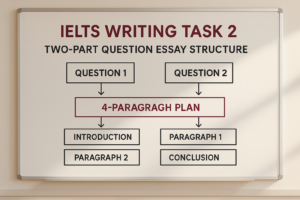
A better Band 7 approach is to keep each paragraph focused on one job. The introduction paraphrases the issue and states the opinion. One body paragraph explains the first main reason. The next body paragraph explains the second. The conclusion closes the argument without adding a surprise idea at the end.
- The position is clear from the beginning.
- Each paragraph develops one main point properly.
- Examples support the argument instead of distracting from it.
- Linking words are used naturally, not as a memorised checklist.
If your structure often feels loose, reading our IELTS Writing Task 2 Band Score Strategy can help you understand how examiners separate an organised answer from a vague one.
The kind of crime and punishment question you may see
Crime topics in IELTS Writing Task 2 usually ask you to discuss causes, evaluate solutions, or decide whether you agree with a statement about punishment. One common pattern is a debate between stricter penalties and broader social reform. That kind of prompt is useful because it pushes you to compare two approaches rather than simply saying crime is bad.
Here is a realistic practice question:
Some people believe that longer prison sentences are the best way to reduce crime, while others think that there are better alternative methods.
Discuss both views and give your own opinion.
This is not a question about whether crime exists. It is a question about the most effective response. That distinction matters. If you spend the essay describing why crime happens but never compare sentencing with alternatives, your task response becomes weaker even if the language is good.
IELTS Writing Task 2 Crime And Punishment band 7 answer sample
Here is a realistic Band 7 style sample answer:
Some people argue that extending prison terms is the most effective way to discourage criminal behaviour, whereas others believe that different measures would reduce crime more successfully. Although tougher sentences may prevent some offences by acting as a warning, I believe that long-term crime reduction depends more on rehabilitation and prevention than on punishment alone.
On the one hand, supporters of longer prison sentences believe that strict punishment sends a clear message to society. If criminals know they will lose many years of freedom, they may think more carefully before breaking the law. In addition, removing repeat offenders from the community can provide immediate protection for the public, especially in cases involving violent crime. For this reason, prison remains an important tool in any justice system.
On the other hand, longer sentences do not always address the reasons why people commit crimes in the first place. Many offences are linked to poor education, drug abuse, unemployment, or unstable family environments. If governments invest only in punishment, they may ignore the deeper causes that continue producing crime. Programmes such as job training, counselling, addiction treatment, and youth intervention can reduce reoffending more effectively by helping people change their behaviour before or after they enter the prison system.
In my opinion, prison is necessary for serious offences, but it should not be treated as the main answer to every crime problem. A justice system that combines fair punishment with strong prevention and rehabilitation policies is more likely to protect society in the long run. Therefore, while longer prison terms may be useful in some situations, alternative methods are often more effective overall.
This answer is not trying to sound clever. It is trying to stay disciplined. The writer acknowledges why longer prison sentences appeal to many people, then explains clearly why prevention and rehabilitation offer a stronger overall solution.
If you want more evidence about whether your own essays hold together under time pressure, working through unlimited IELTS mock tests can show you much faster where your structure starts slipping.
Why this sample is around Band 7
The first reason is task control. The writer answers both sides of the discussion and gives a clear opinion. That sounds basic, but it is where many essays lose marks. Some candidates spend so much time explaining one side that the other side becomes a short afterthought. Others discuss both views but never make their own judgement clear. This sample avoids both problems.
The second reason is coherence. Each paragraph has a simple purpose. The introduction frames the debate. The first body paragraph explains why longer prison sentences may help. The second body paragraph explains their limits and presents alternatives. The conclusion makes the final judgement. That sequence feels logical, which is exactly what examiners want.
The third reason is language control. The essay uses topic-appropriate words such as offenders, rehabilitation, reoffending, and justice system, but it does not force unusual vocabulary into every sentence. A Band 7 essay usually sounds clear before it sounds impressive.
- Task Response: both views are covered and the opinion is consistent.
- Coherence and Cohesion: the argument moves in a steady and easy-to-follow order.
- Lexical Resource: vocabulary fits the topic without sounding memorised.
- Grammar Range and Accuracy: sentence forms vary enough to show control, even if the essay is not flawless.
Paragraph-by-paragraph breakdown of the answer
The introduction works because it does three things quickly. It paraphrases the question, shows that there are two competing views, and states the writer’s opinion. There is no wasted space. In IELTS, a long introduction often looks ambitious but steals time from the body paragraphs where most of the real scoring happens.
The first body paragraph is balanced. It does not say that longer prison sentences solve everything. It simply explains why some people support them. That makes the paragraph believable. A weaker essay often creates a fake version of the opposite side just so it can knock it down easily.
The second body paragraph is where the argument becomes stronger. Instead of repeating that alternatives are good, the writer explains why punishment alone is limited. It then gives specific alternatives such as counselling, addiction treatment, and youth intervention. This is good development because the paragraph moves from general claim to concrete support.
The conclusion is short, which is usually a smart decision. It restates the main judgement and ends the essay cleanly. In a timed test, the conclusion is not the place to add a new idea about police funding, education reform, or social inequality. That usually weakens the structure rather than improving it.
- Keep the introduction to two or three sentences.
- Use one body paragraph for each main side of the discussion.
- Develop each point with explanation before adding examples.
- Keep the conclusion brief and aligned with the opinion already given.
Useful language for crime and punishment essays
One reason candidates struggle with this topic is that they either repeat the word crime too often or try to sound formal in a way that feels unnatural. You do not need highly technical legal vocabulary. You just need a small bank of accurate phrases that help you write clearly.
Useful nouns include offender, sentence, deterrent, rehabilitation, reoffending, public safety, and justice system. Useful verb phrases include commit an offence, reduce reoffending, protect the public, address the root causes, and play a preventive role.
The key is accuracy. For example, if you use the word deterrent, make sure the sentence shows what it deters and why. If you mention rehabilitation, explain what that means in practice. Examiners respond better to clear meaning than to decorative vocabulary.
If you are still building more stable essay language, our IELTS preparation plans can help you work on topic vocabulary, structure, and timed feedback in a more organised way.
- Do not repeat one keyword in every sentence.
- Use issue-specific vocabulary only when you can control it.
- Prefer clear collocations over rare words you barely understand.
- Explain social causes and solutions in plain language.
Common mistakes that keep essays below Band 7
The first common problem is writing an opinion essay inside a discussion essay. When the question says Discuss both views and give your own opinion, you must cover both sides. If you spend ninety per cent of the essay defending one position and mention the other in one sentence, the answer feels incomplete.
The second problem is shallow development. Many candidates write a body paragraph that looks organised because it has a topic sentence and a linking phrase, but the actual idea stays thin. They say longer prison sentences reduce crime because criminals are afraid, then move on immediately. A stronger paragraph explains why that fear might work, where it may be limited, and what kind of crimes it might affect.
The third problem is drifting into moral language instead of analytical language. IELTS is not testing whether your personal feelings about criminals are strong. It is testing whether you can build a reasoned argument in English. Phrases such as criminals deserve suffering or society must be harsh can make the essay sound emotional rather than thoughtful.
- Answer the exact task type, not the one you wish you saw.
- Develop ideas with explanation, not only opinion.
- Avoid emotional overstatement.
- Keep examples short and relevant.
How to practise this topic under exam conditions
A good way to practise crime and punishment essays is to separate the work into stages. First, spend ten minutes planning only. Write the question, identify the task type, choose your position, and map one main idea for each body paragraph. Then write the essay in full under timed conditions. After that, review whether the finished answer actually matched the plan or drifted away from it halfway through.
This matters because Band 7 writing usually comes from repeatable habits rather than occasional good essays. If you always rush the planning stage, your argument is likely to become uneven. If you always write long conclusions, you are probably wasting time that should have gone into development. Timed practice works best when you measure specific habits, not when you simply count how many essays you completed.
Before the FAQ section, it is worth saying something blunt: if your writing score has been stuck for months, random sample essays are not enough. You need targeted feedback, a baseline, and a correction cycle that shows whether the same mistakes are still repeating.
Ready to find out your IELTS band score?
Take the IELTS Express Pre-Test for just $4.99 and get your personalised band prediction with a 14-day improvement plan.
FAQ: IELTS Writing Task 2 Crime And Punishment band 7 answer
Is this sample a guaranteed Band 7 essay?
No sample can guarantee the exact score you will receive in a live exam, because real band scores depend on the full response and how consistently you control the language on test day. This answer is designed to reflect the level of structure, clarity, and development commonly seen around Band 7.
Do I need to support both sides equally in this type of question?
You need to discuss both views clearly, but the depth does not have to be mathematically equal. What matters is that neither side feels ignored and that your own opinion is easy to identify.
Should I use real examples in a crime and punishment essay?
You can, but they are not necessary. In IELTS, a short logical example is usually enough. Inventing statistics or complicated real-world cases often wastes time and can make the essay less controlled.
What vocabulary is most useful for this topic?
Useful vocabulary includes words such as offender, deterrent, rehabilitation, justice system, and reoffending. However, vocabulary only helps when it is used accurately and naturally in a clear argument.
How can I move from Band 6 to Band 7 in Writing Task 2?
The jump usually comes from better paragraph control, clearer opinion statements, stronger idea development, and fewer repeated grammar mistakes. It is rarely about memorising more advanced words. It is more often about writing a cleaner argument from start to finish.
What to copy from this answer and what to avoid
The best thing to copy from this IELTS Writing Task 2 Crime And Punishment band 7 answer is the structure. Notice how the essay answers the question directly, keeps one clear reason in each body paragraph, and ends without losing control. That is the pattern worth practising.
The worst thing to copy is the exact wording. If you memorise full sentences, they will often sound awkward when the topic changes slightly. A better approach is to learn the shape: paraphrase the question, state a position, develop one reason at a time, and keep the conclusion clean. That gives you something flexible enough to use in the real exam.
If you can do that consistently, the score becomes much more predictable. And that is usually what candidates really want: not one lucky essay, but a writing process they can trust under pressure.