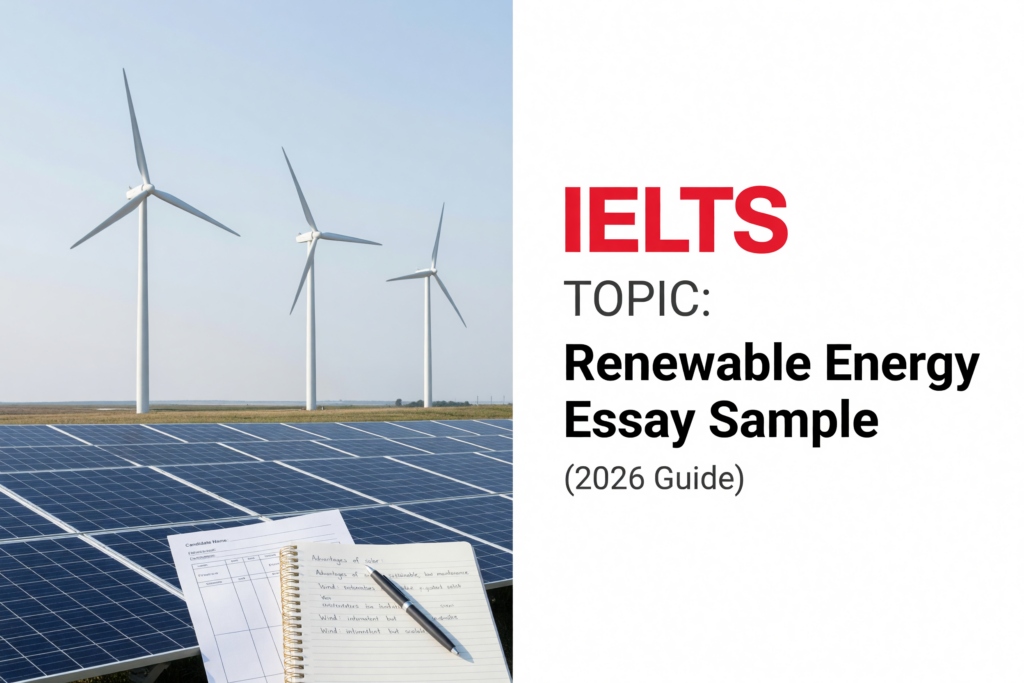
If you are looking for an IELTS Writing Task 2 Renewable Energy essay sample, you probably want more than a polished model answer that sounds good for a minute and then leaves you stuck when the real exam question changes. Most candidates need a realistic sample they can study for structure, argument control, and practical language choices. Before you assume your writing is already close to your target band, take the IELTS Express Pre-Test to get a clearer picture of your current score and the habits that may still be limiting your result.
Renewable energy is a common IELTS theme because it connects naturally to the environment, government policy, economic development, and daily life. That also makes it easy to handle badly. Candidates often write broad statements about saving the planet without narrowing the actual issue in the prompt. A stronger essay stays calmer than that. It answers the exact question, develops one point at a time, and uses examples that feel believable rather than dramatic.
What examiners want from a renewable energy Task 2 essay
An essay on renewable energy is marked in the same way as any other IELTS Writing Task 2 response. Examiners still assess task response, coherence and cohesion, lexical resource, and grammatical range and accuracy. In plain language, they want to see whether you answered the question directly, organised the response logically, used vocabulary with enough precision, and controlled grammar well enough for the meaning to stay clear.
This matters because energy topics can tempt candidates to write like campaigners instead of exam candidates. You do not need to sound passionate. You need to sound controlled. A good renewable energy essay stays close to the wording of the task, explains the main ideas properly, and avoids trying to solve every environmental problem in one short response.
- answer the exact question rather than the whole topic of climate change
- make your opinion clear early if the task asks for one
- give each body paragraph one obvious purpose
- use examples that directly support the argument
Why renewable energy questions can be harder than they look
Renewable energy feels familiar because people hear about solar power, wind farms, and rising energy costs all the time. That familiarity can create weak essays. Candidates often begin too quickly and produce vague claims such as renewable energy is the future or governments must invest more, without explaining why those points answer the exact task.
A better approach is to narrow the issue immediately. Is the question about government spending, consumer behaviour, environmental responsibility, or economic trade-offs? Is it an opinion essay, a discuss-both-views task, or a problem-solution question? Once you define the job properly, the writing becomes much easier to control. If you want a stronger foundation for that control, the IELTS Writing Task 2 band score strategy guide is a useful place to sharpen your planning habits.
A sample renewable energy question you can practise with
Here is a realistic IELTS-style question on this theme:
Some people think governments should invest heavily in renewable energy sources such as solar and wind power, while others believe this money should be spent on improving existing traditional energy systems. Discuss both views and give your own opinion.
This is a discuss both views essay with an opinion. That means you need to explain both positions fairly and still make your own judgement clear. For this sample, the position will be that traditional systems still need some improvement in the short term, but governments should invest more heavily in renewable energy because it offers stronger long-term environmental and economic benefits.
IELTS Writing Task 2 Renewable Energy essay sample
Sample essay:
Energy policy has become a major issue for governments because countries need reliable power while also facing environmental pressure. Some people argue that public money should be used to improve existing traditional energy systems, whereas others believe that governments should focus far more on renewable energy sources such as solar and wind power. In my opinion, although traditional systems may still need limited short-term support, heavier investment in renewable energy is the wiser long-term choice.
On the one hand, there are understandable reasons for improving traditional energy systems. Many countries still depend heavily on coal, gas, or oil for electricity, transport, and industry, so a sudden move away from these systems could cause serious disruption. Supporters of this view often argue that existing energy networks can be made cleaner and more efficient through better technology, which may reduce emissions while protecting jobs and keeping energy supplies stable. In developing economies especially, governments may worry that a rapid transition to newer systems could be too expensive or technically difficult.
On the other hand, supporters of renewable energy argue that long-term investment in solar, wind, and similar sources is far more sustainable. Traditional fuels are finite and continue to contribute heavily to air pollution and climate-related problems. By contrast, renewable energy can reduce dependence on imported fuel, lower environmental damage, and create new industries over time. Although the initial cost of renewable infrastructure may be high, supporters argue that these systems often become more cost-effective in the long run because the energy source itself is naturally available.
I believe the second view is more convincing. While governments should maintain stable power supplies during any transition period, spending most public money on old systems would only delay necessary change. Investment in renewable energy gives countries a better chance to improve energy security, reduce environmental harm, and build a more durable economy. For that reason, it should be the main priority.
In conclusion, improving traditional energy systems may offer short-term stability, but I believe governments should invest more heavily in renewable energy because it provides stronger long-term benefits for both the environment and the economy.
Why this sample is close to Band 7 level
This sample works because it answers both sides of the argument clearly and keeps a steady opinion from the introduction to the conclusion. The first body paragraph explains why some people support upgrading traditional systems. The second shows why renewable energy has a stronger long-term case. Nothing feels confused about the direction of the essay.
The support is also practical enough to sound credible. The response mentions energy security, jobs, imported fuel, infrastructure cost, pollution, and long-term economic benefits. These are concrete points, which makes the discussion easier to trust. Candidates often lose marks when they write about environmental issues in very abstract language without showing how they affect real policy decisions.
- the opinion is clear early and stays consistent
- each body paragraph has one clear role
- the support is realistic rather than dramatic
- the conclusion returns to the same judgement without changing direction
The language is strong without trying too hard to sound academic. That is an important lesson for IELTS candidates. A good essay does not need complicated vocabulary in every sentence. It needs clear structure, relevant support, and language you can control under timed conditions. If you want to test whether your own writing is stable enough, access unlimited IELTS mock tests and compare your results across several timed attempts.
Useful ideas and vocabulary for this topic
You do not need to memorise the full sample answer. It is more useful to learn the ideas and sentence patterns that help you organise a renewable energy argument. These essays often involve cost, infrastructure, public policy, environmental impact, and long-term planning, so a small bank of flexible language can help.
- long-term energy security
- public investment in infrastructure
- dependence on fossil fuels
- short-term transition costs
- lower emissions and cleaner air
This kind of language keeps the essay precise without making it heavy or unnatural. It also makes it easier to compare two sides fairly. Clear, usable vocabulary usually scores better than difficult vocabulary you cannot control properly.
Common mistakes in renewable energy essays
One common mistake is turning the essay into a general article about climate change. Candidates start discussing recycling, plastic waste, public transport, and endangered animals even when the question only asks about energy investment. That weakens task response because the essay drifts away from the real issue.
Another mistake is making extreme claims. Some candidates write as if traditional energy should disappear overnight, while others argue that renewable power is unrealistic in every situation. Both positions usually sound simplistic. A stronger essay recognises that governments often need to balance immediate reliability with long-term reform.
- answering the broad topic of the environment instead of the exact prompt
- listing advantages of solar or wind power without building an argument
- making absolute claims that are hard to defend
- forgetting to compare both views clearly in a discuss essay
If those problems sound familiar, the fix is usually simple. Slow down before you write, define the exact debate, and choose examples you can explain properly instead of stacking vague points.
How to plan your own answer in under five minutes
In the exam, a short planning stage can save you from a weak structure later. You do not need a full outline. You need a map of the argument. For a renewable energy discuss-both-views essay, that usually means deciding what each side believes, what your own position is, and which examples you can explain quickly.
- underline the task words and the exact focus of the question
- decide your opinion before writing the introduction
- give one body paragraph to each main side of the debate
- choose examples such as fuel costs, pollution, energy reliability, or infrastructure only if they fit the prompt
- leave time at the end to check grammar, repetition, and clear linking
This habit is simple, but it works. Many weak essays are not weak because the writer lacks ideas. They are weak because the ideas arrive in the wrong order. If you want more structured help with planning, feedback, and score improvement, see our IELTS preparation plans and compare the support that matches your timeline.
How to make your opinion clear without sounding repetitive
Many candidates think they need to repeat phrases such as I believe in every paragraph. That usually makes the essay sound stiff. A better approach is to make the opinion clear in the introduction, support it through paragraph choice and explanation, and then restate it naturally in the conclusion.
In this sample, the writer’s position is that traditional systems may still need limited support, but renewable energy deserves the main share of investment. That judgement appears early, then becomes stronger because the later paragraphs explain why stability matters in the short term while sustainability matters more in the long term. The structure itself carries part of the opinion. That is much better than repeating the same sentence again and again.
How to adapt this sample to other environment-related Task 2 questions
The wording of the IELTS prompt may change. One task may focus on public transport, another on pollution, and another on government spending. Even so, the core method can stay the same. First, identify the main contrast in the question. Second, decide your position. Third, build body paragraphs that do real argumentative work instead of simply listing views.
This is why sample essays are useful when you study them properly. You are not trying to copy the topic details. You are learning how to frame a debate, choose practical support, and keep control of paragraph structure. Those skills transfer well across many Writing Task 2 themes, including technology, health, education, and public policy topics.
Ready to find out your IELTS band score?
Take the IELTS Express Pre-Test for just $4.99 and get your personalised band prediction with a 14-day improvement plan.
FAQ: IELTS Writing Task 2 Renewable Energy essay sample
Is this IELTS Writing Task 2 Renewable Energy essay sample good enough for Band 8?
It is closer to a solid Band 7 model. A Band 8 response would usually show slightly sharper development, more flexible vocabulary, and tighter control of complex grammar.
Should I memorise a renewable energy essay before the exam?
No. It is better to learn the structure, useful ideas, and sentence patterns. Memorised essays often become awkward when the real question changes angle.
What examples are safe to use in a renewable energy essay?
Safe examples usually include solar and wind power, electricity costs, fuel imports, air pollution, and infrastructure investment. The best examples are the ones you can explain clearly and connect directly to the prompt.
Do I need advanced vocabulary for this topic?
No. You need precise vocabulary, not flashy vocabulary. Clear phrases such as renewable energy, traditional energy systems, long-term investment, and energy security are often more effective than difficult words you cannot control well.
How should I practise after reading a sample like this?
Write your own answer to a different environment or policy question under timed conditions, then compare your structure, clarity, and paragraph control with the sample.
Study the method, then write your own answer
The best use of an IELTS Writing Task 2 Renewable Energy essay sample is to build method, not memorisation. Read the question carefully, narrow the debate early, and make sure each paragraph has one clear role.
If you can do that under timed conditions, your writing becomes much more reliable. That is the real value of a strong sample answer. Clear structure, relevant support, and language you can control will help you much more than trying to sound dramatic or overly clever.