If you are looking for an IELTS Speaking Part 2 Shopping cue card sample, you probably do not want a perfect script that sounds memorised. You want a realistic answer you can actually learn from and adapt in the exam. Before you rely on guesswork, take the IELTS Express Pre-Test to get a clearer picture of your current band score and the speaking habits that may still be limiting your result.
Shopping is a common IELTS topic because it is familiar, flexible, and easy for examiners to extend into Part 3 discussion. That sounds simple, but it can still go wrong. Many candidates give short, flat answers, repeat the same basic words, or spend too long describing the shop instead of telling a clear story. A stronger answer feels personal, organised, and easy to follow.
What the shopping cue card is really testing
In IELTS Speaking Part 2, the examiner is not testing whether you love shopping. They are checking whether you can speak for up to two minutes with enough fluency, clear organisation, and precise language. A shopping topic gives you room to show narrative control because you can talk about a person, a place, a decision, a feeling, and a result in one answer.
This matters because many candidates mistake familiarity for safety. They think, “I know shopping, so I do not need to prepare.” Then the answer becomes vague. A better approach is to build a simple structure you can reuse. If you want a bigger picture of how the whole test works, this IELTS Speaking Test complete guide is a useful foundation.
- Speak in a clear timeline rather than random details
- Show natural vocabulary instead of memorised phrases
- Develop each prompt point with one or two useful details
- Finish with a clear feeling or final judgement
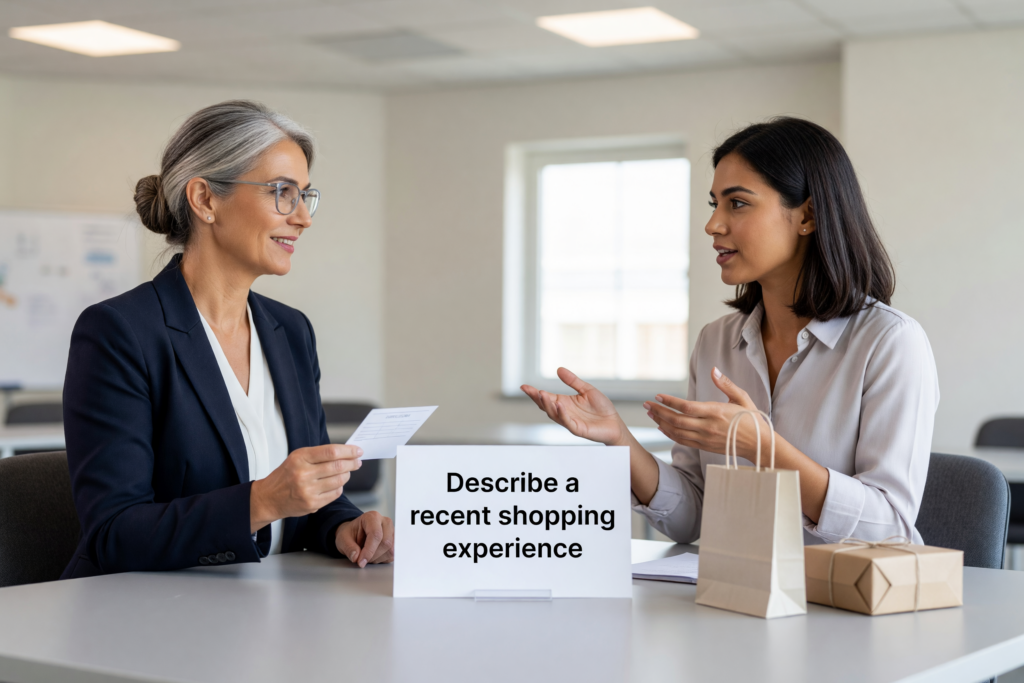
A typical IELTS Speaking Part 2 shopping cue card
A common version of this topic looks like this:
Describe a time when you bought something from a shop or online that you were very happy with.
- what you bought
- where you bought it
- why you bought it
- and explain why you were happy with it
This cue card is straightforward, but it still needs control. You do not need an extraordinary story. In fact, a normal purchase often works better because it is easier to describe naturally. The key is to choose an item that gives you enough to say about context, reason, experience, and result.
IELTS Speaking Part 2 Shopping cue card sample answer
Here is a realistic sample answer that would suit a solid Band 7-style performance:
Sample answer:
I would like to talk about a laptop that I bought last year and was genuinely happy with. I had been using an older one for quite a long time, but it had become very slow and unreliable, especially when I was trying to study online and join video classes. After a few frustrating weeks, I decided it was time to replace it with something more practical.
I bought it from a large electronics store in a shopping centre near my home. I actually looked at a few models online first, but I still wanted to see them in person before making a decision. When I went to the shop, one of the staff members explained the main differences between the models in a very simple way, which helped me a lot because I am not especially technical.
The main reason I bought it was that I needed something dependable for studying, writing assignments, and practising English every day. I also wanted a device with a better battery life because my old laptop would run out of power very quickly. In the end, I chose a mid-range model rather than the cheapest one because it seemed like a better long-term option.
I was very happy with it for a few reasons. First, it worked smoothly from the beginning, so I could use it without stress. Second, it made my daily routine easier because I could join classes, type notes, and watch practice lessons without technical problems. Finally, I felt I had made a sensible decision rather than an impulsive purchase. It was not only useful, but also worth the money, so I came away feeling satisfied and quite relieved.
Why this sample works for a strong band score
This answer works because it sounds like a person speaking, not reading from a script. The story is simple, but it has shape. The speaker explains the problem, the buying process, the reason for the choice, and the result. That creates a natural flow, which helps fluency and coherence.
The language is also controlled. There is enough variety to sound capable, but not so much that the answer becomes unnatural. Phrases such as very slow and unreliable, a better long-term option, and worth the money are practical and believable. If you want more repetition under timed conditions, access unlimited IELTS mock tests and compare how stable your speaking stays across different topics.
- The opening states the item clearly
- The middle develops where, why, and how the purchase happened
- The ending explains satisfaction in a direct way
- The tone sounds natural rather than dramatic
How to organise your own shopping cue card answer
You do not need to memorise the full sample. It is more useful to remember a flexible four-part structure. Start by naming the item. Then explain where or how you bought it. After that, give the reason it mattered at that time. Finally, explain why you felt pleased with the purchase.
That structure works well because it follows the cue card prompts closely. It also reduces the risk of stopping too early. When candidates freeze, it is often because they try to sound impressive instead of moving step by step. A simple structure gives you enough material to keep speaking. If you want more support on speaking development, the IELTS Speaking Part 2 and Part 3 framework can help you build a more repeatable method.
- Item: what exactly did you buy?
- Place: where did you buy it, or was it online?
- Reason: why did you need or want it?
- Result: why did it make you happy?
Useful vocabulary for shopping topics
You do not need fancy vocabulary for a shopping cue card. You need words that fit everyday situations and that you can pronounce clearly. Strong vocabulary in Speaking usually sounds ordinary but accurate.
- good value for money
- reliable and practical
- mid-range model
- compare different options
- make an informed decision
- slightly overpriced
- battery life
- customer service
These phrases are useful because they are flexible. You can use them for electronics, clothes, books, furniture, or online purchases. That makes them safer than highly specific words you may forget under pressure.
Common mistakes in shopping cue cards
One common mistake is choosing an item that is too boring to describe, then giving almost no detail. A boring item is not the problem by itself. The real problem is failing to add context. Even a simple purchase like shoes or headphones can work if you explain why you needed them, how you chose them, and what changed afterwards.
Another mistake is turning the answer into a list. Candidates say what they bought, where they bought it, why they bought it, and why they liked it, but each point is only one sentence long. That creates a thin answer. You should stretch each prompt point with one reason, one detail, or one example.
- Do not memorise a dramatic story that sounds artificial
- Do not repeat basic words like good, nice, and happy too often
- Do not spend too long describing the shop and forget the main item
- Do not stop after forty seconds because you answered too briefly
How to sound natural instead of memorised
Natural speaking usually includes small, clear reflections. For example, instead of saying, “I bought a laptop and it was good,” you can say, “I chose it because my old one was becoming unreliable, and I needed something I could trust every day.” That sounds more human because it shows thought, not just information.
You can also improve naturalness by varying sentence openings. Start one sentence with time, another with reason, and another with feeling. Small changes like that make your speech sound less mechanical. If you are preparing seriously for a target score, see our IELTS preparation plans and choose the level of support that matches your timeline.
How Part 3 may extend the shopping topic
After the cue card, the examiner may ask broader questions about shopping habits, online shopping, advertising, consumer behaviour, or how shopping has changed over time. That means this topic is not only about one purchase. It can lead to discussion about society and personal choice.
A good way to prepare is to move from the personal story to broader opinions. For example, if your Part 2 answer is about buying a laptop online or in a store, Part 3 may ask whether online shopping is better than traditional shopping. It helps to practise that transition in advance so you are not surprised by the shift.
Before the FAQ, use this quick checkpoint if you want to know whether your current speaking level is already close to your target band:
Ready to find out your IELTS band score?
Take the IELTS Express Pre-Test for just $4.99 and get your personalised band prediction with a 14-day improvement plan.
FAQ: IELTS Speaking Part 2 Shopping cue card sample
Do I need an unusual shopping story for this cue card?
No. A normal purchase often works better because it is easier to explain clearly and naturally. The examiner is listening for fluency, organisation, vocabulary, and pronunciation, not judging whether your story is exciting.
Can I talk about buying something online?
Yes. Online shopping is completely suitable for this topic. In fact, it can give you useful language about comparing reviews, delivery time, price differences, and convenience.
What if I finish my answer too quickly?
Add more development to each cue card point. Explain what happened before the purchase, why you compared options, how you felt during the decision, and what happened afterwards. That usually gives you enough material to reach the full speaking time more comfortably.
How many advanced words should I use?
Only use vocabulary you can control naturally. A few accurate phrases are better than many complicated words that sound forced or are hard to pronounce clearly.
Is it okay to use a cue card answer template?
Yes, if you mean a structure rather than a memorised script. A reliable structure helps you stay organised. A memorised answer often sounds stiff and can break down when the topic changes slightly.
A smarter way to practise this topic
The best way to use this IELTS Speaking Part 2 Shopping cue card sample is not to copy every sentence. Study the structure, borrow the useful vocabulary, and then build your own version around a real purchase from your life. That is usually the fastest way to sound confident and natural in the exam.
If you can describe the item clearly, explain why it mattered, and finish with a believable reason you were happy with it, you are already doing the important work. From there, the next step is repetition. Practise with a timer, listen back, and tighten the weak parts until the answer feels steady under pressure.