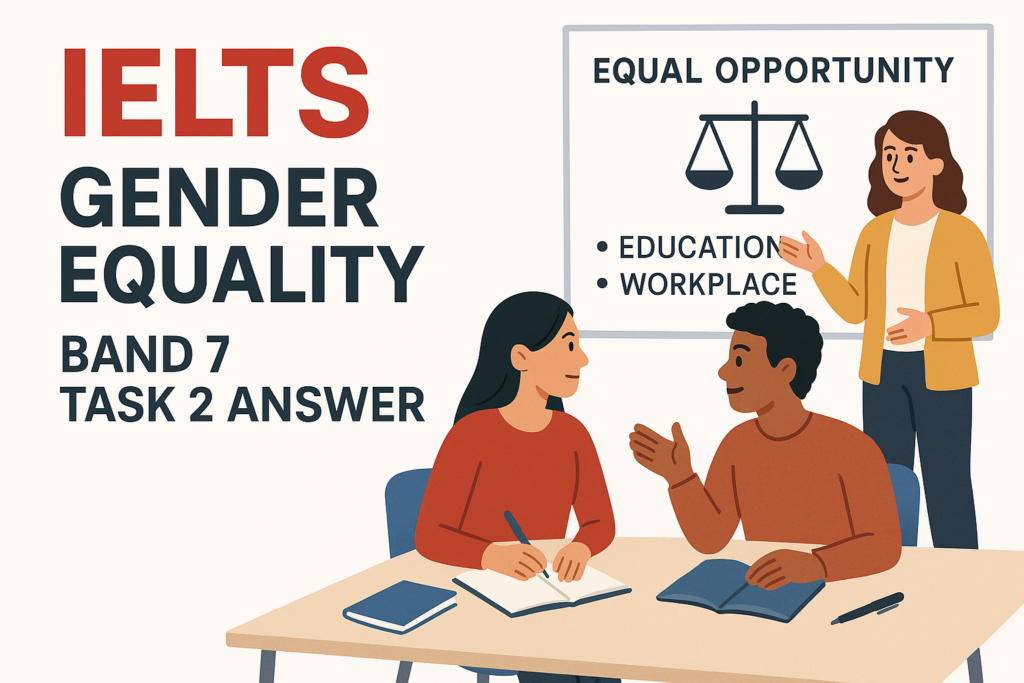
If you are preparing an IELTS Writing Task 2 Gender Equality band 7 answer, the safest approach is to treat gender equality as a question about fairness, opportunity, social responsibility, and practical policy. Before you write full essays, take the IELTS Express Pre-Test to check your current writing band and see which part of your essay needs the most work.
Gender equality is a strong IELTS topic because most candidates understand the basic idea, but many answers become too general. Some candidates write only that men and women should be equal. Others list workplace problems without explaining causes or solutions. A Band 7 answer needs a clear position, developed ideas, realistic examples, and language that stays precise rather than emotional.
What A Gender Equality Essay Needs To Do
An IELTS Task 2 essay about gender equality should first identify the exact task. If the question asks whether men and women should have equal opportunities, your answer should discuss education, work, leadership, family roles, and legal protection. If it asks whether governments should do more, your essay should focus on policy, not only personal attitudes.
Many candidates lose marks because they make the topic too broad. They mention salaries, schools, culture, sport, family life, politics, and history in one paragraph. That gives the examiner a list, not an argument. A stronger answer chooses two or three areas and explains them carefully.
- Read the question type before choosing your position.
- Decide whether the essay is mainly about work, education, law, family roles, or social attitudes.
- Use examples that a general reader can understand.
- Keep your opinion consistent from the introduction to the conclusion.
IELTS Writing Task 2 Gender Equality Band 7 Answer Structure
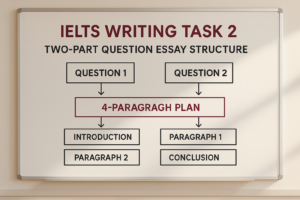
A reliable Band 7 structure has four paragraphs: introduction, body paragraph one, body paragraph two, and conclusion. For gender equality essays, body paragraph one can explain why equal opportunity benefits individuals and society. Body paragraph two can discuss practical barriers, such as unpaid care, workplace discrimination, limited leadership pathways, or traditional expectations.
If the question asks for your opinion, make your position clear in the introduction. A safe position is that equal rights and opportunities should be protected, but real equality also needs practical support such as fair hiring, parental leave, safe workplaces, and access to education. This gives you room to discuss both principle and implementation.
If you want to test this structure under exam timing, use unlimited IELTS mock tests and practise several society, education, work, and government policy essays in one week. Timed practice shows whether your argument stays clear when the topic changes.
Sample Question For A Gender Equality Essay
Here is a realistic IELTS Writing Task 2 question:
Some people believe that men and women should have the same opportunities in education and employment. Others think traditional roles are still important in society. Discuss both views and give your own opinion.
This is a discuss both views and give your opinion question. You need to explain why some people support equal opportunities, why others value traditional roles, and what you think. A safe Band 7 position is that people should be free to choose their roles, but gender should not limit access to education, work, income, or leadership.
Band 7 Sample Answer: Gender Equality
People have different views about whether men and women should have the same opportunities in education and employment, or whether traditional roles should remain important. Some people believe that equal access is necessary for fairness and social progress. Others argue that traditional family roles can provide stability. In my view, men and women should have equal opportunities, while families should still be free to organise their private lives in the way that suits them.
On the one hand, equal opportunities in education and employment are necessary because talent is not limited by gender. When girls and boys can study the same subjects, choose the same careers, and compete for the same positions, society can use a wider range of skills. For example, more women in medicine, engineering, law, business, and public leadership can help organisations make better decisions and serve different groups of people. Equality also supports financial independence. If women are excluded from good jobs, they may become dependent on others and have fewer choices in life.
On the other hand, some people believe traditional roles still have value. In many families, one parent may focus more on earning income while the other spends more time caring for children or older relatives. This arrangement can work well if both adults choose it freely and respect each other’s contribution. The problem begins when society assumes that care work must always belong to women or that men should avoid family responsibilities. Traditional roles should be personal choices, not fixed rules that limit education, employment, or public life.
I believe the best approach is equal opportunity with genuine choice. Governments and employers should remove barriers that prevent women from studying, working, being promoted, or receiving equal pay for equal work. At the same time, men should not be judged negatively for taking parental leave or sharing care responsibilities. Equality does not mean every person must live the same way. It means people should not be pushed into a role because of gender.
In conclusion, traditional family arrangements may suit some people, but they should not be used to restrict opportunity. Men and women should have equal access to education, employment, leadership, and family choices. A fair society allows individuals to decide their own path instead of forcing them into one.
Why This Sample Answer Reaches Band 7
This sample answer reaches a Band 7 style because it answers all parts of the question. The introduction presents both views and gives a clear opinion. The first body paragraph explains equal opportunity with examples from education, careers, and financial independence. The second body paragraph discusses traditional roles without rejecting family choice completely.
The answer also avoids an extreme position. It does not say traditional roles are always wrong, and it does not say equality means everyone must make identical choices. This matters because IELTS rewards a well-developed argument. A mature answer can recognise complexity while still giving a clear view.
Useful Vocabulary For Gender Equality Essays
Gender equality essays need vocabulary for fairness, opportunity, work, education, family, and law. Do not memorise rare political terms if you cannot use them naturally. Learn flexible phrases that can fit several question types.
- equal opportunity: the chance for people to study, work, and succeed without unfair barriers.
- gender discrimination: unfair treatment because someone is male or female.
- traditional roles: expectations about what men and women are supposed to do in family or society.
- financial independence: the ability to support yourself with your own income.
- parental leave: time away from work to care for a new child.
- equal pay: fair payment for the same or equivalent work.
Use these phrases inside full sentences. For example, you could write, “Equal opportunity in education allows students to choose subjects based on ability and interest rather than gender expectations.” That sentence is clear, relevant, and easy for the examiner to follow.
Common Mistakes In Gender Equality Essays
The first mistake is writing only a moral statement. Saying that gender equality is fair is true, but it is not enough for a full Task 2 paragraph. Explain how fairness affects education, income, safety, leadership, family choice, or economic growth.
The second mistake is confusing equality with sameness. A strong essay does not need to argue that men and women must make the same decisions. It should argue that they should have the same right to choose, study, work, lead, and be treated fairly. If your Task 2 ideas often stay too general, compare your writing with the IELTS Writing Task 2 band score guide.
The third mistake is using exaggerated claims. Avoid saying that all men think one way or all women think another way. IELTS topics are about society, not stereotypes. Use careful language such as many people, some workplaces, certain cultures, or in some families when you need to generalise.
Planning A Gender Equality Band 7 Answer In Five Minutes
Use the first five minutes to decide the question type, your position, and two main ideas. For the sample question above, your plan could be: equal opportunity helps society use talent and supports independence; traditional family roles can work only when they are freely chosen; my opinion is that gender should not limit education, work, or family choice.
This plan is enough. Do not write six different ideas before you start. Too many points can make your essay rushed and shallow. A Band 7 answer usually develops a small number of relevant ideas with clear examples and explanations.
- Minute one: identify the question type.
- Minute two: choose your overall opinion.
- Minute three: choose the strongest reason for equal opportunity.
- Minute four: choose how to discuss traditional roles fairly.
- Minute five: decide your example and conclusion line.
How To Adapt This Answer To Other Gender Equality Questions
You can adapt the same ideas to several question types. For an agree or disagree question about equal pay, discuss fairness, productivity, and the need to judge employees by work rather than gender. For a problem and solution question, discuss discrimination, unpaid care, limited childcare, or weak workplace policies, then suggest fair hiring, parental leave, flexible work, and clear pay rules.
Be careful with memorisation. You can reuse ideas, but you must change the answer to fit the wording. If the question focuses on education, write more about subject choice, scholarships, and confidence. If it focuses on employment, write more about hiring, promotion, pay, and parental leave. For more topic-based models, read the IELTS Writing Task 2 sample answers page and compare how each essay develops its argument.
Final Tips Before You Write Your Own Answer
Before writing your own gender equality essay, decide whether the question is mainly about rights, work, education, family roles, culture, or government policy. That decision will help you choose examples quickly. Then write a clear introduction and make sure each body paragraph supports your position.
Do not chase difficult vocabulary. A clear sentence with accurate grammar is better than a complicated sentence that loses meaning. If your test date is close and you need structured support, see our IELTS preparation plans and choose support that matches your target band and deadline.
Ready to find out your IELTS band score?
Take the IELTS Express Pre-Test for just $4.99 and get your personalised band prediction with a 14-day improvement plan.
FAQ: IELTS Writing Task 2 Gender Equality Band 7 Answer
Is gender equality a common IELTS Writing Task 2 topic?
Yes. It can appear under education, employment, family, government policy, culture, leadership, or social change. Prepare flexible ideas rather than one memorised essay.
What opinion is safest for a gender equality essay?
A balanced opinion is often safest. You can argue that men and women should have equal opportunities, while also recognising that families may choose different private arrangements.
Can I discuss traditional gender roles in IELTS?
Yes, if the question asks about them. Explain that traditional roles may suit some families when chosen freely, but they should not block education, employment, pay, or leadership opportunities.
Do I need advanced vocabulary for Band 7?
No. You need accurate vocabulary used naturally. Terms such as equal opportunity, discrimination, parental leave, financial independence, equal pay, and workplace policy are useful if they fit the sentence.
How many examples should I include?
One clear example in each main body paragraph is usually enough. Examples should support the main idea instead of replacing explanation.