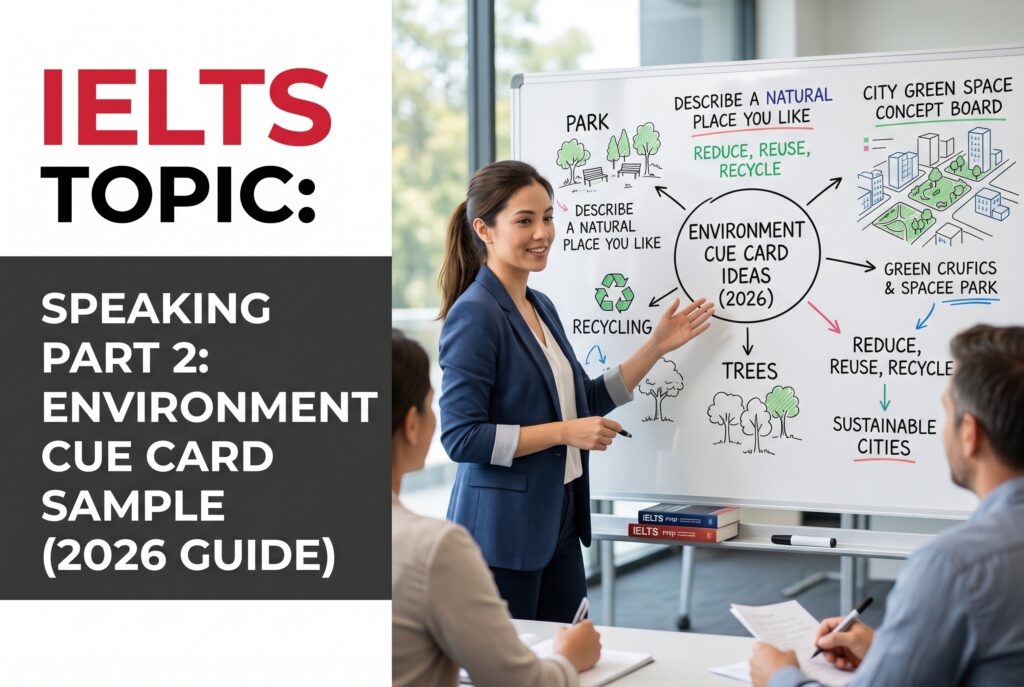
If you are looking for an IELTS Speaking Part 2 Environment cue card sample, you probably want more than one polished answer to memorise. You need a response you can learn from, adapt, and deliver naturally under pressure. In the real test, the examiner is not only listening for ideas about the environment. They are listening for fluency, organisation, vocabulary control, and your ability to speak for nearly two minutes without sounding lost or rehearsed. Before you rely on guesswork about your current Speaking level, take the IELTS Express Pre-Test to get a clearer picture of your band score and the areas that still need work.
Environment topics appear often in IELTS because they are familiar but still flexible. You might be asked to describe a place with clean air, a park you enjoy, a natural area that impressed you, or a place where people protect nature. That sounds manageable, but many candidates still struggle because their answer stays too simple, too repetitive, or too vague. The good news is that this is a topic you can prepare well without sounding robotic. Once you know how to structure the cue card, choose specific detail, and extend your answer with a personal reaction, the task becomes much easier to control.
What this IELTS Speaking Part 2 Environment cue card sample needs to do
A strong cue card answer does three jobs at the same time. First, it answers all parts of the prompt clearly. Second, it gives enough detail to fill the time naturally. Third, it shows the examiner that your English remains organised even while you are speaking freely.
With an environment topic, candidates often make one of two mistakes. Some give a very general answer about climate change, pollution, or recycling without describing one real place or experience. Others describe a place clearly but run out of language because they do not know how to extend their ideas. A good sample answer should help you avoid both problems by balancing personal detail with useful topic language.
If you want the wider scoring context around this task, the IELTS Speaking Part 2/3 framework is a useful reference before your next practice session.
A common environment cue card prompt and how to read it
A very common version of this topic looks like this:
- Describe a place with a good natural environment.
- You should say where it is.
- When you went there.
- What you can see or do there.
- And explain why you think it has a good environment.
When you read a prompt like this, do not panic and start planning a perfect speech. Just identify four things: the place, the time, the activities or features, and your explanation. That already gives you a clean structure for the two minutes.
You do not need an extraordinary story. In fact, ordinary places often work better because they are easier to describe honestly. A national park, a beach with clean water, a quiet botanical garden, or even a well-managed lake near your city can all become strong answers if the details feel real and specific.
IELTS Speaking Part 2 Environment cue card sample answer
One place with a very good natural environment that I would like to describe is a national park near my hometown that I visited with two friends during a short weekend trip last year. It is about two hours away from the city, so it is close enough for a quick visit, but once you arrive, it feels completely different from urban life.
The first thing I noticed there was how clean and calm everything felt. The air was much fresher than in the city, and there was very little traffic noise, so we could hear birds and running water quite clearly. The park had a large walking trail through native trees, a small river, and several open areas where people could sit, relax, and have a picnic without disturbing the landscape too much.
We spent most of the day walking, taking photos, and stopping at different lookout points. One part I remember particularly well was a wooden platform facing a valley. From there, we could see a wide green area with almost no buildings, which made the place feel peaceful and well protected. There were also clear signs asking visitors not to leave rubbish, and I think that helped keep the park in very good condition.
I think it has a good environment for two main reasons. First, the place itself is naturally beautiful, with clean water, healthy trees, and plenty of open space. Second, it seemed to be managed responsibly. The walking paths were organised, the public facilities were simple but clean, and the area did not feel overcrowded or damaged by tourism. For me, that combination is important, because a good environment is not only about nature on its own. It is also about how people look after it. After visiting that park, I felt more relaxed and also a bit more aware of how important it is to protect places like that.
Why this sample answer works for a solid band score
This answer works because it sounds personal, organised, and easy to follow. It does not try to impress the examiner with forced academic language. Instead, it uses a clear sequence: where the place is, when the speaker went there, what the place looked like, what happened during the visit, and why the environment felt good.
It also includes sensory detail, which is very useful in Part 2. Phrases such as fresh air, traffic noise, native trees, running water, and wide green area help the answer feel real. That matters because examiners respond well to language that paints a picture without becoming dramatic or unnatural.
If your fluency becomes unstable once you start speaking for longer, it helps to access unlimited IELTS mock tests so you can practise complete Part 2 answers under realistic timing instead of only doing short fragments.
Vocabulary you can use for an environment topic
You do not need specialist environmental vocabulary to give a strong answer, but you do need some accurate and flexible language. The safest words are the ones you can use naturally while speaking.
- fresh air – useful for parks, beaches, mountains, or countryside places
- clean water – useful for rivers, lakes, beaches, or protected areas
- green space – useful for urban parks and open public areas
- well maintained – useful when talking about cleanliness and management
- peaceful atmosphere – useful for describing how the place feels
- protected area – useful for parks, forests, and reserves
- natural beauty – useful when explaining why the place is attractive
- overcrowded – useful if you want to contrast a clean place with a damaged one
The key is not to force all of these into one answer. Choose a few that fit your real example. A shorter answer with natural vocabulary is always better than a long answer full of words you cannot control properly.
How to plan your one-minute notes quickly
During the one-minute preparation time, many candidates waste precious seconds by trying to write whole sentences. That is almost never useful. For this cue card, you only need short note prompts that can help you speak in a logical order.
- Place: national park near hometown
- Time: last year, weekend trip
- Features: fresh air, river, trees, lookout point
- Activities: walked, took photos, picnic
- Why good: clean, peaceful, protected, well managed
That is enough. These notes are not a script. They are memory triggers. Once you have them, you can speak more naturally because you are following ideas, not trying to recite lines. This is often what separates a confident answer from one that sounds memorised.
If your wider preparation still feels random, you can see our IELTS preparation plans and follow a more structured study path instead of guessing which speaking weakness matters most.
Common mistakes in an environment cue card answer
One common mistake is becoming too general. Candidates start talking about pollution, global warming, or government policy when the cue card only asked them to describe one place. That can be relevant in Part 3, but in Part 2 it often weakens the answer because the description becomes less personal and less clear.
Another mistake is choosing a place that the speaker cannot describe properly. If you pick a famous forest or beach that you have never really experienced, your answer may sound thin after thirty seconds. It is usually smarter to choose a real place, even if it is simpler, because you can add honest detail.
A third issue is repetition. Candidates often say beautiful, clean, and nice too many times. Try to vary your language with words like peaceful, well maintained, refreshing, unspoilt, or quiet when they fit.
Finally, some candidates forget the final instruction: explain why you think it has a good environment. Do not stop after the description. Add a clear judgement at the end. That final explanation helps complete the task properly.
How to extend your answer if you finish too early
If you notice that your answer is ending after one minute, do not panic. Just extend it with one or two safe directions. You can describe another small detail about the place, explain how you felt there, compare it with your city, or mention why more people should protect similar places.
For example, after describing the national park, you could add that it reminded you how stressful urban life can be, or that children should visit places like that to understand the importance of nature. These extra ideas are easy to develop and still stay connected to the cue card.
The best extension strategy is simple: add feeling, comparison, or reflection. That gives your answer more depth without making it sound like a speech on environmental policy.
Ready to find out your IELTS band score?
Take the IELTS Express Pre-Test for just $4.99 and get your personalised band prediction with a 14-day improvement plan.
FAQ: IELTS Speaking Part 2 Environment cue card sample
What kind of place should I choose for an environment cue card?
Choose a place you can describe clearly and honestly. A park, beach, lake, forest, or botanical garden can all work well if you can explain what you saw, what you did there, and why it felt like a good environment.
Do I need advanced environmental vocabulary for this topic?
No. Simple but accurate language is usually enough. Words such as fresh air, clean water, green space, and peaceful are often more effective than complicated terms you cannot use naturally.
Can I talk about a place in my city instead of a famous natural area?
Yes. In fact, that is often a better choice because your answer will sound more real. The examiner does not care whether the place is famous. They care whether you can describe it clearly and develop your ideas well.
What if I finish my Part 2 answer too quickly?
Add one more layer of detail. You can talk about how the place made you feel, compare it with another location, or explain why protecting it matters. These are safe ways to extend the answer naturally.
Will the examiner ask follow-up questions about the environment in Part 3?
Possibly, yes. After this cue card, the examiner may ask broader questions about pollution, public parks, climate awareness, or how cities should protect natural spaces. That is why it helps to practise both personal description and simple opinion language.
Your next step with this cue card topic
The best way to use this IELTS Speaking Part 2 Environment cue card sample is not to memorise it line by line. Use it as a model. Notice how it answers the prompt, includes clear detail, and ends with a simple explanation. Then replace the place and details with your own real example.
Once you can do that confidently, this topic becomes much less intimidating. You do not need a perfect story. You need a clear structure, flexible vocabulary, and enough calm control to keep speaking naturally for the full time.