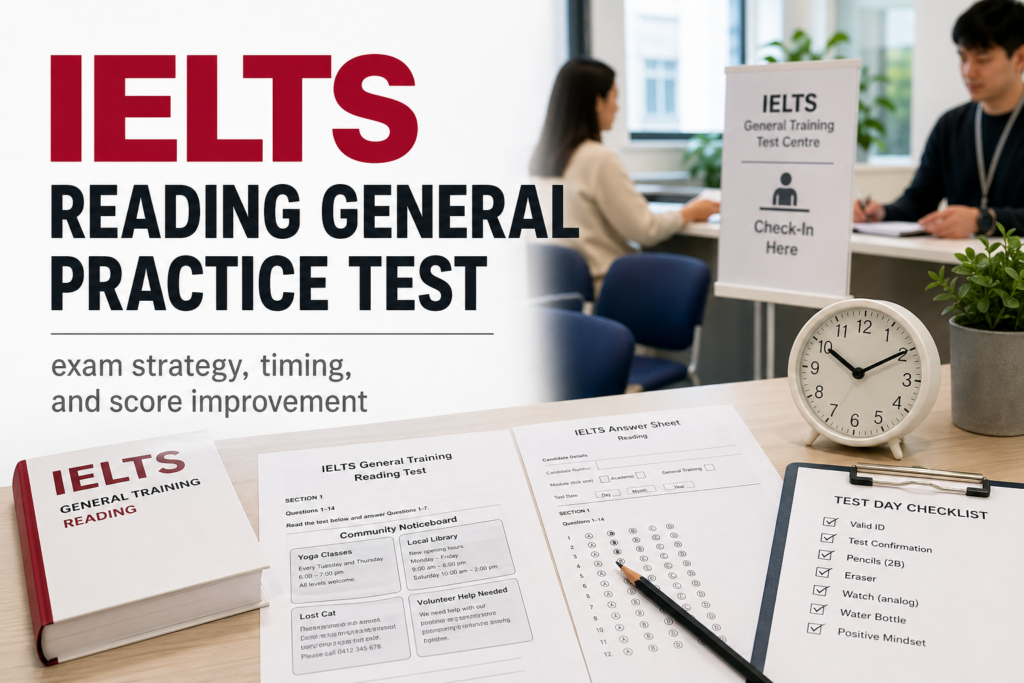
If you are searching for an IELTS Reading General practice test, you probably want more than a random worksheet. You want practice that feels close enough to the real exam to show whether your timing, accuracy, and question control are actually improving. Before you assume Reading is already safe, take the IELTS Express Pre-Test to get a clearer view of your current level and the sections that still need attention.
A good practice test does two jobs. First, it shows how many answers you can get right under pressure. Second, it shows where the marks are leaking. Many candidates do plenty of practice but still stay stuck because they only look at the final score. The real value comes from understanding why answers were missed and whether the problem was timing, vocabulary, question type control, or avoidable carelessness.
What an IELTS Reading General practice test should help you measure
General Training Reading is not only about reading speed. It tests whether you can move between everyday texts, workplace notices, short factual pieces, and longer passages without losing accuracy. A proper practice test should tell you how well you handle that mix.
It should also reveal whether your score drops at a predictable point. Some candidates start well and run out of time in Section 3. Others finish the paper but lose too many marks in matching tasks, true or false style questions, or instruction errors. When you know the pattern, practice becomes more useful because you stop studying in the dark.
If you need the wider format first, this IELTS test format guide is a helpful place to review timing and structure before your next full paper.
Why many candidates use practice tests badly
The most common mistake is doing one paper after another without reviewing anything properly. That feels productive, but it often becomes repetition without improvement. A candidate may complete four tests in a week and still keep missing the same question types because nothing was analysed afterwards.
Another problem is using untimed practice for too long. Untimed work can help at the start, especially if you are still learning the task types, but the real exam is timed. If you never practise with the clock running, your score estimate stays softer than it should be.
A third issue is treating every wrong answer as a vocabulary problem. Sometimes vocabulary is the issue, but often the real cause is weaker scanning, poor question order, or changing an answer without enough evidence. If your broader reading method still feels shaky, this IELTS Reading practice guide is worth using alongside your test papers.
How to simulate the real test more accurately
The safest way to use an IELTS Reading General practice test is to copy real conditions as closely as possible. Sit down for the full hour, remove distractions, and do not pause to check answers or look up vocabulary in the middle. That matters because the exam measures control under pressure, not comfort while studying.
Use a quiet space, a visible timer, and one full sitting. If you are preparing on paper, practise transferring answers neatly and keeping track of question numbers. If you will sit the computer-based test, also spend some time reading longer screens and scrolling without losing your place. The core reading skill is the same, but the test experience can still feel different if you never train for it.
A realistic practice session should answer three questions: how many marks you scored, where your time went, and which task types made you hesitate. That is a much stronger feedback loop than simply writing down a band estimate and moving on.
A practical timing plan for your IELTS Reading General practice test
General Training Reading often rewards disciplined pacing more than dramatic speed. A sensible starting split is to give yourself roughly 15 minutes for Section 1, 20 minutes for Section 2, and 25 minutes for Section 3. The exact split can shift a little, but you should expect the later part of the paper to deserve more time.
- Section 1: around 15 minutes for notices, short texts, and straightforward information search
- Section 2: around 20 minutes for workplace or everyday functional texts that still require careful reading
- Section 3: around 25 minutes for the longest and usually most demanding passage set
This timing plan is useful because it stops easy early questions from stealing time from the harder end of the test. Many candidates feel comfortable in the first section and do not notice that they are reading too slowly until the final set becomes rushed. If you want to check whether your current score is already in the safe range, you can also access unlimited IELTS mock tests and compare your results across several recent papers.
Which question types usually cause the biggest score drops
In General Training Reading, not all wrong answers come from the same source. Multiple choice can be a problem when options look similar and one small detail changes the meaning. Matching headings and matching information often become time-heavy because candidates search the whole text repeatedly without a clear map.
True, false, not given and yes, no, not given questions can also cause trouble. The issue is usually not the grammar of the labels. The issue is reading too quickly and treating a related idea as if it were the same idea. In the real test, a sentence may mention the topic but still not confirm the exact claim in the question.
Sentence completion and short answer tasks often expose a different weakness: candidates find the right area but lose the mark through spelling, word form, or writing too many words. That is why review should separate comprehension errors from answer-format errors. They need different fixes.
How to review a practice test so your score actually improves
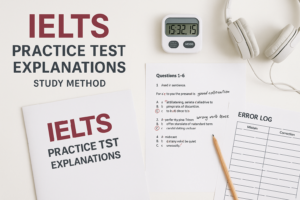
Once the test is finished, resist the urge to mark it quickly and move on. Review is where progress happens. Start by checking every wrong answer and label the cause as one of four groups: timing, vocabulary, question type confusion, or careless error. This simple label already gives you a much clearer study plan.
Then return to the passage and find the proof line for each wrong answer. Ask yourself what clue you missed. Did the passage paraphrase the question in a way you did not recognise? Did a small contrast word such as however or instead change the meaning? Did you spend so long on one earlier question that you rushed the rest?
Write short notes, not essays. For example: “missed paraphrase”, “changed answer without proof”, “ignored word limit”, or “too slow in Section 2”. Over a few tests, patterns appear quickly. That is when your practice becomes strategic instead of repetitive.
How often should you do a full IELTS Reading General practice test
That depends on your timeline. If your exam is still several weeks away, one or two full tests each week is often enough, provided you review them properly. If your test date is close, you may do more, but only if you still have time to study the mistakes. Endless full papers with no repair work usually produce stress more than improvement.
A balanced weekly plan often works better than an all-or-nothing routine. You might do one full test, one targeted session on a weak question type, one timed single section, and one vocabulary or paraphrase review session. That gives you both exam realism and focused correction.
If your preparation feels too scattered, you can see our IELTS preparation plans and follow a clearer study structure instead of guessing which weakness matters most this week.
A seven-day practice cycle you can repeat
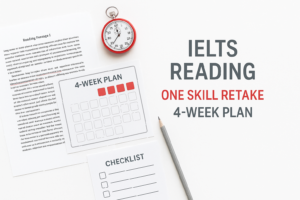
If you want a simple system, use a seven-day loop. On Day 1, complete one full IELTS Reading General practice test under strict timing. On Day 2, review every wrong answer and note the cause. On Day 3, repeat one difficult section with a clearer timing target. On Day 4, focus on one weak question type, such as matching or true/false style tasks.
On Day 5, do a shorter timed set and pay special attention to answer-format accuracy. On Day 6, review vocabulary and paraphrases from the week’s passages. On Day 7, do another full section or a fresh full test, depending on how close your exam is.
This kind of cycle works because it connects testing with repair. You are not only seeing the problem. You are fixing it while the pattern is still fresh.
Ready to find out your IELTS band score?
Take the IELTS Express Pre-Test for just $4.99 and get your personalised band prediction with a 14-day improvement plan.
FAQ: IELTS Reading General practice test
How long should an IELTS Reading General practice test take?
A full test should take 60 minutes, just like the real exam. The most useful practice is done in one sitting without pauses, because that gives you a more honest picture of your timing and concentration.
How many practice tests should I do before my exam?
There is no magic number. A smaller number of well-reviewed tests is better than a large number of rushed ones. For many candidates, one or two full papers each week plus targeted review works well.
Why is my practice test score not improving even though I keep doing more papers?
This usually happens because the review is too shallow. If you do not identify why answers were wrong, you can repeat the same mistakes for weeks. Score growth often comes from better analysis, not just more volume.
Should I practise IELTS Reading General on paper or on a computer?
You should practise in the format you expect to sit, but the main reading skills are the same in both versions. If you will take the computer-based exam, include some screen-based timed practice so the experience feels familiar.
What score should I aim for in a practice test?
Your target depends on the band score you need for study, work, or migration. What matters most is not a single lucky result but a stable range across several recent tests under proper conditions.
Your next step after the next practice test
An IELTS Reading General practice test is only useful when it changes what you do next. Treat each paper as a diagnosis tool. Check the score, track the timing, label the mistakes, and fix the pattern before the next round. That is how practice turns into a stronger result instead of a pile of completed worksheets.
If your scores are close to your target, keep the process calm and consistent. If they are still unstable, that is not a reason to panic. It is simply a sign that your review process needs to become sharper and more honest.