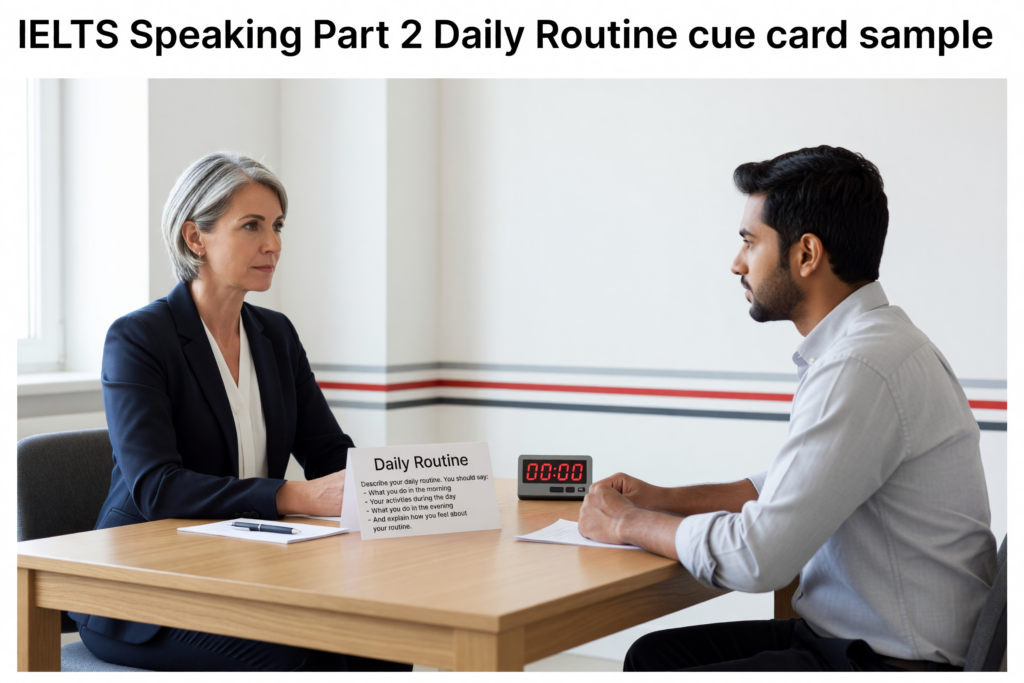
If you are practising IELTS Speaking Part 2 Daily Routine cue card sample, the topic can feel deceptively easy. Most candidates think they can talk about their day without much preparation, then discover they run out of ideas after thirty seconds. A daily routine topic is simple on the surface, but the examiner is not scoring the topic itself. The examiner is scoring how clearly you organise your ideas, how naturally you develop detail, and how steadily you speak under pressure.
Before you keep drilling random cue cards, take the IELTS Express Pre-Test to see where your current speaking level sits. That gives you a more useful baseline than guessing whether your answer already sounds like Band 7 or whether it still feels thin and repetitive.
In this guide, you will see a full sample answer for a daily routine cue card, learn why it works, pick up vocabulary that sounds natural in Part 2, and review the kind of follow-up discussion that may appear in Part 3. The goal is not to memorise a script. The goal is to understand what a strong answer sounds like, then build your own version with enough detail, fluency, and control to keep the examiner engaged for the full two minutes.
What the examiner wants from a daily routine cue card
A typical daily routine cue card asks you to describe a regular activity in your day, a routine you enjoy, or a habit that is important to your work or study life. The task sounds familiar, which is why many candidates answer it too generally. They say they wake up, have breakfast, go to work, and sleep. That is not wrong, but it is far too flat to create a strong score.
To score well, you need to do more than list steps. You need to shape the answer. That means choosing one routine clearly, adding concrete detail, and explaining why it matters to you. A routine becomes interesting when you show what happens, how you feel about it, and what role it plays in your day. The examiner is listening for fluency and coherence, vocabulary range, grammatical control, and pronunciation. A routine topic gives you a good chance to show all four if you avoid sounding mechanical.
- Choose one clear routine instead of describing your whole life story
- Add detail about timing, setting, and purpose
- Explain why the routine matters or how it helps you
- Finish with a reflection so the answer does not stop abruptly
A full sample answer you can model
Here is a sample answer for a candidate aiming at Band 7 or above:
“One daily routine that is quite important to me is the way I start my morning before work. On weekdays, I usually wake up at about six o’clock, drink a glass of water, and then spend around twenty to thirty minutes planning my day. I know that sounds simple, but it has become one of the most useful habits in my routine because it helps me feel calm before everything gets busy.
Normally, I sit at my kitchen table with a notebook and a cup of coffee, and I write down the three main things I need to finish that day. After that, I check my messages briefly, but I try not to get distracted too early. If I start looking at emails or social media straight away, I lose focus very quickly, so this small planning habit keeps me organised.
What I like about this routine is that it gives structure to the rest of my day. Even if my schedule changes later, I still feel more prepared because I began the morning with a clear plan. I also think it improves my mood. If I rush out of bed and start reacting to problems immediately, I feel stressed. But if I give myself that quiet half hour first, I usually work much better.
I would say this routine is important to me because it is simple, realistic, and easy to maintain. It does not require expensive equipment or a huge amount of time, but it makes a noticeable difference to my productivity and state of mind. That is why I have kept doing it for quite a long time.”
This answer works because it is specific without being complicated. It does not try to impress the examiner with artificial language. Instead, it develops one routine in a logical order and ends with a clear personal reason.
Why this sample can score well in IELTS Speaking Part 2
The strongest point in this sample is control. The candidate does not rush to cover ten different activities. The answer stays centred on one morning routine and develops it with steady detail. That helps fluency and coherence because the listener can follow the answer easily from beginning to end.
The vocabulary also sounds natural. Phrases like “planning my day”, “gets busy”, “lose focus”, “gives structure”, and “state of mind” fit everyday spoken English well. They are more useful than forcing advanced expressions that do not sound natural in conversation. Good IELTS speaking vocabulary is often precise rather than flashy.
Grammar range is present too. The answer uses present simple for routine, conditional ideas such as what happens if the speaker checks messages too early, and comparison between calm and stressful mornings. That gives enough variation to show control without making the answer sound rehearsed. If you want a bigger framework for how Part 2 connects to Part 3, our IELTS Speaking Part 2/3 Framework gives a useful overview of how strong candidates keep speaking answers organised.
How to build your own answer without memorising
A sample answer is useful, but copying it word for word is a bad strategy. Examiners hear memorised speech all the time. The rhythm becomes unnatural, the detail feels generic, and the candidate struggles if the topic changes slightly. It is much safer to memorise a structure than a script.
A simple four-part structure works well for a daily routine topic:
- Name the routine and say when it happens
- Describe what you usually do step by step
- Add one practical detail about the setting, habit, or reason
- Explain why the routine matters to you
This structure helps you speak for close to two minutes without sounding like you are stretching empty ideas. For example, if your routine is an evening study session, you can say when it starts, what materials you use, why you prefer that time, and how it affects your concentration. That is enough to create a strong answer. You do not need a dramatic story. You need enough concrete detail to make the routine feel real.
If you are still not sure whether your answers are long enough, practise with timed speaking tasks and compare your performance against unlimited IELTS mock tests. That gives you a better sense of pacing and shows whether your answer keeps its shape after the first minute.
Useful vocabulary for a daily routine topic
You do not need difficult vocabulary for this cue card, but you do need language that sounds slightly more precise than basic textbook words. A daily routine answer improves quickly when you move beyond repeating “I do this every day” and start using more natural patterns.
Useful vocabulary includes:
- get into the habit of for a routine you have built over time
- set aside time for a planned part of the day
- stay on track for keeping focus and following a plan
- clear my head for a habit that helps you feel mentally calmer
- part of my schedule for a routine that happens regularly
- small but effective for a habit that seems simple but helps a lot
You can also use flexible sentence starters that sound natural in speaking:
- “What I usually do first is …”
- “The reason I keep doing it is …”
- “One thing I have noticed is …”
- “It may sound ordinary, but …”
- “The main benefit for me is …”
The trick is not to overload the answer. Choose language you can pronounce clearly and use confidently. A simpler phrase delivered naturally is always better than an ambitious phrase that makes you hesitate. If you want more topic-level preparation, our IELTS Speaking Part 2 Tips and Strategies guide is worth reading because it shows how to expand answers without drifting off topic.
How to use your one-minute planning time well
The one-minute preparation stage is where many daily routine answers either become focused or fall apart. Candidates often waste that minute writing full sentences. That creates pressure and usually leads to memorised delivery. Short prompts work much better.
If the cue card is about a daily routine you enjoy, your notes might look like this:
- Routine: morning planning before work
- Time: 6:00 am, weekdays
- Actions: water, coffee, notebook, top three tasks
- Benefit: calm, organised, less stress
- Reason important: improves productivity every day
That is enough to guide a full answer. The notes are not meant to be read like a script. They are there to stop you from going blank. A good cue card response often feels conversational because the notes are light and the speaker is free to explain ideas naturally.
Another useful trick is to choose a clear angle before you start speaking. Is your routine mainly about productivity, health, study, relaxation, or family life? Once you know that, the answer becomes easier to control. Without that centre, candidates often list several unrelated habits and the response loses coherence.
Common mistakes candidates make on this cue card
The most common mistake is turning the answer into a timetable. Candidates describe every hour of their day, which sounds more like a schedule than a developed speaking answer. The cue card asks for a routine, not a full diary. Pick one routine and stay with it.
A second mistake is giving no reflection. Some candidates describe what they do but never explain why it matters. That makes the answer feel incomplete. Even one or two sentences about why the routine helps you, why you enjoy it, or why you keep it consistent can lift the answer noticeably.
A third mistake is forcing unrealistic routines because they sound impressive. If you do not actually wake up at five in the morning to meditate, run ten kilometres, and read philosophy before breakfast, do not build your answer around that fantasy. IELTS does not check whether the story is true, but invented routines still need to sound believable. Simple, realistic answers are easier to deliver well.
- Avoid listing your whole day from morning to night
- Do not leave out the reason the routine matters
- Keep the detail believable and easy to explain
- Do not memorise a polished script and hope it fits every topic
Likely Part 3 follow-up questions
After a daily routine cue card, the examiner often moves into broader discussion about habits, work-life balance, technology, or lifestyle change. Part 3 is wider and slightly more analytical, but the speaking still needs to stay clear and direct.
Common follow-up questions include:
- Why do some people find it hard to keep a regular routine?
- Are daily routines more important for children or adults?
- How has technology changed people’s routines?
- Do modern lifestyles make people more or less organised?
- Is it better to have a fixed routine or a flexible one?
To answer these well, make one clear point first, then explain it. For example, if you are asked how technology has changed routines, you might say it has made people more efficient in some ways because they can manage calendars and reminders easily, but it has also made distraction more common. That is a balanced answer. It sounds thoughtful without becoming too abstract.
A practical way to practise before test day
The best way to practise this topic is repetition with variation. Keep the same structure, but switch the routine. One day, talk about a morning planning habit. Another day, describe an evening study routine. On another day, speak about a gym habit, a commute, or a family dinner routine. That trains flexibility instead of memorisation.
Record yourself and listen back for three things: where you hesitate, where you repeat the same words, and where the answer becomes too general. Those are the real weak points to fix. Most candidates do not need magic tips. They need more control, better detail, and cleaner organisation.
If you want stronger support before your next speaking test, you can also look at our IELTS preparation plans and choose the level of coaching that fits your timeline. A routine topic may sound basic, but it is a good test of whether your speaking is actually clear, natural, and well-developed under pressure.
Ready to find out your IELTS band score?
Take the IELTS Express Pre-Test for just $4.99 and get your personalised band prediction with a 14-day improvement plan.
FAQ: IELTS Speaking Part 2 Daily Routine cue card sample
Do I need to describe my whole day in a daily routine cue card?
No. It is usually better to choose one clear routine and develop it properly. If you try to describe your entire day, the answer often becomes rushed and repetitive.
Is it okay to invent a routine if my real life is boring?
Yes. IELTS does not judge whether the story is true. It judges your English. Still, the routine should sound realistic and easy for you to explain naturally.
How long should I speak in Part 2?
You should aim to keep speaking until the examiner stops you, which is usually close to two minutes. A well-structured answer with enough detail makes that much easier.
What kind of vocabulary helps most with daily routine topics?
Practical everyday vocabulary works best, especially language about habits, timing, focus, and benefits. You do not need complicated words if your answer is clear and precise.
Can a simple routine still get a high score?
Absolutely. A simple routine can score very well if you organise it clearly, add specific detail, and explain why it matters to you. The score comes from language performance, not from having an exciting lifestyle.
Your next step
If this topic has been giving you trouble, keep the fix simple. Pick one believable routine, use a four-part structure, and practise adding concrete detail instead of listing basic actions. That alone can make your answer sound more mature and much easier to follow.
A strong IELTS Speaking Part 2 Daily Routine cue card sample is not built from fancy vocabulary or a dramatic story. It is built from clarity, steady development, and enough personal detail to sound real. If you can deliver that under timed conditions, you are already much closer to the band score you want.