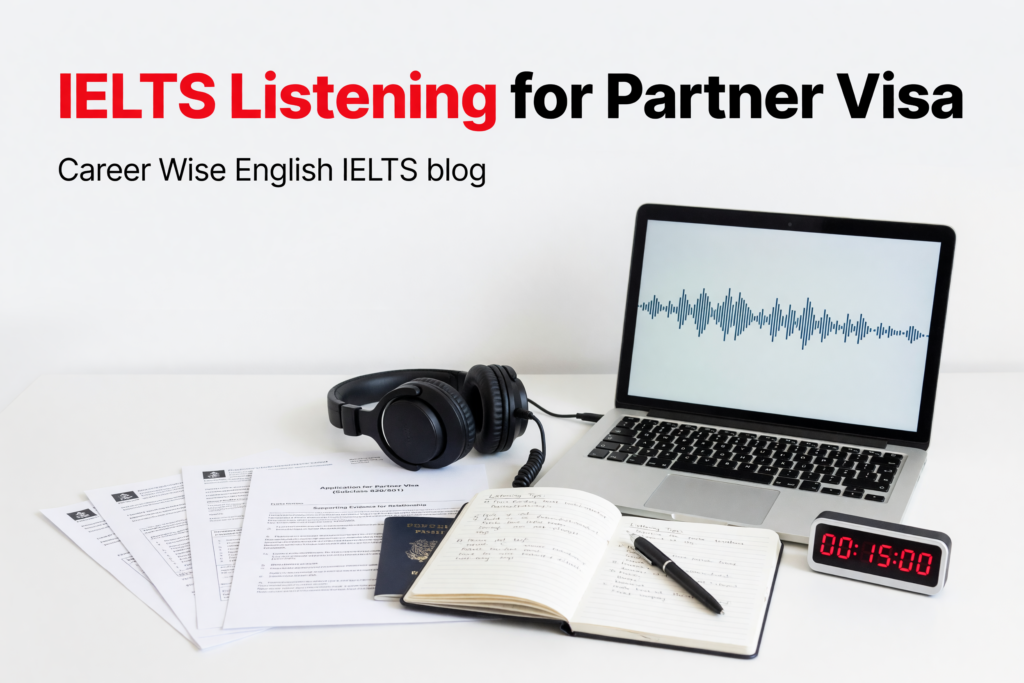
If you are preparing for an Australian partner visa, the English test requirement can feel more stressful than it needs to be. Many applicants hear different advice from friends, migration forums, and agents, then end up confused about which IELTS module to book and what score they actually need. When the target keyword is IELTS Listening for Partner Visa, the real issue is simple: you need to understand the listening score requirement, the test format, and the most efficient way to prepare for functional English without turning the process into a full-time job.
Before you spend weeks using the wrong practice material, take the IELTS Express Pre-Test to see where your current level sits. That gives you a clearer starting point and helps you judge whether you need light revision or a more structured improvement plan.
This guide explains what IELTS Listening means for partner visa applicants, what score usually matters, how the section works, where candidates lose easy marks, and how to build a practical study plan. The aim is not to make the test sound harder than it is. The aim is to help you prepare in a way that is accurate, calm, and efficient.
What score do you need in IELTS Listening for Partner Visa?
For most Australian partner visa applicants, the benchmark is functional English. In IELTS terms, that usually means at least Band 4.5 in each skill, including Listening. This matters because some people hear the word average and assume a stronger Reading or Speaking score can cancel out a weaker Listening result. In practice, that is a risky assumption. If Listening falls below the required threshold, the overall application strategy becomes more complicated and may trigger extra cost or delay.
The first practical step is checking the current visa requirement against your exact pathway and then preparing for the correct target. Most partner visa applicants do not need a high academic score. They need a safe, dependable functional English result. That changes how you should study. You are not trying to sound perfect. You are trying to perform consistently across everyday listening tasks under time pressure.
- Partner visa applicants usually prepare for functional English, not a competitive points score
- Listening still matters as a standalone skill
- A realistic Band 4.5 target needs structure, not guesswork
- Over-preparing the wrong materials wastes time and money
Which IELTS test should partner visa applicants take?
For partner visa purposes, candidates normally take IELTS General Training rather than IELTS Academic. That distinction matters because the overall purpose of the test is different. Academic IELTS is designed for university and professional registration contexts. General Training is built around everyday English, workplace communication, and practical comprehension.
The Listening section itself follows the same broad format across Academic and General Training, but your overall preparation should still match the visa pathway you are on. If you practise only with Academic-focused advice, you can end up studying with the wrong mindset. A partner visa applicant should usually focus on practical comprehension, familiar accents, instructions, short conversations, and common real-life topics rather than treating the exam like a university entrance filter.
If you want a broader overview of the visa-focused version of the test, our IELTS for Partner Visa complete guide explains how the English requirement fits into the wider application process.
How the IELTS Listening test works
The IELTS Listening test has four sections and 40 questions. You hear each recording once, which is why timing and concentration matter so much. The content usually moves from easier everyday situations to more complex discussions. Early sections may involve booking details, travel arrangements, or service information. Later sections may include an educational or workplace topic with more detail and faster information flow.
For partner visa applicants, the main challenge is rarely advanced vocabulary. It is accuracy under pressure. You need to follow the recording, read ahead quickly, notice signpost language, and transfer the answer without spelling errors or missing word limits. A surprising number of candidates understand the recording well enough but still lose marks because they write too many words, confuse dates and numbers, or miss a speaker change.
- Section 1 usually covers an everyday conversation
- Section 2 often focuses on practical information or instructions
- Sections 3 and 4 demand stronger concentration and note tracking
- You hear the audio once, so recovery speed matters
Why IELTS Listening can still trip up partner visa applicants
Some applicants underestimate Listening because Band 4.5 sounds modest on paper. That can backfire. A lower target score does not mean you can walk in cold and pass comfortably. It means the mistakes that block you are usually basic but repeated. Losing one mark on spelling does not matter much on its own. Losing six or seven marks through small avoidable errors absolutely does.
Another common problem is using passive study methods. Watching English videos with subtitles or listening to podcasts casually may help general exposure, but it does not train test skill. IELTS Listening is a task-based exam. You need practice with form completion, note completion, multiple choice, map labelling, and short-answer formats. You also need to build the habit of staying calm when you miss one answer so that one mistake does not become four.
Many candidates preparing for visas are also balancing work, family, and paperwork. That makes efficient study even more important. You do not need a perfect accent and you do not need complex grammar for Listening. You need controlled practice, repeated exposure to the task types, and a plan for the errors you personally make most often.
The most common IELTS Listening mistakes for partner visa candidates
The most frequent mistakes are not dramatic. They are small errors that accumulate across the paper. Candidates miss plurals, write a number in the wrong format, fail to notice that a speaker corrected an earlier detail, or keep chasing one missed answer instead of refocusing on the next question. These problems are common because the recording does not pause for you to recover.
A second cluster of mistakes comes from weak pre-listening habits. Many people do not read the question set properly before the audio starts. As a result, they miss clues about grammar, expected word type, or answer limits. If the form expects a noun and you are listening vaguely for any familiar word, your answer quality drops immediately.
If this section is already costing you marks, spend time with targeted practice rather than random repetition. Our IELTS Listening Practice guide is useful if you want a broader framework for building score-safe listening habits.
- Ignoring word limits such as “ONE WORD ONLY”
- Misspelling common answers like street names, months, or occupations
- Missing corrections such as “not Tuesday, Wednesday”
- Panicking after one lost answer and losing the next few as well
- Failing to read ahead before the recording starts
A practical study plan for IELTS Listening for Partner Visa
A simple study plan usually works better than an ambitious one that collapses after three days. Start by finding your current level. Then identify the question types where you lose the most marks. From there, build short sessions that focus on real weaknesses rather than doing full tests every day. Full tests are useful for measurement, but they are not always the best tool for improvement.
A practical weekly structure could look like this:
- One full timed listening test to measure progress
- Two short sessions on error correction, especially spelling and answer form
- Two sessions on specific question types such as form completion or multiple choice
- One review session using transcripts to see exactly where you lost track
This approach keeps the workload realistic while still improving the skills that matter. If you want a more intensive option, access unlimited IELTS mock tests and use them as timed checkpoints rather than as random practice. That gives you a better sense of whether your score is moving safely above the minimum.
How to prepare efficiently when time is limited
Partner visa applicants often study around work shifts, parenting, or the rest of the visa process. That means efficiency matters more than theory. If you only have 30 to 40 minutes a day, focus on one clear task. For example, do one listening section, mark it carefully, review the transcript, and write down the exact reason for every wrong answer. That is more useful than doing a whole test carelessly and telling yourself you will review it later.
It also helps to separate language problems from test-management problems. If you understood the audio but wrote the wrong number format, that is not a listening-comprehension issue. If you never recognised the answer because the speaker paraphrased it, that is a vocabulary and anticipation issue. If you understood the answer but stayed stuck on the previous question, that is a concentration and pacing issue. Improvement becomes faster once you diagnose mistakes honestly.
For many visa candidates, the smartest goal is not maximum score. It is reliable execution. A stable Band 5 or 5.5 in practice tests usually gives much more breathing room than sitting right on the edge of Band 4.5.
What to do in the final week before the test
In the final week, stop looking for miracle tactics. The best use of time is controlled review. Keep practising with the same timing conditions, check spelling carefully, and keep your sleep and routine steady. Last-minute overload can hurt concentration more than it helps.
This is also a good point to confirm logistics. Make sure you know the test format, the start time, what identification you need, and how your answers will be entered. Small practical errors create unnecessary nerves, and nerves affect listening more than many people realise because once the recording starts, there is no pause button.
Right before the FAQ section, the strongest move is simple: know your level, practise the task types you miss most often, and walk in with a calm routine rather than an overloaded study plan.
Ready to find out your IELTS band score?
Take the IELTS Express Pre-Test for just $4.99 and get your personalised band prediction with a 14-day improvement plan.
FAQ: IELTS Listening for Partner Visa
Do I need IELTS Academic or General Training for a partner visa?
Most partner visa applicants prepare for IELTS General Training, not Academic. The visa pathway is usually based on functional English rather than university entry, so General Training is the more relevant option.
What listening band score is usually needed for a partner visa?
For many applicants, the practical target is Band 4.5 in Listening as part of functional English. You should still confirm the current requirement for your exact visa pathway before booking the test.
Is IELTS Listening hard for partner visa applicants?
It can be harder than people expect, not because the language is advanced, but because the test moves quickly and small mistakes cost marks. Spelling, word limits, and missed corrections are common reasons people fall short.
How long should I study for IELTS Listening for Partner Visa?
That depends on your starting level. If your English is already close to functional level, a few weeks of structured practice may be enough. If your listening accuracy is inconsistent, you may need a longer block of targeted study.
What is the best way to improve quickly?
The fastest improvement usually comes from timed practice, transcript review, and error tracking. Do not just repeat full tests. Work out why each wrong answer happened, then fix that pattern directly.
Should I take mock tests before booking the real exam?
Yes. Mock tests help you see whether your score is safely above the minimum or still too close for comfort. That makes booking decisions much more informed and reduces the chance of paying for a retake.
Your next step
If your goal is simply to meet the English requirement without wasting time, keep the process practical. Learn the format, practise under timed conditions, and fix the small recurring mistakes that quietly drag your score down. That is usually enough to turn IELTS Listening from a vague worry into a manageable part of the partner visa process.
If you want a quick, useful benchmark before your next study block, start with the IELTS Express Pre-Test and then build from real evidence instead of guesswork. That is the cleanest way to know how close you are and what to work on next.