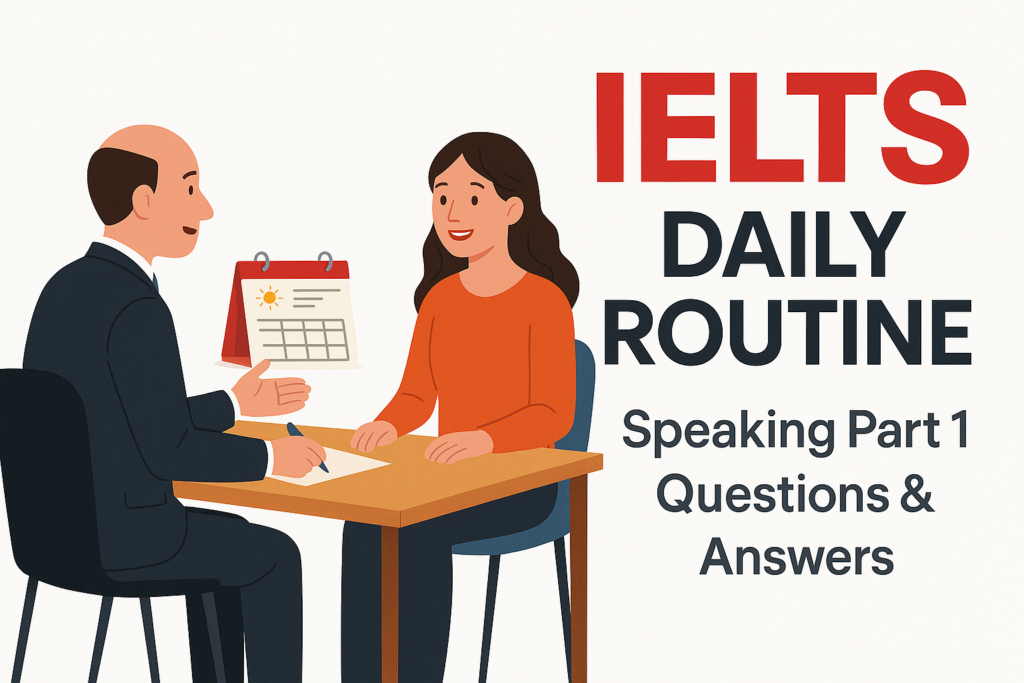
IELTS Speaking Part 1 Daily Routine questions and answers are popular because they seem simple at first. You wake up, study, work, eat, travel, relax, and sleep. The challenge is turning those ordinary actions into clear, natural spoken English under test pressure. Before you practise a long list of model answers, take the IELTS Express Pre-Test to check your current speaking band range and see whether your main gap is fluency, vocabulary, grammar, or answer development.
Daily routine is a safe topic when you know how to extend your answers. The examiner is not looking for an exciting life story. They want to hear whether you can answer personal questions directly, use present simple and frequency language accurately, and give small details without sounding memorised. A good Part 1 answer is usually two to four sentences.
IELTS Speaking Part 1 Daily Routine Questions And Answers: What To Expect
In Part 1, daily routine questions are usually about your normal weekday, mornings, evenings, free time, study habits, work habits, weekends, and whether your routine has changed. The questions are personal, so the safest answers are honest and specific.
The basic structure is simple: answer the question, add one reason, then include a small example or detail. If the examiner asks what you usually do in the morning, do not only say, “I have breakfast and go to work.” Add when you wake up, what you do first, and why that routine works for you.
- Use present simple for regular habits.
- Use frequency phrases such as usually, often, sometimes, and rarely.
- Add one reason or example to avoid very short answers.
- Keep the answer natural, not dramatic.
- Stop before it becomes a Part 2 speech.
Common IELTS Speaking Part 1 Daily Routine Questions
These questions are common in practice materials and real interview-style preparation. The examiner may change the wording, so practise flexible ideas rather than fixed scripts.
- What is your daily routine like?
- What do you usually do in the morning?
- Do you have the same routine every day?
- What is your favourite part of the day?
- Do you prefer mornings or evenings?
- Has your daily routine changed recently?
- What do you usually do after work or study?
- Do you think it is important to have a routine?
- How do you spend your weekends?
- Would you like to change anything about your routine?
When you practise, record your answers and listen back. Check whether you answered the exact question, used natural tense, and added enough detail. For more short-answer models across everyday topics, use the IELTS Speaking Part 1 sample answers guide.
Sample Answers About Morning Routine
Question: What do you usually do in the morning?
I usually wake up around six thirty, check my messages briefly, and then have breakfast. I try to keep mornings fairly calm because it helps me start the day with more focus.
Question: Do you like getting up early?
Yes, I prefer getting up early because I feel more organised when I have extra time. If I wake up late, I often feel rushed for the rest of the morning.
Question: Is breakfast important in your routine?
Yes, it is fairly important. I do not always eat a large breakfast, but I like having something simple before work or study because it gives me energy.
These answers are not long, but they work because they include habits, reasons, and personal detail. Avoid giving a list of actions only. A list sounds flat unless you explain why one part matters.
Sample Answers About Work Or Study Routine
Question: What is your daily routine like on weekdays?
On weekdays, my routine is quite structured. I usually start with work or study in the morning, take a short break in the afternoon, and finish important tasks before dinner if possible.
Question: Do you follow a strict schedule?
Not exactly. I have a general schedule, but I try to keep it flexible because some days are busier than others. I mainly make sure the important tasks are done first.
Question: What do you usually do after work or study?
After work or study, I usually relax for a while, have dinner, and do something quiet, such as reading or watching a video. I try not to continue working too late because it affects my sleep.
If you want to practise routine answers under real timing pressure, access unlimited IELTS mock tests and answer without pausing to prepare perfect sentences.
Sample Answers About Evenings And Free Time
Question: What is your favourite part of the day?
My favourite part of the day is usually the evening. It is the time when I can slow down, talk with family or friends, and do something that is not connected to work.
Question: Do you do the same things every evening?
Mostly, yes. I usually have dinner, tidy up a little, and then relax. On some evenings I study or exercise, but I prefer not to make the evening too busy.
Question: How do you usually relax?
I usually relax by listening to music, watching something light, or going for a short walk. I find simple activities better than using my phone for hours.
Evening routine answers are useful because they let you talk about habits, preferences, and reasons. You can also show contrast, such as “During the day I am busy, but in the evening I prefer a slower pace.”
Useful Vocabulary For Daily Routine Answers
You do not need advanced vocabulary for this topic. Accurate everyday words are stronger than forced phrases. Focus on language that helps you explain time, frequency, habits, and feelings.
- Routine: the regular things you do each day.
- Schedule: a plan for when tasks happen.
- Flexible: able to change when needed.
- Rushed: having to do things too quickly.
- Productive: able to complete useful work.
- Take a break: stop working or studying for a short time.
- Wind down: relax after being busy.
- Consistent: happening in a regular way.
Use these words in simple sentences. For example, “My schedule is flexible,” or “I like to wind down before bed.” Do not use a word unless you can pronounce it clearly and use it naturally.
Grammar Patterns That Help With Routine Topics
The present simple is the most useful tense for daily routine. You can say, “I wake up early,” “I usually study at night,” or “I take the bus to work.” This tense shows regular habits.
Frequency language adds detail. Useful phrases include every day, most mornings, twice a week, from time to time, hardly ever, and once in a while. These phrases make your answer more precise without making it complicated.
Past and present contrast is also helpful. For example: “When I was a student, my routine was less organised, but now I plan my day more carefully.” This shows tense control and gives the answer more depth.
How To Extend A Short Answer Naturally
Many candidates lose chances in Part 1 because their answers are too short. The fix is not to speak for a long time. The fix is to add one useful layer. Start with the answer, add why, then add a small personal detail.
For example, if the question is “Do you have the same routine every day?”, a weak answer is “Yes, usually.” A stronger answer is: “Yes, during the week my routine is quite similar because I work regular hours. On weekends, I keep it more flexible and usually wake up later.”
This answer is still short, but it gives the examiner more language to assess. It uses contrast, frequency, and a clear reason. That is exactly what routine questions are good for.
Common Mistakes With Daily Routine Answers
The first mistake is listing actions without explanation. “I wake up, brush my teeth, eat breakfast, go to work, come home, and sleep” is understandable, but it sounds mechanical. Add one reason or feeling.
The second mistake is using the wrong tense. If the question asks about your usual routine, use present simple. If it asks whether your routine has changed, use present perfect or past simple where needed.
The third mistake is overusing “always”. Real routines are rarely exact every day. Words such as usually, normally, often, and generally sound more natural.
The fourth mistake is memorising a perfect routine that does not match the question. If the examiner asks about evenings, do not give a prepared answer about mornings. Listen first, then answer the exact question.
If you are unsure why your Speaking answers sound limited, see our IELTS preparation plans and choose support that includes spoken feedback, not only written model answers.
A Seven-Day Practice Plan For Daily Routine Questions
On day one, record answers to ten routine questions. Keep each answer under thirty seconds. On day two, add one reason to every answer. On day three, practise morning and evening questions only.
On day four, practise weekday and weekend contrast. On day five, use frequency language in every answer. On day six, practise changed-routine questions using past and present tenses. On day seven, record a full Part 1 set and write down three repeated problems.
The goal is not to memorise a perfect daily schedule. The goal is to build flexible answer habits so you can respond clearly when the examiner changes the wording.
Final Checklist Before Your Speaking Test
Before test day, make sure you can answer questions about mornings, evenings, weekdays, weekends, work or study habits, free time, sleep, exercise, and changes in your routine. Practise at a natural speed and stop before the answer becomes too long.
Daily routine can become one of the easiest IELTS Speaking Part 1 topics if you keep your answers specific. Use clear tense, add one reason, and sound like you are describing your real life, not reading from a script.
Ready to find out your IELTS band score?
Take the IELTS Express Pre-Test for just $4.99 and get your personalised band prediction with a 14-day improvement plan.
FAQ: IELTS Speaking Part 1 Daily Routine Questions And Answers
What daily routine questions are common in IELTS Speaking Part 1?
Common questions ask about your morning routine, evening routine, weekday schedule, weekends, favourite time of day, and whether your routine has changed recently.
How long should my daily routine answers be?
Most answers should be two to four sentences. Give a direct answer, add one reason, and include a small detail from your own life if it fits naturally.
What tense should I use for daily routine answers?
Use present simple for regular habits, such as “I usually wake up early.” Use past simple or present perfect when you talk about changes in your routine.
Can I say my routine is boring?
Yes. You can say your routine is simple or repetitive, then explain why. IELTS Speaking rewards clear communication, not an exciting lifestyle.
Should I memorise daily routine sample answers?
No. Use sample answers to learn structure and vocabulary, but practise changing them so they match your real routine and the exact question asked.