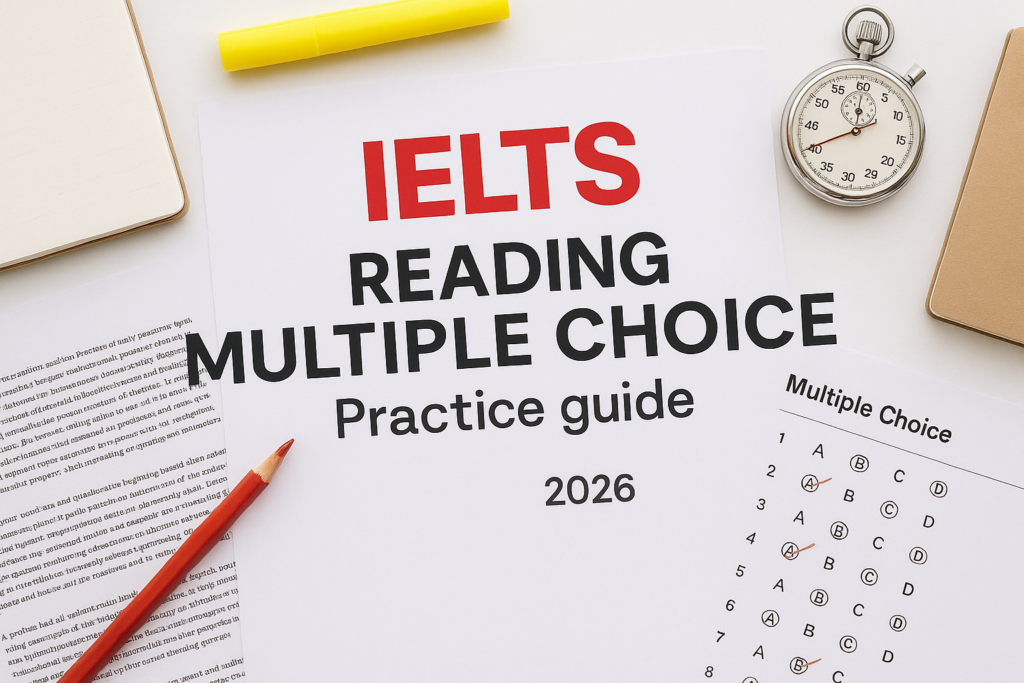
IELTS Reading Multiple Choice practice guide questions are dangerous because they look familiar. You read a passage, see four options, and feel that one answer is obviously close. Then the answer key shows that the option you chose was a distractor. Before you do another full test, take the IELTS Express Pre-Test to check whether your Reading problem is timing, paraphrase, vocabulary, or evidence checking.
Multiple choice in IELTS Reading does not reward general understanding alone. It rewards controlled reading. You need to locate the right part of the passage, understand the exact question, compare every option against evidence, and avoid options that are partly true but not the answer. This guide gives you a repeatable method, examples of common traps, timing advice, and a practice routine you can use with Academic or General Training Reading.
IELTS Reading Multiple Choice Practice Guide: What The Task Tests
Multiple choice questions test whether you can understand detail, main ideas, opinions, reasons, results, and implied meaning. Sometimes you choose one answer from four options. Sometimes you choose two or more answers from a longer list. The wording changes, but the core skill is the same: the answer must be supported by the passage, not by your memory or outside knowledge.
The hardest part is that IELTS options are usually written with attractive language from the passage. A wrong option may use the same topic, the same person, or one true detail. That does not make it correct. The correct option matches the exact meaning required by the question.
- Read the question stem before reading the options.
- Identify what type of information is needed.
- Locate the relevant part of the passage.
- Compare each option against the evidence.
- Eliminate options that are too broad, too narrow, or slightly distorted.
Why Multiple Choice Feels Harder Than It Looks
Multiple choice feels simple because the answer is already on the page. You do not need to spell a word, count a word limit, or transfer a phrase from the passage. But this is exactly why candidates become careless. They choose the option that feels familiar instead of proving it.
The test writers know this. They build options from nearby ideas, repeated keywords, contrasts, and partial truths. If the passage says a method was useful for some learners, an option may say it was useful for all learners. If the passage says a project was delayed because of cost and weather, an option may mention cost only. These small changes matter.
Good multiple choice practice trains patience. You do not need to read slowly all the time, but you do need to slow down at the answer sentence and check the full meaning.
Step One: Read The Question Stem First
Start with the question stem, not the options. The stem tells you what kind of answer you need. Are you looking for a reason, a result, a problem, a purpose, an opinion, or a comparison? If you skip this step, the options can pull your attention in four directions before you know the task.
Underline or mentally note the controlling words in the stem. Words such as main, first, most likely, according to the writer, why, how, and which of the following change the target. A question asking for the main reason is not asking for any reason. A question asking what the writer suggests is not asking for a stated fact only.
For broader Reading accuracy work, connect this habit with the IELTS Reading Practice system so multiple choice is not practised separately from timing and review.
Step Two: Predict The Answer Area
After reading the stem, scan the passage for names, dates, nouns, repeated terms, or paragraph topics that point to the answer area. You do not need to understand the whole passage before answering one question. You need to find the part of the passage that actually controls the answer.
Once you find the likely area, read a little before and after it. Many wrong answers come from reading only one sentence. IELTS often places the key contrast, limitation, or result in the following sentence. Words such as however, although, despite, rather than, led to, and as a result can completely change the answer.
If you cannot locate the answer area quickly, mark the question and move on. Spending four minutes searching for one answer can damage the rest of the section.
Step Three: Compare Options Against Evidence
When you reach the options, treat each one like a claim. Ask: where does the passage prove this? If the option cannot be proven, it is not safe. Do not choose it because it sounds reasonable. IELTS Reading is passage-based, not opinion-based.
Use elimination carefully. Cross out options that contradict the passage, add information the passage does not give, answer a different question, or exaggerate the claim. Then compare the remaining options. The final decision should be based on meaning, not on which option uses the most familiar words.
If you want realistic pressure practice, access unlimited IELTS mock tests and force yourself to justify each multiple choice answer with a passage line before checking the key.
Common Distractors In IELTS Reading Multiple Choice
The first distractor is the keyword match. The option repeats a word from the passage, so it feels correct, but the meaning is different. Keywords help you locate information; they do not prove the answer.
The second distractor is the partial truth. Part of the option is correct, but another part is unsupported or wrong. For example, the passage may say a policy improved attendance, while the option says it improved attendance and reduced costs. If the cost claim is not supported, the option fails.
The third distractor is the wrong focus. The passage may discuss a problem, a cause, and a solution in the same paragraph. If the question asks for the cause, an option about the solution may still sound relevant but answer the wrong thing.
The fourth distractor is outside knowledge. You may know something true about the topic, but if the passage does not say it, you cannot use it.
How To Handle Questions With Two Or More Answers
Some multiple choice sets ask you to choose two answers from five options, or three answers from a longer list. These questions require even stricter evidence control. Do not choose the first two options that sound plausible. Check every option.
Use a simple marking system. Put a tick beside options clearly supported by the passage, a cross beside options clearly wrong, and a question mark beside options that need a second check. Only decide after all options have been tested. This prevents the common mistake of choosing two early options and ignoring a stronger answer later in the list.
For multi-answer questions, watch plural wording. If the question asks which two problems are mentioned, both answers must be problems. An option about a benefit, result, or example may be related but still wrong.
Timing Strategy For Multiple Choice
Multiple choice can steal time because candidates keep rereading the options. Set a rough limit. If a question is not solved after one careful evidence check, mark it, choose the best current option if needed, and return later if time allows. The goal is not perfection on one question. The goal is the best total score across forty questions.
In a full Reading section, protect easier marks first. If a multiple choice item is unusually difficult, do not let it consume the time needed for sentence completion, matching information, or summary completion. A balanced timing plan usually beats heroic effort on one hard item.
If your Reading score keeps dropping under pressure, see our IELTS preparation plans and choose a route that includes timed diagnosis rather than just more practice tests.
Vocabulary And Paraphrase Practice
Multiple choice is heavily based on paraphrase. The option may say “a sudden increase” while the passage says “rose sharply”. The option may say “not enough evidence” while the passage says “limited proof”. You need to recognise meaning across different words.
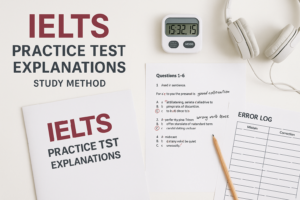
After each practice set, make a small paraphrase table. Write the option wording on one side and the passage wording on the other. This trains the exact connection IELTS expects. Do not copy every new word from the passage. Focus on the words that controlled the answer.
Pay special attention to qualifiers: some, many, most, all, only, mainly, rarely, initially, eventually, and likely. These words often decide whether an option is accurate or exaggerated.
A Practice Routine For Better Accuracy
Use three stages. First, complete ten multiple choice questions untimed and write the evidence line for every answer. This builds accuracy without panic. Second, repeat the same task with a timer and keep the evidence habit. Third, mix multiple choice with other Reading question types so you practise switching methods.
Review is the real improvement stage. For every wrong answer, write why it was wrong. Was it a keyword trap, a partial truth, a missed contrast, a vocabulary issue, or a timing decision? After two or three sets, your repeated pattern will be obvious.
If your mistakes are mainly vocabulary-based, spend more time reviewing paraphrases. If they are mainly timing-based, practise locating the answer area faster. If they are mainly distractor-based, slow down when comparing options.
Common Mistakes To Avoid
Do not read the options first and then hunt for matching words. This usually makes distractors more attractive. Do not choose an answer because it is true in real life. Do not ignore small words in the stem. Do not assume the answer must appear in the same words as the option.
Another common mistake is changing a correct answer at the end because another option feels familiar. Only change an answer when you find stronger evidence. A feeling is not evidence.
Finally, do not practise only full tests. Full tests show your score, but focused sets show your habits. Use both. A candidate who understands why each wrong answer happened will improve faster than a candidate who simply completes more papers.
Final Checklist Before Your Next Practice Test
Before you start, remind yourself of the method: stem first, answer area second, evidence third, options last. During the test, slow down around contrast words and qualifiers. After the test, review every wrong answer by cause, not just by correct letter.
Multiple choice becomes easier when you stop treating it like a guessing task. The correct answer is not the most familiar option. It is the option that best matches the passage and answers the exact question. That is a skill you can train.
Ready to find out your IELTS band score?
Take the IELTS Express Pre-Test for just $4.99 and get your personalised band prediction with a 14-day improvement plan.
FAQ: IELTS Reading Multiple Choice Practice Guide
How should I practise IELTS Reading multiple choice questions?
Practise by reading the question stem first, locating the answer area, comparing each option with passage evidence, and reviewing every wrong answer by cause. Do some sets untimed before adding test pressure.
Why do I keep choosing wrong multiple choice answers?
You may be choosing keyword matches, partial truths, or options that sound reasonable but are not proven by the passage. The fix is to require evidence for every option before deciding.
Should I read all options before the passage?
Read the question stem first, but be careful with the options. Reading all options too early can make distractors more attractive. Locate the answer area, then compare the options carefully.
How long should I spend on one multiple choice question?
There is no fixed rule, but do not let one question take several minutes. If evidence is not clear after a careful check, mark it, choose the best option if necessary, and return later.
Are multiple choice questions harder in Academic IELTS Reading?
The method is similar in Academic and General Training Reading. Academic passages may be denser, so paraphrase, qualifiers, and evidence checking become especially important.