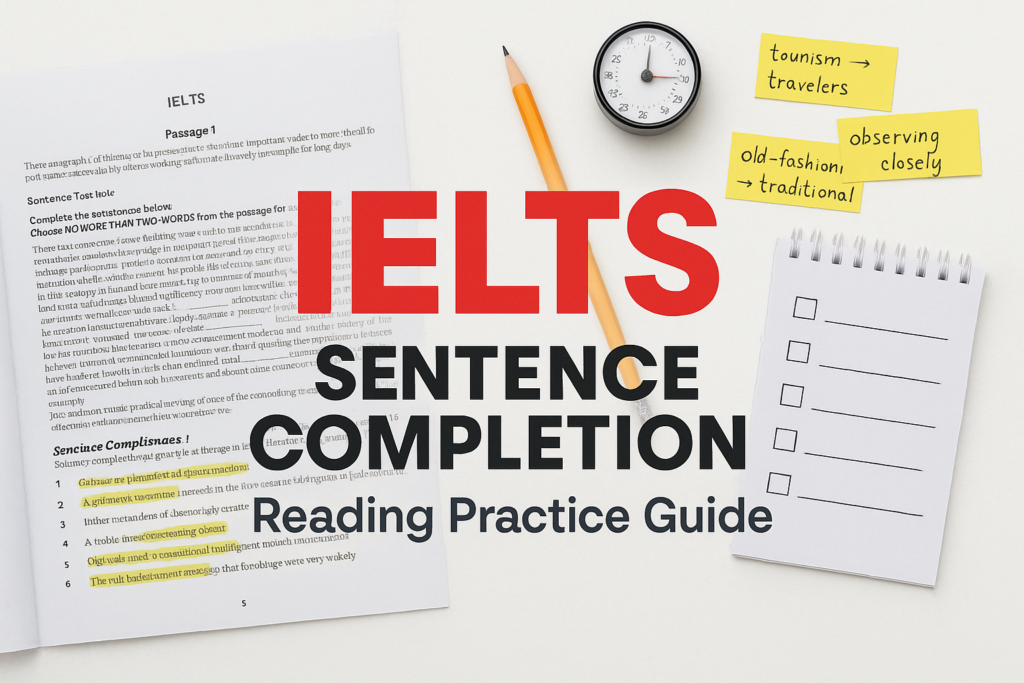
IELTS Reading Sentence Completion practice guide work is about more than filling gaps with words that sound right. Sentence completion questions test whether you can follow meaning across a passage, locate the relevant sentence area, and copy the exact answer within the word limit. Before you spend another week doing random Reading sets, take the IELTS Express Pre-Test to check your current band range and see whether your main issue is timing, vocabulary, evidence checking, or question-type strategy.
Sentence completion can feel simple because the answer is usually in the text. The problem is that IELTS rarely rewards surface matching. A sentence in the question may paraphrase the passage, change the grammar around the gap, or place the answer near a tempting distractor. This guide gives you a practical method for Academic and General Training Reading so you can handle sentence completion with more control.
IELTS Reading Sentence Completion Practice Guide: What The Task Tests
In sentence completion, you are given incomplete sentences and must complete each gap using words from the passage, or sometimes from a list depending on the task format. The instruction may say no more than one word, no more than two words, or no more than three words and/or a number. That instruction is not decoration. If you write too many words, the answer is wrong even when the meaning is correct.
The task tests detailed reading, paraphrase recognition, grammar fit, and accurate copying. You need to find the part of the passage that contains the answer, understand the sentence around it, and make sure the words you write fit both the meaning and the grammar of the question sentence.
- Read the word limit before looking for answers.
- Predict the type of word needed in each gap.
- Scan for names, dates, nouns, and paraphrased clues.
- Check the sentence after filling the gap.
- Copy spelling and plural forms exactly from the passage.
How Sentence Completion Differs From Summary Completion
Sentence completion usually gives you separate sentences, while summary completion gives you a connected paragraph. That difference matters. In sentence completion, each question may focus on a different detail, although the answers often follow passage order. In summary completion, the surrounding paragraph may give stronger clues about the overall topic and flow.
With sentence completion, do not assume every sentence is about the same part of the passage. Read each sentence as its own clue. Identify the subject, the verb, and the missing word type. Then move to the passage and look for the same idea in different language.
For a broader Reading foundation, use the IELTS Reading Practice guide alongside this question-type method so you are improving both speed and accuracy.
Step One: Read The Instruction And Word Limit
The first step is boring but essential. Read the instruction before you read the questions. If the instruction says no more than two words, an answer such as “the original design” is too long. If it says one word only, even a correct two-word phrase will lose the mark.
Also check whether numbers count separately. IELTS instructions may allow a number with words. If the answer is “25 students”, make sure the wording fits the stated limit. Do not add articles such as a, an, or the unless they are clearly needed and allowed.
Many candidates lose marks here because they understand the passage but ignore the rules. Your first habit should be simple: circle the word limit, then answer within it.
Step Two: Predict The Missing Word Type
Before you search the passage, look at the grammar around the gap. Is the sentence missing a noun, adjective, verb, date, place, name, number, or short phrase? Prediction narrows the search and stops you from grabbing a word that does not fit.
For example, if the sentence says “The researcher described the method as ___”, you probably need an adjective. If it says “The experiment was conducted in ___”, you may need a place, year, room, or location phrase. If it says “Participants were asked to record their ___”, you probably need a noun.
Prediction is not guessing. It is preparing your brain to recognise the answer when the passage paraphrases the question. This is especially useful when the passage contains several related details close together.
Step Three: Locate The Right Passage Area
Sentence completion answers usually appear in passage order, but do not rely on that blindly. Start by scanning for fixed clues: names, dates, technical terms, places, or unusual nouns in the question. If the question uses general language, look for paraphrases instead.
After you locate a possible sentence, read around it. The answer may be just before or just after the keyword match. IELTS often places the keyword in one sentence and the answer in the next. If you only read the exact line that contains the familiar word, you may miss the real answer.
If you want to practise this under real timing, access unlimited IELTS mock tests and review each sentence completion item by asking where the evidence appeared, not only whether your answer was right.
Step Four: Match Meaning, Not Just Keywords
Keyword matching is useful for locating an area, but it is not enough for choosing the answer. The question may say “main reason” while the passage says “primary cause”. The question may say “people were unwilling” while the passage says “participants showed little interest”. If you are waiting for exact words, you will be slow and easily misled.
Train yourself to look for meaning families. Cause, reason, factor, and explanation may point to the same idea. Increase, rise, growth, and expansion may point to the same trend. Problem, difficulty, challenge, and obstacle may point to the same function in the sentence.
A strong sentence completion answer comes from the passage evidence, not from your outside knowledge. Even if you know the topic well, choose the wording that the passage supports.
Step Five: Check Grammar After Filling The Gap
Once you choose an answer, read the completed sentence silently. Does it sound grammatically complete? Does the noun agree with the verb? Does the adjective sit in the right position? Does the preposition before the gap make sense with your answer?
Grammar checking helps you catch near-misses. If the sentence says “one of the most important ___”, a singular noun may be wrong because the phrase usually needs a plural noun after “one of the most important”. If the sentence says “was caused by ___”, the answer may need a noun phrase rather than a verb.
This final check takes only a few seconds, but it can save marks that are lost through careless copying or poor fit.
Common Traps In Sentence Completion
The first trap is writing too many words. Candidates often copy a whole phrase because it feels safer. It is not safer if it breaks the word limit. Choose the smallest exact answer that completes the sentence correctly.
The second trap is using a synonym instead of words from the passage when the task asks you to use words from the text. If the passage says “rapid growth” and you write “fast increase”, your meaning may be fine, but your answer may still be marked wrong.
The third trap is missing plural forms. If the passage answer is “resources” and you write “resource”, the sentence may become grammatically wrong. Copy the form exactly unless the task format clearly allows adjustment.
The fourth trap is choosing a nearby distractor. IELTS passages often mention several dates, people, causes, or examples close together. The answer must complete the question sentence, not just appear in the same paragraph.
A Practical Timing Method
Sentence completion should not consume too much time. For most candidates, the first pass should be controlled. Read the instruction, scan the questions, predict the gap type, locate the passage area, answer, and move on. If one item is not clear, mark it and continue.
Do not stare at one gap for three minutes while easier marks wait later in the passage. IELTS Reading rewards total score, not loyalty to one difficult question. If the evidence is not obvious, leave a light mark, complete the surrounding questions, and return with better context.
If Reading timing is a repeated problem, see our IELTS preparation plans and choose support that includes question-type diagnosis, not just more practice papers.
Practice Routine For Sentence Completion
Use a focused routine instead of only doing full tests. First, complete five to eight sentence completion questions without timing pressure and write down the evidence line for each answer. Second, repeat with a short timer. Third, review every mistake by category: word limit, wrong passage area, paraphrase missed, grammar mismatch, spelling, or plural error.
After three practice sets, patterns usually appear. If most mistakes are word-limit errors, slow down before writing. If most mistakes are paraphrase errors, build a small synonym list from the passage. If most mistakes are grammar fit errors, spend more time predicting the missing word type before scanning.
Academic And General Training Differences
The core method is the same for Academic and General Training Reading, but the texts can feel different. Academic passages may use research language, abstract nouns, and technical explanations. General Training texts may include workplace notices, policies, advertisements, instructions, and community information.
In Academic Reading, paraphrase and dense sentence structure are often the main challenge. In General Training, the challenge may be speed, practical detail, and avoiding similar-looking information across notices or sections. In both versions, the answer must come from the text and fit the instruction.
Practise with the version of IELTS you plan to sit. If you are preparing for migration, study the IELTS Reading General for Migration Australia guide so your practice matches your goal.
Final Checklist Before You Answer
Before you move to the next question, check five things. Did you follow the word limit? Did the answer come from the correct part of the passage? Does the completed sentence make grammatical sense? Did you copy spelling correctly? Did you include singular or plural form accurately?
This checklist should become automatic. Sentence completion is not won by rushing. It is won by controlled reading, clean evidence, and careful copying. When your method is repeatable, the question type becomes much less stressful.
Ready to find out your IELTS band score?
Take the IELTS Express Pre-Test for just $4.99 and get your personalised band prediction with a 14-day improvement plan.
FAQ: IELTS Reading Sentence Completion Practice Guide
How do I answer IELTS Reading sentence completion questions?
Read the word limit, predict the missing word type, locate the relevant passage area, match the meaning, copy the answer from the text, and check grammar after filling the gap.
Do sentence completion answers come in order?
They often follow passage order, but you should not depend on order alone. Use the question clues and passage evidence to confirm each answer.
Can I use my own words in IELTS sentence completion?
If the instruction says to use words from the passage, use the exact passage wording. Do not replace the answer with your own synonym, even if the meaning is similar.
What is the biggest mistake in sentence completion?
The most common mistakes are ignoring the word limit, copying too many words, choosing a nearby distractor, and failing to check whether the completed sentence is grammatical.
How can I practise sentence completion at home?
Do short sets, record the evidence line for each answer, review errors by cause, and gradually add timing. Focused review is more useful than simply completing many passages.