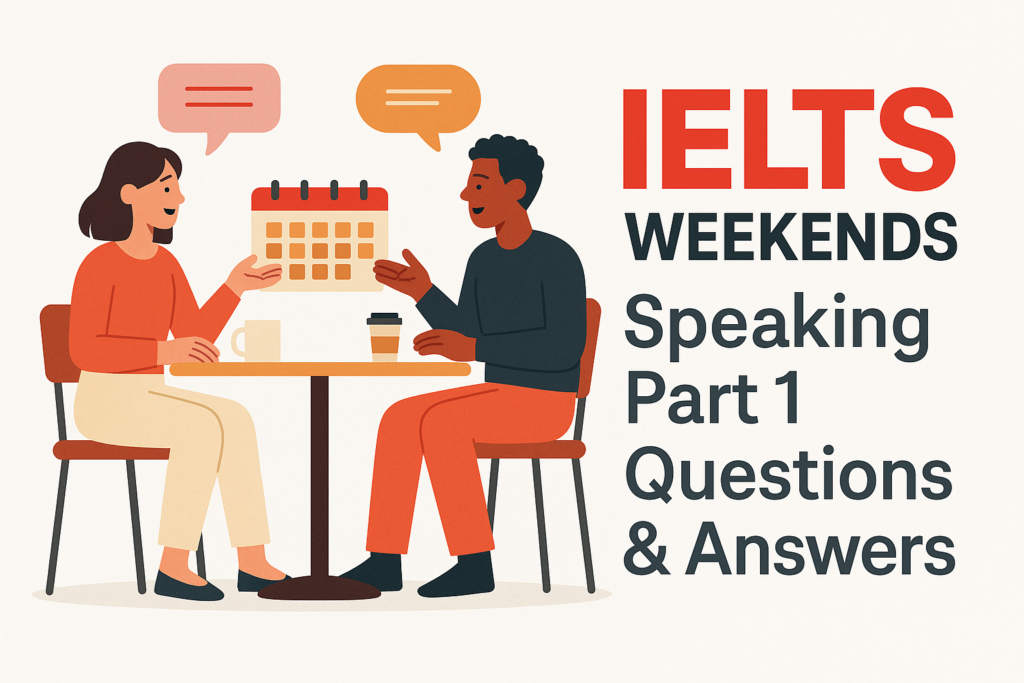
IELTS Speaking Part 1 Weekends questions and answers are common because weekends reveal how naturally you can talk about habits, free time, family, friends, study, work, and personal preferences. The topic is familiar, but that can actually make candidates careless. Before you practise a long list of weekend model answers, take the IELTS Express Pre-Test to check your current speaking band range and see whether your main gap is fluency, vocabulary, grammar, or answer development.
In Part 1, the examiner does not expect a perfect or exciting weekend. They want clear communication. A good answer usually has two to four sentences: a direct answer, one reason, and a small personal detail. This guide gives you weekend questions, natural sample answers, useful vocabulary, grammar patterns, and a simple practice routine.
IELTS Speaking Part 1 Weekends Questions And Answers: What To Expect
Weekend questions in IELTS Speaking Part 1 usually ask about your real habits, not your perfect lifestyle. You may be asked what you normally do on weekends, whether you prefer busy or quiet weekends, who you spend time with, and whether your weekends have changed. The safest answers sound personal, clear, and easy to follow.
A strong weekend answer normally has three parts: answer the question directly, give one reason, and add a small example. If the examiner asks whether you like weekends, do not stop at “Yes, I do.” Say why you enjoy them and mention one thing you usually do.
- Use present simple for regular weekend habits.
- Use frequency phrases such as usually, often, sometimes, and once in a while.
- Give one reason so the answer does not sound too short.
- Keep the tone natural and conversational.
- Avoid turning Part 1 into a long Part 2 story.
Common IELTS Speaking Part 1 Weekend Questions
These are common weekend questions. The examiner may change the wording, so practise flexible answers instead of memorising one fixed script.
- What do you usually do on weekends?
- Do you prefer relaxing or being active on weekends?
- Do you spend weekends with family or friends?
- Are your weekends busy?
- What did you do last weekend?
- Do you think weekends are important?
- Would you like to have longer weekends?
- Has the way you spend weekends changed?
- Do you study or work on weekends?
- What is your ideal weekend?
When practising, record short answers and listen for clarity. If your answer is only one sentence, add a reason. If it becomes too long, cut one detail. For more examples across personal topics, use the IELTS Speaking Part 1 sample answers guide.
Sample Answers About Normal Weekends
Question: What do you usually do on weekends?
I usually try to rest a little and catch up on things I could not finish during the week. If I have time, I meet friends or go out for a meal, but I also like having a quiet morning at home.
Question: Are your weekends busy?
They are sometimes busy, especially if I have family plans or errands to do. However, I try to keep at least part of the weekend free because I need some time to recharge.
Question: Do you enjoy weekends?
Yes, definitely. Weekends give me a chance to slow down and do things at my own pace, which is different from weekdays when everything feels more scheduled.
These answers work because they are specific but not over-prepared. They include real-life details, simple grammar, and natural reasons.
Sample Answers About Relaxing On Weekends
Question: Do you prefer relaxing or being active on weekends?
I prefer a mix of both. I like to relax in the morning, but later in the day I usually want to go outside, exercise, or meet someone so the weekend does not feel wasted.
Question: How do you usually relax on weekends?
I usually relax by sleeping a bit longer, listening to music, watching something light, or going for a walk. I do not need anything special; I just like having fewer deadlines.
Question: Is it important to rest on weekends?
Yes, I think it is important because people need time to recover from work or study. If I do not rest properly, I feel less productive the next week.
If you want to practise this topic under realistic timing, access unlimited IELTS mock tests and answer weekend questions without pausing to prepare perfect sentences.
Sample Answers About Family And Friends
Question: Do you spend weekends with family?
Yes, when possible. I might have a meal with my family or help with things at home. It is a simple way to stay connected, especially when weekdays are busy.
Question: Do you prefer spending weekends alone or with other people?
It depends on the week. If I have been very busy, I prefer some time alone. But if I feel relaxed, I enjoy seeing friends because it makes the weekend more enjoyable.
Question: What do you usually do with friends on weekends?
We usually keep it simple. We might go for coffee, watch a movie, eat out, or just talk. I prefer casual plans because they are easier to organise.
Friend and family answers are useful because they let you show preference language. Phrases such as “it depends”, “when possible”, and “I prefer” sound natural in Part 1.
Useful Vocabulary For Weekend Answers
You do not need rare words for weekend topics. Everyday vocabulary is enough if you use it accurately and naturally.
- Recharge: rest and get your energy back.
- Catch up on: do something you did not have time to do earlier.
- Errands: small practical tasks such as shopping or appointments.
- Flexible: able to change easily.
- Laid-back: relaxed and not too formal.
- Quality time: meaningful time with family or friends.
- Sleep in: wake up later than usual.
- Plan ahead: organise something before it happens.
Use these phrases in short, controlled sentences. For example, “I like to sleep in on Sundays” is stronger than forcing advanced language that you cannot pronounce confidently.
Grammar Patterns That Help With Weekend Topics
The present simple is the main tense for regular weekend habits. You can say, “I usually visit my parents,” “I often go shopping,” or “I sometimes study on Saturday mornings.” This tense is clear and reliable for habits.
Use past simple when the examiner asks about last weekend. For example, “Last weekend I stayed home because the weather was bad.” Use would like to for future preferences, such as “I would like to spend more weekends travelling.” These small tense changes show control.
Contrast language also helps. You can say, “During the week I am very busy, but on weekends I try to slow down.” This gives the examiner more grammar to assess without making your answer too long.
How To Extend Short Weekend Answers
Many candidates answer weekend questions too briefly because the topic feels obvious. The easiest extension method is answer, reason, example. Start with your main answer, explain why, then add one real detail.
For example, if the question is “Do you like weekends?”, a weak answer is “Yes, I like them.” A stronger answer is: “Yes, I like weekends because I can choose my own schedule. On Saturday mornings, I usually sleep a little longer and have breakfast without rushing.” This is still short, but it gives useful language.
Do not add three unrelated activities just to speak longer. One clear example is usually better than a list.
Common Mistakes With Weekend Answers
The first mistake is giving a one-word answer. Weekend questions are simple, but IELTS still needs enough language to assess. Add a reason or small detail.
The second mistake is using only memorised phrases, such as “I hang out with my friends” for every question. That phrase is fine when it fits, but it should not be your only answer.
The third mistake is mixing tenses. If the examiner asks what you usually do, use present simple. If they ask what you did last weekend, use past simple.
The fourth mistake is sounding too dramatic. You do not need to describe an amazing weekend. A realistic answer about resting, shopping, family, study, or exercise can still score well if it is clear.
If your Speaking answers often feel flat, see our IELTS preparation plans and choose support that includes spoken feedback, not only model answers.
A Seven-Day Practice Plan For Weekend Questions
On day one, record answers to ten weekend questions. Keep each answer under thirty seconds. On day two, add one reason to every answer. On day three, practise questions about relaxing and being active.
On day four, practise family and friends questions. On day five, practise last-weekend questions using past simple. On day six, practise ideal-weekend and future-preference questions. On day seven, record a full Part 1 set and note three repeated problems.
This routine builds flexible answer habits. You are not memorising a weekend script; you are learning how to respond naturally when the examiner changes the question.
Final Checklist Before Your Speaking Test
Before test day, make sure you can answer questions about normal weekends, relaxing, family, friends, study, work, errands, last weekend, ideal weekends, and whether weekends are important. Practise at a natural speed and stop before the answer becomes too long.
Weekend questions can become one of the easiest IELTS Speaking Part 1 topics if you keep your answers honest and specific. Use clear tense, add one reason, and sound like you are describing your real life.
Ready to find out your IELTS band score?
Take the IELTS Express Pre-Test for just $4.99 and get your personalised band prediction with a 14-day improvement plan.
FAQ: IELTS Speaking Part 1 Weekends Questions And Answers
What weekend questions are common in IELTS Speaking Part 1?
Common questions ask what you usually do on weekends, whether you prefer relaxing or being active, who you spend time with, and what you did last weekend.
How long should my weekend answers be?
Most answers should be two to four sentences. Give a direct answer, add one reason, and include one small personal detail if it fits naturally.
What tense should I use for weekend questions?
Use present simple for regular weekend habits, past simple for last weekend, and would like to when talking about an ideal or future weekend.
Can I say I do nothing special on weekends?
Yes. You can say your weekends are quiet or simple, then explain why. IELTS rewards clear, natural English, not an exciting lifestyle.
Should I memorise weekend sample answers?
No. Use samples to learn structure and vocabulary, but adapt them so they match your real life and the exact question the examiner asks.