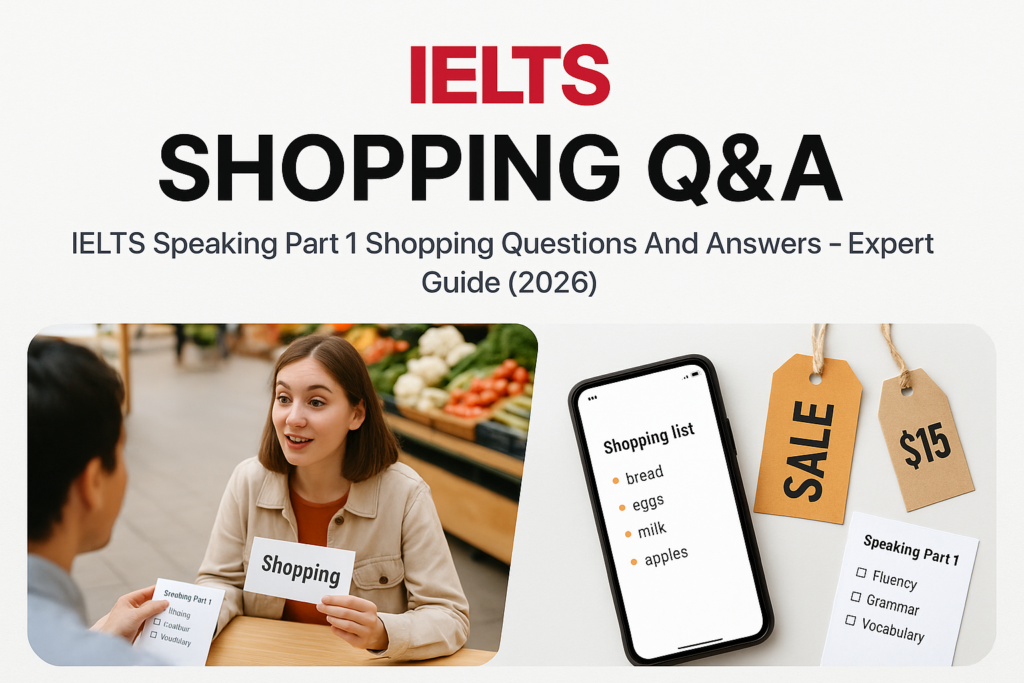
IELTS Speaking Part 1 Shopping questions and answers are common because shopping is part of everyday life, but many candidates still make the topic sound flat. You may be asked where you shop, whether you prefer online or in-store shopping, what you bought recently, whether shopping habits have changed, or whether people in your country enjoy shopping. Before you memorise model answers, take the IELTS Express Pre-Test to check your current speaking band range and see whether your biggest issue is fluency, vocabulary, grammar, or answer development.
The shopping topic is not testing whether you love fashion, brands, or spending money. The examiner wants to hear clear personal answers about ordinary habits. A strong Part 1 answer is usually two to four sentences: answer the question, give one reason, and add a small real-life detail. That is enough to sound natural without turning a simple question into a speech.
IELTS Speaking Part 1 Shopping Questions And Answers: What To Expect
Shopping can appear as a light Part 1 topic. The examiner may ask about your usual shopping places, online shopping, local markets, shopping with friends, favourite shops, expensive purchases, or whether shopping is popular in your country. The questions feel simple, but your answer still needs structure.
The most common mistake is answering with one short sentence. If the examiner asks whether you like shopping and you say, “Yes, I do,” you have not shown much language. A better answer adds a reason and a situation: “Yes, but mostly when I need something specific. I do not enjoy walking around for hours, but I like comparing products before I buy.”
- Answer the exact question first.
- Add one natural reason.
- Include a small example if it helps.
- Use everyday shopping vocabulary accurately.
- Stop before the answer becomes a memorised Part 2 response.
Common IELTS Speaking Part 1 Shopping Questions
These are typical shopping questions. The examiner may change the wording, so practise flexible ideas instead of one fixed script.
- Do you like shopping?
- Where do you usually go shopping?
- Do you prefer shopping online or in stores?
- What do you usually buy?
- Do you compare prices before buying something?
- Who do you usually go shopping with?
- Did you enjoy shopping when you were younger?
- Are there many shops near your home?
- Is shopping popular in your country?
- Have your shopping habits changed recently?
When you practise, do not try to prepare perfect answers for every question. Choose five questions, record your answers, and check whether each one has a direct answer plus a reason. If the answer sounds too general, add one concrete detail.
Sample Answers About Shopping Habits
Question: Do you like shopping?
Yes, but only when I need something. I enjoy finding a good product at a fair price, but I do not really like shopping just to pass the time.
Question: How often do you go shopping?
I usually go shopping once or twice a week for groceries. For clothes or electronics, I shop much less often because I prefer to think carefully before spending money.
Question: What do you usually buy?
Most of the time I buy food, household items, or small things I need for work. I occasionally buy clothes, but I am not someone who follows every new fashion trend.
These answers are short, but they are developed. They answer the question, add a reason, and include a personal detail. That is the safest Part 1 style.
If you want to compare shopping answers with other everyday topics, use the IELTS Speaking Part 1 sample answers page and notice how the best answers stay natural rather than dramatic.
Online Shopping Or In-Store Shopping
Online versus in-store shopping is a common comparison. This is useful because it lets you talk about convenience, price, delivery, quality, customer service, and the chance to see the product before buying.
Question: Do you prefer shopping online or in stores?
I prefer shopping online for simple items because it saves time and I can compare prices quickly. However, for clothes or shoes, I still prefer going to a shop because I want to check the size and quality.
Question: What are the disadvantages of online shopping?
The main disadvantage is that the product may not look the same as it did online. Delivery can also be slow, and returning an item is sometimes annoying.
Question: Do you think people shop online more than before?
Yes, definitely. Many people now buy groceries, clothes, and electronics online because it is convenient. At the same time, some people still enjoy visiting shops for the experience.
To practise these answers under realistic timing, access unlimited IELTS mock tests and record your Part 1 answers without pausing to write a full script first.
Sample Answers About Shops And Markets
Question: Are there many shops near your home?
Yes, there are several small shops and supermarkets nearby. It is convenient because I can buy basic things without travelling far.
Question: Do you like going to markets?
Sometimes, yes. Markets can be more interesting than supermarkets because there is more variety and the atmosphere feels lively, especially on weekends.
Question: What kind of shops are popular in your area?
Food shops, cafes, pharmacies, and convenience stores are probably the most popular. People need those places regularly, so they are usually busy.
Questions about shops and markets are easy to answer if you connect them to daily life. Mention location, convenience, price, atmosphere, or product variety. You do not need to describe every shop in detail.
Sample Answers About Shopping With Other People
Question: Do you usually shop alone or with other people?
I usually shop alone because it is faster. If I need an opinion, especially for clothes, I may go with a friend or family member.
Question: Is shopping with friends enjoyable?
It can be enjoyable if we are not in a hurry. Shopping with friends is more social, but it can also take longer because everyone wants to visit different stores.
Question: Who chooses what to buy in your family?
It depends on the item. For groceries, the person who cooks usually decides. For bigger purchases, my family normally compares options and decides together.
These questions let you use comparison language naturally. You can compare shopping alone with shopping in a group, or small purchases with expensive purchases.
Useful Vocabulary For Shopping Answers
You do not need unusual vocabulary for the shopping topic. You need accurate words that help you explain habits and opinions clearly. Simple phrases often sound more natural than forced advanced language.
- Convenient: easy and practical to use or access.
- Affordable: not too expensive.
- Quality: how good or reliable something is.
- Discount: a lower price than usual.
- Refund: money returned after you take a product back.
- Return policy: the rules for returning a product.
- Impulse buy: something you buy suddenly without planning.
- Compare prices: check different prices before choosing.
Use these words in ordinary sentences. For example: “I compare prices before buying electronics,” or “I avoid impulse buys because I am trying to save money.” Clear, accurate vocabulary is better than sounding unnatural.
Grammar Patterns That Work Well For Shopping
Frequency language is useful. You can say I usually shop online, I sometimes visit markets, I rarely buy expensive items, or I almost always compare prices. These phrases help your answer sound specific.
Past and present contrast also works well. For example: “I used to enjoy shopping at malls, but now I prefer online shopping because it saves time.” This shows tense control without making the answer complicated.
Comparatives are helpful for online and in-store answers. You can say online shopping is more convenient, local markets are cheaper, supermarkets are more reliable, or small shops are friendlier. Use comparison only when it fits the question.
For a full answer-building system, review the IELTS Speaking Part 1 tips and strategies guide and apply the same structure to shopping questions.
Common Mistakes With Shopping Answers
The first mistake is giving a list instead of an answer. If the question asks where you usually shop, do not only list five places. Choose one or two and explain why. The reason is more useful than the list.
The second mistake is sounding too formal. Shopping is an everyday topic, so phrases like “I frequently acquire consumer products from commercial establishments” sound strange. Say it simply: “I usually buy groceries from a supermarket near my home.”
The third mistake is pretending to love shopping if you do not. You can say you are not very interested in shopping, then explain what you do buy and why. Honest answers are easier to develop and usually sound more natural.
The fourth mistake is using memorised answers that ignore the exact question. If the examiner asks about online shopping, do not give a prepared answer about your favourite market. Listen carefully and adapt.
If Speaking still feels hard to control under pressure, see our IELTS preparation plans and choose support that includes spoken feedback, not only written model answers.
How To Answer If You Do Not Enjoy Shopping
It is completely acceptable to say that shopping is not one of your hobbies. The key is to develop the answer. For example: “I do not really enjoy shopping because I find it tiring, but I still buy things I need, especially groceries and basic clothes.”
This answer works because it is honest and still gives detail. IELTS Speaking does not require you to have exciting opinions. It requires you to communicate clearly. A simple answer with a reason is enough.
If the examiner asks follow-up questions, connect shopping to practical situations: saving money, buying gifts, replacing old items, food shopping, online delivery, or comparing quality. That gives you plenty to say without pretending to be passionate.
A Seven-Day Practice Plan For Shopping Questions
On day one, record ten short answers about your shopping habits. Keep each answer under thirty seconds. On day two, add one clear reason to every answer. On day three, practise online versus in-store comparison answers.
On day four, practise past and present answers about how your shopping habits have changed. On day five, practise vocabulary such as discount, refund, quality, affordable, and impulse buy in natural sentences. On day six, mix shopping with other Part 1 topics so you can change topic smoothly. On day seven, record a full Part 1 practice set and note three repeated problems.
The aim is not to memorise perfect shopping answers. The aim is to build flexible control so you can answer naturally when the examiner changes the wording.
Final Checklist Before Your Speaking Test
Before test day, make sure you can answer questions about where you shop, how often you shop, online shopping, markets, shopping with friends, recent purchases, and shopping habits in your country. Practise answering at a natural speed and stop before the answer becomes too long.
Check that your answers include reasons, examples, and flexible vocabulary. Avoid memorising complete responses. If you can listen carefully, answer the exact question, and add one useful detail, shopping can become one of the easiest Part 1 topics.
Ready to find out your IELTS band score?
Take the IELTS Express Pre-Test for just $4.99 and get your personalised band prediction with a 14-day improvement plan.
FAQ: IELTS Speaking Part 1 Shopping Questions And Answers
What shopping questions are common in IELTS Speaking Part 1?
Common questions include whether you like shopping, where you usually shop, whether you prefer online or in-store shopping, what you usually buy, and whether shopping is popular in your country.
How long should my shopping answers be?
Most Part 1 answers should be two to four sentences. Give a direct answer, add one reason, and include a small example if it fits naturally.
Can I say I do not like shopping?
Yes. You can say shopping is not a hobby for you, then explain what you normally buy and why. Honest answers can still show strong English.
What vocabulary is useful for shopping answers?
Useful words include convenient, affordable, quality, discount, refund, return policy, impulse buy, compare prices, online shopping, local market, and supermarket.
Should I memorise shopping sample answers?
No. Practise useful ideas and phrases, but avoid memorising full answers. The examiner may ask the question differently, so flexible answers are safer.